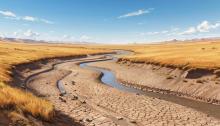
Zhayik-Caspian Basin Inspectorate has provided a detailed commentary on questions regarding the fate of the Bukharka channel. While its previous response demonstrated bureaucratic sluggishness, the new one reveals the scale of a systemic catastrophe (there is no other word for it) in Kazakhstan's water resource management.
The main mystery was resolved with unexpected simplicity: the Bukharka channel is indeed 'no-man's-land', but not by accident. The Inspectorate explains this for historical reasons. In Soviet times, most of the channels of the Ural Delta were given the status of irrigation and water-supply canals and were transferred to the balance sheets of water management organisations. However, Bukharka, Zolotenok and Zarosly, located on the territory of the former Balikshinsky District, which 'carried out fisheries, excluding the irrigation of agricultural crops', were left out of this process.
In other words, channels used for irrigation received official status and owners, while those serving fisheries and natural flood regulation ended up in a legal vacuum. Half a century later, the Soviet logic of administrative division has turned into an ecological catastrophe – waterways that did not fit into the narrow confines of agricultural use were simply left unattended.
As for the water protection zones, which are precisely meant to protect water bodies from negative human impacts, they were not established on the Bukharka, precisely because 'the dried-up Bukharka had not been used as a water body for 30-40 years and had no water regime of its own'. So it turns out that a water body is not protected because it has dried up, and it has dried up because it was not protected. A classic vicious circle.
The Inspectorate honestly lists what is needed to restore the Bukharka: cleaning out the channel with deepening of the riverbed, connection to the Ural River, and construction of a water-regulating head hydraulic structure. And only after this can a water protection zone be established. At the same time, the department explains that 'to date, the Akimat of the Atyrau Region does not have an approved programme for the restoration of the Bukharka channel, and no funding has been allocated'.
So it seems all parties involved fully understand what needs to be done, but no one intends to do it yet. The Water Inspectorate can only 'prepare recommendations for eliminating identified violations and send them for consideration to the relevant local executive body'. And the local executive bodies are supposed to 'organise work on cleaning out surface water bodies', but there is no programme and no funding has been allocated.
And the most interesting part is that no one even knows the scale of the problem. The department reported that 'information on the number of similar water bodies in the Atyrau Region is unavailable'. How many more channels and waterways are in a similar condition? How many water bodies have disappeared or are disappearing right now, while departments figure out (or not) who is responsible for them?
And yet, we must give credit to the department – such detailed and frank responses are rare in the practice of interdepartmental interaction in Kazakhstan. Moreover, in light of our editorial office's numerous requests, the Zhayik-Caspian Basin Inspectorate sent a letter to the Akimat of the city of Atyrau 'on carrying out relevant measures for the restoration of the Bukharka channel of the Zhayik River'. This means there might be at least a small chance for the Bukharka after all.
When all is said and done, the Inspectorate's response confirms the main conclusion from our previous articles: the problem of the Bukharka is not about individual violations or oversights, but about fundamental flaws in the water resources management system. The state has created an administrative structure in which water bodies can exist in a legal vacuum, and responsibility for their preservation is dispersed among various departments.
In the face of growing water scarcity and climate change, such carelessness borders on criminal negligence. But it would be unfair to place all the responsibility solely on the departments. The problem of the Bukharka has been drawing the attention of individual activists and journalists for years, but the voice of those who live and work in the immediate vicinity of the channel is heard far less. Perhaps more active participation by local residents in discussions about water use problems could accelerate the search for solutions. Civil dialogue with the authorities and constructive proposals are often more effective than waiting for initiatives from above.