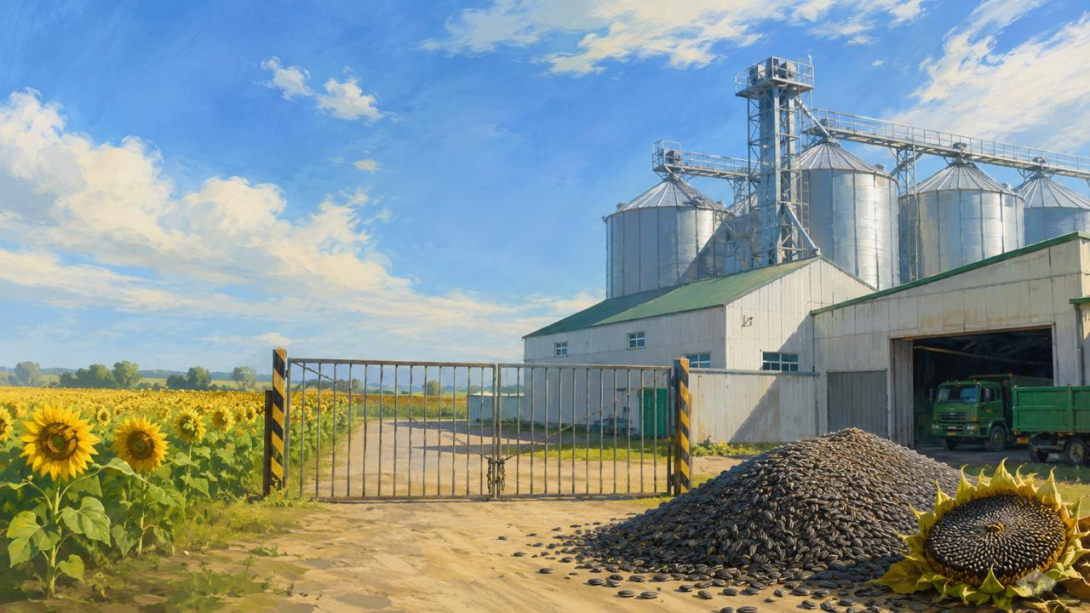
Almost 3,300 tonnes of sunflower seeds, three companies and one grain elevator that refuses to release someone else's crop. In June 2026, the owners of the produce stored at the Ilyichevka Astyk LLP grain elevator in the Taiynsha district of the North Kazakhstan Region (NKR) stated that they faced a refusal to ship and blocked access to the warehouses. A complaint to the police did not change the situation; the entrepreneurs were advised to seek protection of their rights in court. A similar conflict involving the same grain elevator had already occurred in 2022 and ended with the recovery of almost half a billion tenge. Is history repeating itself, or is this about a long-standing practice?
WHAT HAPPENED
Three companies from the same group, Amanat jer 2020 LLP, KazGrain Feeders LLP, and Nabbat-Pukhalsk LLP, kept their 2025 sunflower seed harvest in storage with Ilyichevka Astyk LLP under separate service contracts.
In June 2026, all three companies submitted requests for the full shipment of the crop, followed shortly after by pre-trial claims demanding the start of shipment by 1 July. However, nothing happened. According to the plaintiffs, access for their representatives to the site was blocked, with verbal references to "fumigation of the premises" and written references to an order suspending warehouse operations "for technical work" until 31 July. The crux of the issue lies in the details. The contract required at least 20 days' notice for such a shutdown, yet the clients only received the order on 3 July – almost a month after the claimed start of the work.
On 2 July, all three companies filed complaints with the Taiynsha district police under Article 189 of the Criminal Code of the Republic of Kazakhstan ("Misappropriation or embezzlement of entrusted property, on an especially large scale"). The investigation confirmed the fact of denial of access for representatives and withholding of goods. However, initiation of a criminal case was refused, and they were advised to resolve the civil dispute in court.
HISTORY REPEATS ITSELF
The story with this grain elevator does not begin in 2026. Four years ago, in 2022, a ruling by the Specialised Inter-district Economic Court of Astana ordered Ilyichevka Astyk LLP to pay 456.2 million tenge in damages and 13.7 million tenge in court fees to Viterra Kazakhstan LLP. The court then established that part of the sunflower seeds placed in storage (initially purchased by the plaintiff, including from KazGrain Feeders LLP) had deteriorated to such an extent that it became unfit for use, while the grain elevator had hindered an independent inspection of the goods' quality.
It appears this current dispute is the second documented instance where the elevator's clients face locked gates and questions about the fate of their own grain.
Furthermore, Ilyichevka Astyk LLP is not the only company affiliated with its founder, Denis Anikin, currently involved in litigation with grain market counterparties. Similar economic disputes are being heard, involving, among others, Green Gold Ilyichevka Factory LLP and Kokshe Grain Export LLP, where Anikin is also named. Each of these cases is being considered independently by the courts, but their cumulative effect makes the question of how coincidental the recurring circumstances of such conflicts are entirely reasonable.
Against this backdrop, another episode described by the plaintiffs draws attention. According to them, during negotiations, they were offered to formalise a sales contract for the disputed goods with a company presented as being linked to Denis Anikin. However, as the plaintiffs claim, subsequent checks did not confirm its connection to Anikin, and the company itself did not carry out any real business activity.
COINCIDENCE OR SYSTEMATIC?
If we compare the 2022 case with the three current lawsuits, what stands out is not a one-off coincidence, but a recurring pattern: first, restricted access to the goods; then, the impossibility of independently verifying their presence or quality; and finally, backdated formal explanations that appear just when stalling is no longer feasible. There is currently no direct evidence of the goods' absence from the elevator, nor of their presence. The plaintiffs claim that it is precisely because of blocked access that they can neither confirm nor deny whether the sunflower seeds are in storage.
What is confirmed, however, is the differing speed of court reactions. In the case brought by Amanat jer 2020 LLP, the North Kazakhstan court fully granted the seizure of the batch of 2,880.804 tonnes and the defendant's property up to the value of 662.6 million tenge. However, in the lawsuits filed by KazGrain Feeders LLP and Nabbat-Pukhalsk LLP, submitted in the Akmola region, the case was first sent for conciliation, and only in a ruling in July 2026 did the judge place a seizure on a batch of 400.458 tonnes but refused to seize the debtor's property for approximately 94.1 million tenge, as no report on the valuation of the goods was presented to the court.
This difference in the pace and scope of interim measures is no mere bureaucratic detail. If the goods physically turn out not to be in the warehouse, the companies whose claims are being heard in the Akmola region currently have no seizure order for the debtor's property commensurate with the stated losses. This means they risk ending up with neither the goods nor compensation.
Today, the plaintiffs insist that the court must ensure a physical inspection and measurement of the goods, if necessary by court bailiffs with police assistance, since law enforcement authorities refuse to intervene independently in a dispute between private companies. If the inspection reveals that the goods are missing or damaged, the plaintiffs would have grounds to ask the court to issue a special ruling and return the case to the realm of criminal prosecution under Article 189 of the Criminal Code of the Republic of Kazakhstan – the very charge for which initiation is currently refused precisely due to a lack of established facts.
We believe that the repetition of this narrative is no longer simply about an economic dispute between two companies, but a signal warranting broader attention to grain elevator storage practices in the region. In fairness, it must be said that no court has yet established the fact of misappropriation or embezzlement of property, and accusations under Article 189 of the Criminal Code remain at the level of party statements. The real test will not be the text of the lawsuits, but whether actual access to the warehouse can be achieved – this fact alone will show whether we are dealing with a protracted commercial conflict or something more serious.
And although the state quite reasonably proceeds from the principle that law enforcement agencies should not interfere in ordinary commercial disputes or substitute for civil proceedings, this approach also has a downside. While a dispute is formally considered civil, an owner may be deprived of the opportunity to promptly inspect the condition of their property and effectively regain control over it. If unscrupulous market participants begin to exploit this, the resulting legal vacuum can turn into a tool for putting pressure on business before the court has had time to establish all the circumstances of the case.
While the courts are sorting out who owns what, the only one who benefits is the one controlling the warehouse. The owner of the grain cannot dispose of it, check its condition, or sell it, and time works against them: prices change, product quality changes, and the financial standing of companies changes. If such a scenario arises for the second time around the same grain elevator, the main question is no longer about the specific dispute, but about how advantageous the very act of withholding someone else's goods may prove to be while their owners go through all the court instances.