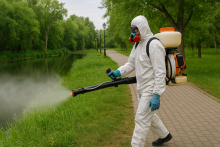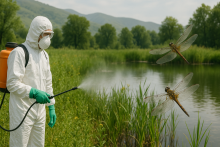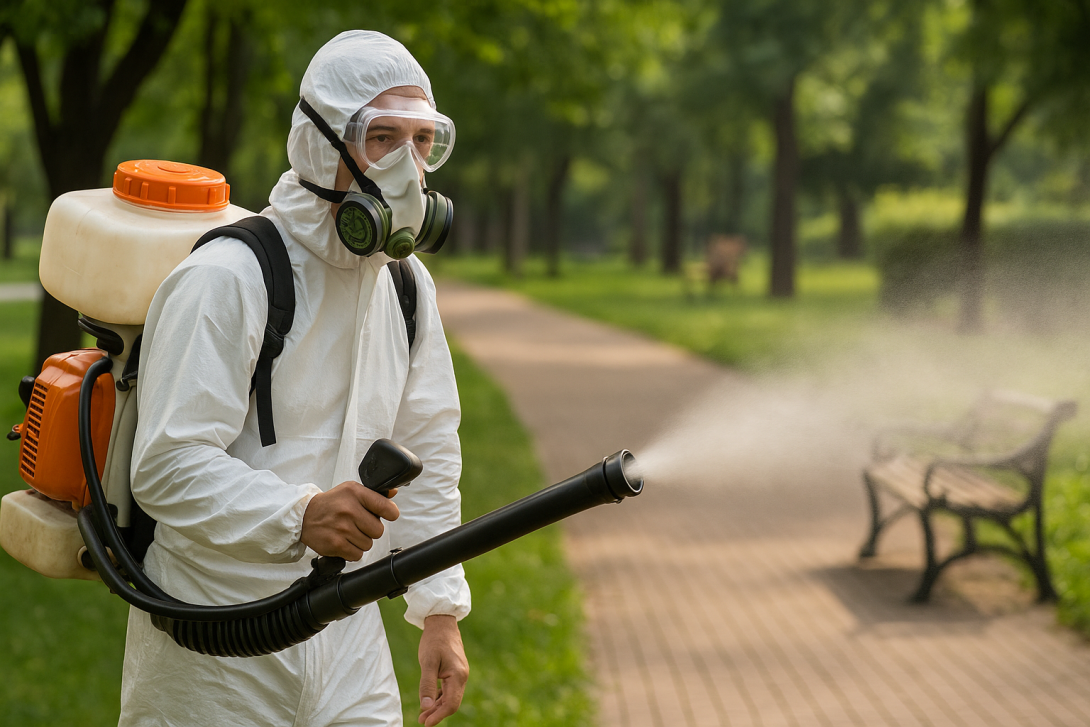
The editorial board of FBRK continues to analyse which preparations are used for disinsection of urban plantings in the regions of Kazakhstan in 2025.
It has become known that in Shymkent, treatments of green zones have been significantly intensified: whereas previously measures were carried out 4 times a year, they are now carried out 10 times per season. The preparation used is «Kardinal», containing chlorpyrifos and cypermethrin — substances banned in the countries of the European Union due to high toxicity.
FROM «IMIDOR» TO «KARDINAL»: A TENFOLD INCREASE IN TREATMENTS
In 2023, the preparations «Imidor» and «Enzhio» were used for disinsection work in Shymkent. The first contains imidacloprid from the neonicotinoid class, the second a combination of thiamethoxam and lambda-cyhalothrin. All these substances are on the list of preparations banned for use in EU countries due to their negative impact on pollinating insects.
In 2025, the approach has changed drastically. On the instructions of the city mayor, the intensity of disinsection measures has been increased more than twofold. Treatments are now carried out across large-scale territories:
- 14 parks (2.6 million sq m) — 10 times per season
- 37 rivers and canals (1.3 million sq m) — 5 times
- 49 flower beds and avenues (1.2 million sq m) — 5 times
To carry out the work, 30 specialists and 20 units of special equipment have been deployed.
PROBLEMS WITH THE CONTRACTOR
The winner of the tender was LLP «Satti Tulik» — a small company from the Turkestan region, registered in 2009 and specialising in agricultural services. The company uses the preparation «Kardinal», containing chlorpyrifos and cypermethrin — a combination of substances classified as hazard class II for humans.
Notably, LLP «Satti Tulik» has problems with the quality of the services it provides. In May, the company received a fine of 1.4 million tenge for deficiencies in blackfly control on water bodies in the Turkestan region while executing a contract worth almost 1.5 billion tenge. Meanwhile, in the neighbouring region, the company uses a biological preparation «Baktitsid», but even with that it fails to cope with the assigned tasks. This raises questions about the professional competence of the contractor entrusted with treating urban areas with a toxic chemical preparation.
PREPARATION NOT FOR THE URBAN ENVIRONMENT
«Kardinal» is a powerful contact-intestinal insectoacaricide intended for agricultural use. The manufacturer explicitly states that the preparation is designed for use in fields and open spaces in the absence of people and animals. Its use in populated areas, courtyards, kindergartens and parks is not regulated by the instructions.
Chlorpyrifos belongs to organophosphorus compounds and, if safety measures are not observed, can cause serious poisoning through inhalation or skin contact. Cypermethrin from the pyrethroid group is extremely toxic to cats, fish, bees and aquatic organisms. According to the instructions, the preparation is prohibited from use within 2 km of water bodies due to its toxicity to aquatic fauna.
RISKS FOR THE URBAN ECOSYSTEM
The use of an agricultural insecticide in a densely populated urban environment creates multiple risks. Treating 37 rivers and canals in the city with a preparation prohibited for use near water bodies could cause serious damage to the aquatic ecosystem. Unlike field conditions, in a city it is practically impossible to ensure the isolation of treated areas from contact with people and domestic animals.
Children are particularly vulnerable, as their sensitivity to toxic substances is significantly higher than that of adults. If precautions are not observed, neurological symptoms, allergic reactions and other signs of intoxication are possible even at low concentrations of substances in the air. A tenfold increase in the frequency of treatments could lead to a cumulative effect of exposure to toxic substances on the health of city residents.
INTERNATIONAL EXPERIENCE AND SCIENTIFIC DATA
Chlorpyrifos is under particular scrutiny from the international scientific community. In 2014, the United States Environmental Protection Agency found that pregnant women living within 1.5 km of fields where chlorpyrifos was used had a 60% increased probability of giving birth to children with autism spectrum disorders.
In 2021, the USA banned the use of chlorpyrifos precisely because of its link to neurological damage in children. In the countries of the European Union, chlorpyrifos is also a banned substance. If used incorrectly, it can have a devastating impact on the cardiovascular, respiratory and central nervous systems of humans.
If conditions of use are violated, cypermethrin can have a toxic effect on the male reproductive system and negatively affect the central nervous system of mammals. Studies show a link between the incorrect use of pyrethroids and various health disorders.
THE NEED FOR A REVISION OF APPROACHES
Every year in Kazakhstan, cases of human poisoning by disinsection preparations are recorded. For the third year running, the editorial board of FBRK is analysing urban disinsection practices in the regions, urging city administrations to responsibly approach the selection of preparations and contractors.
Earlier we wrote that in Aktobe they are also using an agricultural preparation, imidacloprid, for urban disinsection, despite its intended purpose being the protection of agricultural crops.
The use of powerful agricultural pesticides in the urban environment requires special justification. If for crop protection the use of such insecticides may be economically justified, then in cities, where people are in close proximity to treated objects, the priority should be public safety.
The existence of biological preparations, which are safer for humans and animals, makes the choice of toxic chemical agents for the urban environment particularly questionable. Especially when the contractor already has experience with biological alternatives, albeit an unsuccessful one.
CONCLUSION
The situation in Shymkent demonstrates systemic problems in the approach to urban disinsection. The tenfold increase in the intensity of treatments with a preparation not intended for the urban environment, combined with the questionable competence of the contractor, creates serious risks for public health and the urban ecosystem.
City administrations should develop special regulations for urban disinsection, distinct from agricultural standards. Perhaps it is necessary to create buffer zones around water bodies and residential areas where the use of aggressive insecticides should be limited or completely excluded.
Stricter selection of contractors, taking into account their professional competence and the quality of previous work, could also improve the safety of the urban environment. Transparency in the choice of preparations and timely information for the population about ongoing treatments remain important elements of public oversight.
The editorial board of FBRK will continue to monitor the disinsection situation in other regions of Kazakhstan in order to form a complete picture of the practices used and to develop recommendations for their improvement.
To be continued...