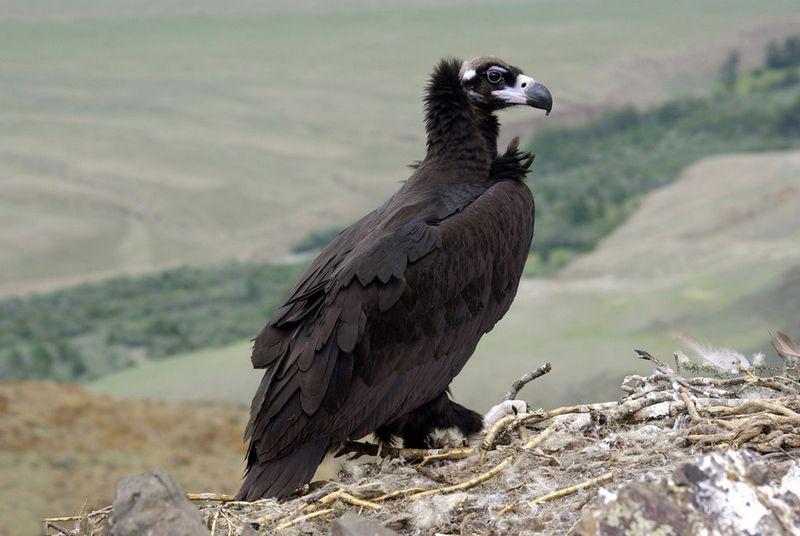
Scientists in Kazakhstan will monitor the movement of black vultures, which are on the brink of extinction, using GPS trackers.
As some media outlets report, on 24 July in Kazakhstan, three black vultures were tagged for the first time in the Syrdarya-Turkestan Nature Park.
Ornithologists in Uzbekistan have also fitted trackers to another two black vultures.
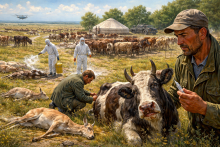
As is well known, vultures primarily feed on carrion – the carcasses of animals that have died from disease, old age, or been killed by predators.
In this way, scavenger birds contribute to protecting nature, as they help prevent the breeding and spread of infections, as well as avoiding soil and water contamination.
Changes in the numbers of these birds can indicate an environmental threat caused by pollution, including toxic substances.
This is exactly what we can observe in Kazakhstan today.
The cause is often attributed to dangerous veterinary medicines used by farmers.
Birds capable of digesting microbes deadly to humans find themselves powerless against the medicines we take for granted.
For example, in India, diclofenac was once widely used as an anti-inflammatory drug for livestock.
It soon became clear that if a scavenger eats the carcass of a cow that was once treated with diclofenac, it amounts to a death sentence: diclofenac destroys the birds' kidneys.
As a result, over a decade, the population of the world's most numerous large bird of prey – the Bengal vulture – declined in India by 99.9%.
In place of vultures, feral dogs began eating carrion in India, leading to an increase in cases of rabies.
Now, the use of diclofenac in Indian veterinary medicine is banned.
All this bears a strong resemblance to the saiga antelope story: first, the Ministry of Ecology allowed saiga hunting, and then we witnessed slaughter in car washes, illegal meat trading, and the organs and hides of rare antelopes scattered across the steppe.
Unsurprisingly, Kazakhstan later recorded mass livestock deaths and the spread of anthrax.
The editorial team of FBRK has compiled a full chronology of events surrounding the 'seizure' of saiga antelopes. You can read about it via this link.
For now, it is worth remembering that nature repeatedly proves its superiority over humans, and despite our foolishness, still bestows upon us extraordinary riches that we clumsily brush aside.
To remind you, the FBRK editorial team regularly reports on the methods used to control insects in regions of Kazakhstan.
We previously wrote that in Astana, Pavlodar and East Kazakhstan regions, biological preparations are used to control the larval form of insects in river floodplains and water bodies.
In regions, the flying form of insects must be fought with chemical preparations, as local specialists are unaware of any biological products that can effectively target the more mature pest individuals.
Meanwhile, in the Karaganda region, only insecticidal agents are used when carrying out disinsection work in populated areas.