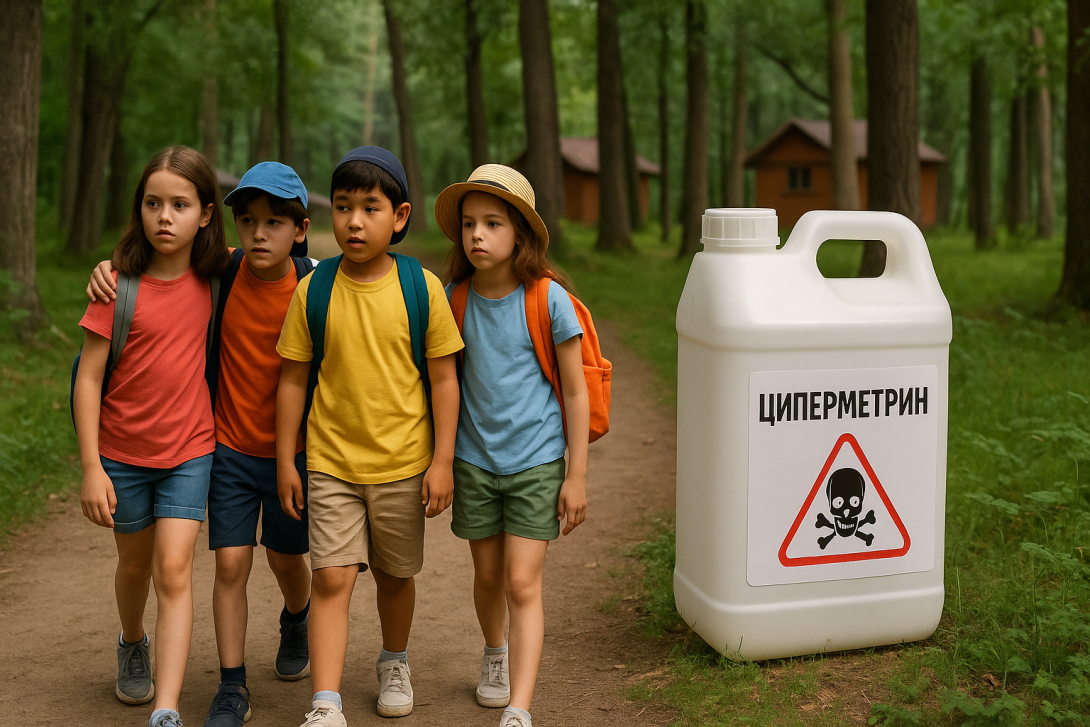
In children's summer camps in the Kostanay region, a highly toxic insecticide is being used, posing a serious threat to children's health. The editorial team of FBRK investigates which substances are used for disinsection in the regions of Kazakhstan in 2025.
For the third consecutive year, the editorial team of FBRK has been analysing which substances are used to poison insects in various regions of Kazakhstan. Our investigation has revealed alarming patterns: local authorities continue to use dangerous chemicals, ignoring the potential risks to public health and the environment.
THE REALITY IN KOSTANAY: CHILDREN UNDER THREAT
In response to an official request from our editorial team, the Department of Sanitary and Epidemiological Control of the Kostanay Region reported that for 2025, the akimat has not allocated funds for the disinsection of populated areas. However, this does not mean residents of the region are completely protected from exposure to dangerous chemicals.
According to the information obtained, there are 9 state-run children's summer health camps in the region where disinsection activities are carried out annually. Work has already been completed at the 'Ally Parus' health camp in Lisakovsk, and treatment is also planned for the 'Orlyonok', 'Chayka', and 'Solnechny' camps.
What is particularly alarming is that the regional authorities have chosen to treat children's holiday sites with 'Cypermethrin', a second-generation insecticide whose active ingredient belongs to the class of pyrethroids. Official representatives described it as a standard means of insect control, yet omitted the fact that this substance can seriously harm the health of the very children for whom these health camps exist.
A paradoxical situation: parents send their children to camp to improve their health, but there they are exposed to toxic substances. This is akin to a situation where the cure turns out to be more dangerous than the disease. It raises the logical question: how conscious is this decision by local authorities, and do they have complete information about the risks of the substance being used?
THE HIDDEN DANGER OF CYPERMETHRIN IN CHILDREN'S CAMPS
The use of cypermethrin in children's health camps causes serious concern. This insecticide is classified as a highly hazardous substance and has an extensive list of negative effects. Studies show it can have a toxic effect on the nervous system, disrupt hormonal balance, and even affect a person's psycho-emotional state, in severe cases provoking depressive states.
A child's body, with its undeveloped detoxification system, is particularly vulnerable to the effects of toxic substances. When cypermethrin enters the body, children may experience headaches, dizziness, convulsions, impaired coordination of movement, and other symptoms of nervous system damage.
Imagine a typical scenario: children play on treated grounds, touch plants that have insecticide residue, and then sit down to eat or take food without thoroughly washing their hands. In such conditions, allergic reactions become almost inevitable — skin rashes, itching, watery eyes, rhinitis can mar a long-awaited holiday. Symptoms appear even at low concentrations of the substance, making cypermethrin particularly insidious for use in areas where children gather.
ENVIRONMENTAL CONSEQUENCES AND LONG-TERM RISKS
In addition to the risks to human health, cypermethrin causes serious damage to the environment. The substance negatively affects the central nervous system of mammals and is highly toxic to cats, fish, bees, and aquatic insects.
The substance is quite persistent. It remains on treated surfaces for up to 20-30 days, and in soil — up to 10 weeks depending on the soil type. This means children staying at camps after disinsection may be exposed to the toxic substance for almost the entire duration of their stay.
Of particular concern is the lack of data on whether any monitoring of children's health status is carried out after disinsection, or whether possible negative reactions are tracked. It remains unclear how the insecticide application is organised: whether a safe period between treatment and children's arrival is observed, whether thorough wet cleaning is carried out after spraying, and whether access to recently treated areas is restricted. Without these precautions, the risks to children's health increase many times over.
A RESPONSIBLE APPROACH TO DISINSECTION
It is important to note that safer alternatives exist. For instance, we previously reported that in Almaty, seasonal treatment of green spaces has begun. According to the city's Department of Ecology and Environment, the activities are carried out predominantly using biological preparations (‘Aktarofit’, ‘Ak Kobelek’, ‘Green Gold’) and chemical agents of a low hazard class, such as 'Diuron' with the active ingredient diflubenzuron. This preparation is significantly less toxic to humans and exhibits fewer side effects upon accidental contact.
CONCLUSION: CHILDREN'S SAFETY UNDER THREAT
The use of cypermethrin in children's health camps in the Kostanay region is a glaring example of an irresponsible approach to the health of the most vulnerable category of citizens. The lack of disinsection in populated areas coupled with the simultaneous use of highly toxic substances in places where children stay raises serious questions about the priorities of local authorities.
It would be advisable for regional authorities to review their disinsection policy, giving preference to safer preparations, especially in children's institutions. An important step would be more open communication with parents about the disinsection agents used, which would allow them to make more informed decisions regarding their children's holidays.
The editorial team of FBRK will continue to monitor the disinsection situation in the regions of Kazakhstan. We call upon akimats to adopt a more responsible approach to choosing preparations, considering not only their effectiveness in insect control but also their safety for people, especially children.
In subsequent articles, we will report on the situation in other regions of the country and continue our investigation into what is being used to poison insects, and possibly our children, in Kazakhstan.
To be continued...