In January 2026, the Bureau of National Statistics surveyed representatives of 12,000 households in all regions of the country, as well as in Astana, Almaty and Shymkent. The proportion of smokers was 15.1% of the population - 2.4 percentage points lower than the figure a year earlier. But while official statistics record a decline in demand, law enforcement agencies report almost every month on the seizure of large quantities of illegal cigarettes, which forces us to take a somewhat different view of the survey figures.
WHAT THE SURVEY SHOWED
According to the Bureau of National Statistics, in rural areas 17.8% of residents smoke, and in cities - 14%. Among men, the proportion of smokers is 30.5%, among women - 4.9%. The vast majority (98.6%) prefer factory-made cigarettes, only 0.4% use e-cigarettes, and 0.9% use heated tobacco products (IQOS, GLO, PLOOM).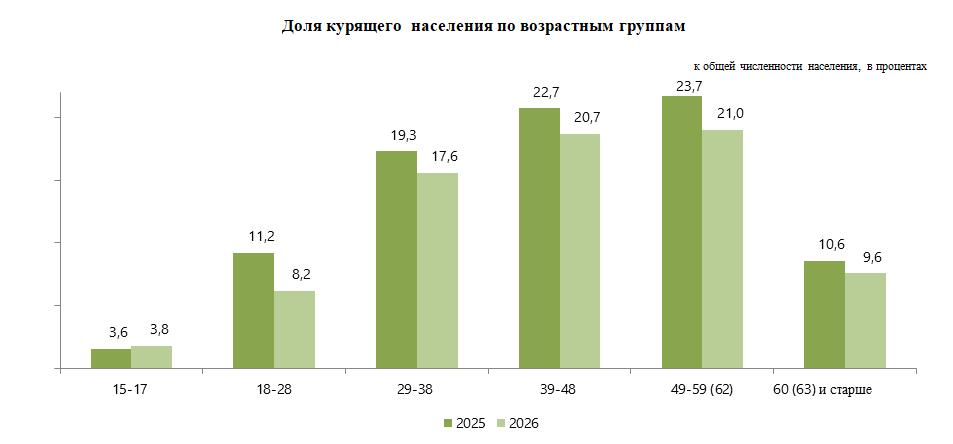
WHERE IS ILLEGAL TOBACCO GOING
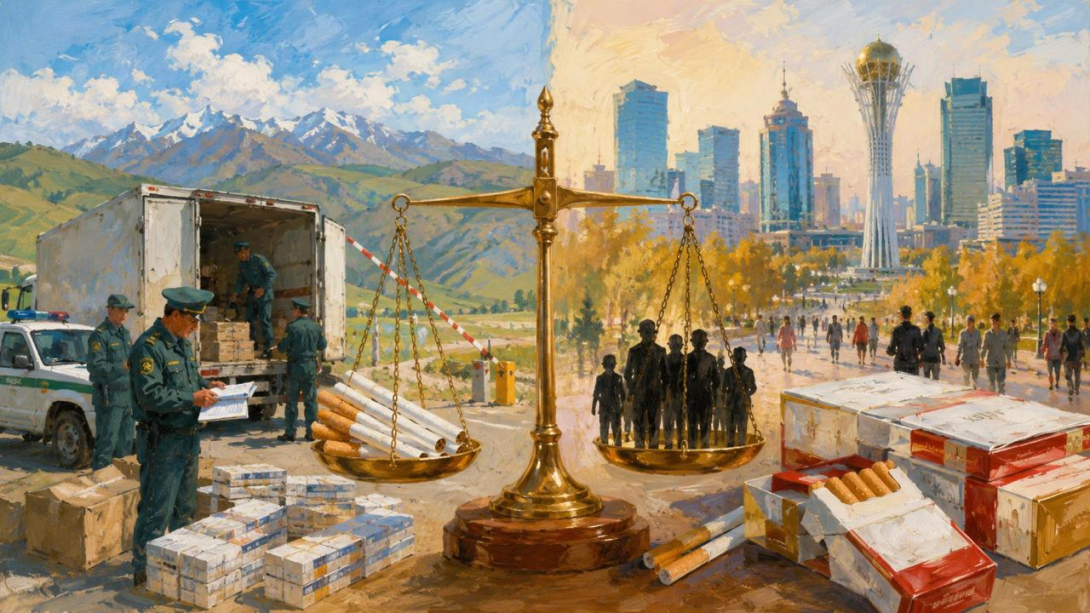
Against the backdrop of these figures, in recent months in Kazakhstan there have been more frequent reports from law enforcement agencies about the seizure of large quantities of contraband cigarettes. Of course, one cannot look for a direct link between the decline in the official smoking rate and the increase in such cases, but this trend certainly deserves separate attention.
Let's recall at least recent incidents. On 8 June 2026, at the 'Karasu' checkpoint in the Zhambyl region, border guards discovered 360,000 packs of cigarettes worth over 180 million tenge in a lorry's hiding places. Since the beginning of the year, the Border Service of the National Security Committee (BS NSC) has prevented 93 similar incidents totalling 386 million tenge.
Soon after, the department of the Agency for Financial Monitoring (AFM) for the Zhambyl region stopped the activity of an organised group importing cigarettes from Kyrgyzstan. 319,000 packs of unmarked products worth 293 million tenge were seized, and unpaid excise duties were estimated at 115 million tenge. According to the investigation, the informal 'Hawala' system was used for payments.
CONTEXT AND SIGNIFICANCE
The official figures and seizure data describe two different sides of the same market, and it is difficult to compare them directly. The Bureau of Statistics survey is based on self-reports from respondents; people report their own habits, and the methodology does not distinguish whether a person smokes legal cigarettes with an excise stamp or illegal ones. Formally, both cases are counted equally as 'smoking', so the decline in the indicator cannot in itself explain whether the illegal market is growing or shrinking.
If we consider the previous assessment by FBRK that the grey market could account for up to 20% of cigarette sales in the country, then official statistics may fail to account for a significant portion of consumers - those who switched to unmarked products rather than quitting smoking.
An additional factor is the increase in minimum retail prices, which the Ministry of Finance recently put forward for discussion. A rise in the legal price historically increases interest in cheaper contraband alternatives, and if this measure is adopted, tracking its real effect on consumption without data on the shadow market will be impossible.
It is also worth noting separately that the increase in minimum retail prices for cigarettes is happening in parallel with the intensification of the fight against smuggling - that is, both legal and illegal products are becoming more expensive simultaneously, and the availability of the cheaper alternative is decreasing. If, at the same time, the real incomes of the population grow more slowly than tobacco prices, some smokers may simply no longer have the financial means to continue smoking either legal or contraband cigarettes.
Recall that earlier FBRK released a series of investigations on the illegal tobacco market in Kazakhstan.
A separate edition was devoted to the case of Sergei Buri - the subject of the investigation into an alleged transnational tobacco smuggling scheme, extradited from Russia. Details are on the FBRK YouTube channel:
- How the contraband cigarette market works in Kazakhstan
- Through which routes the illegal tobacco flow goes
- The Sergei Buri case: what FBRK managed to find out
Photo: Bureau of National Statistics