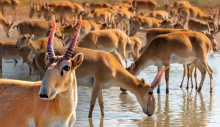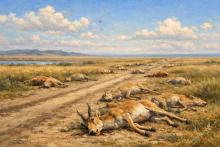
When journalists ask difficult questions, officials turn into masters of verbal acrobatics. The response from the Ministry of Ecology to the FBRC editorial team's request for the biological justification for resuming the cull of saiga antelope in 2025 is a perfect illustration of this art. Instead of providing a specific scientific document, the department offered us a fascinating journey through the labyrinth of regulatory legal acts and references to copyright law.
This bureaucratic masterpiece begins in a fairly traditional way – with a lengthy quotation from the 'Rules for Regulating Animal Numbers', which imply that population regulation is carried out in accordance with a biological justification. The reference to an order from the Minister of Agriculture from 2010 – a document fifteen years old, which is presumably meant to serve as an unshakeable scientific foundation for decisions made in 2025 – looks particularly amusing. Let's say that's the case. 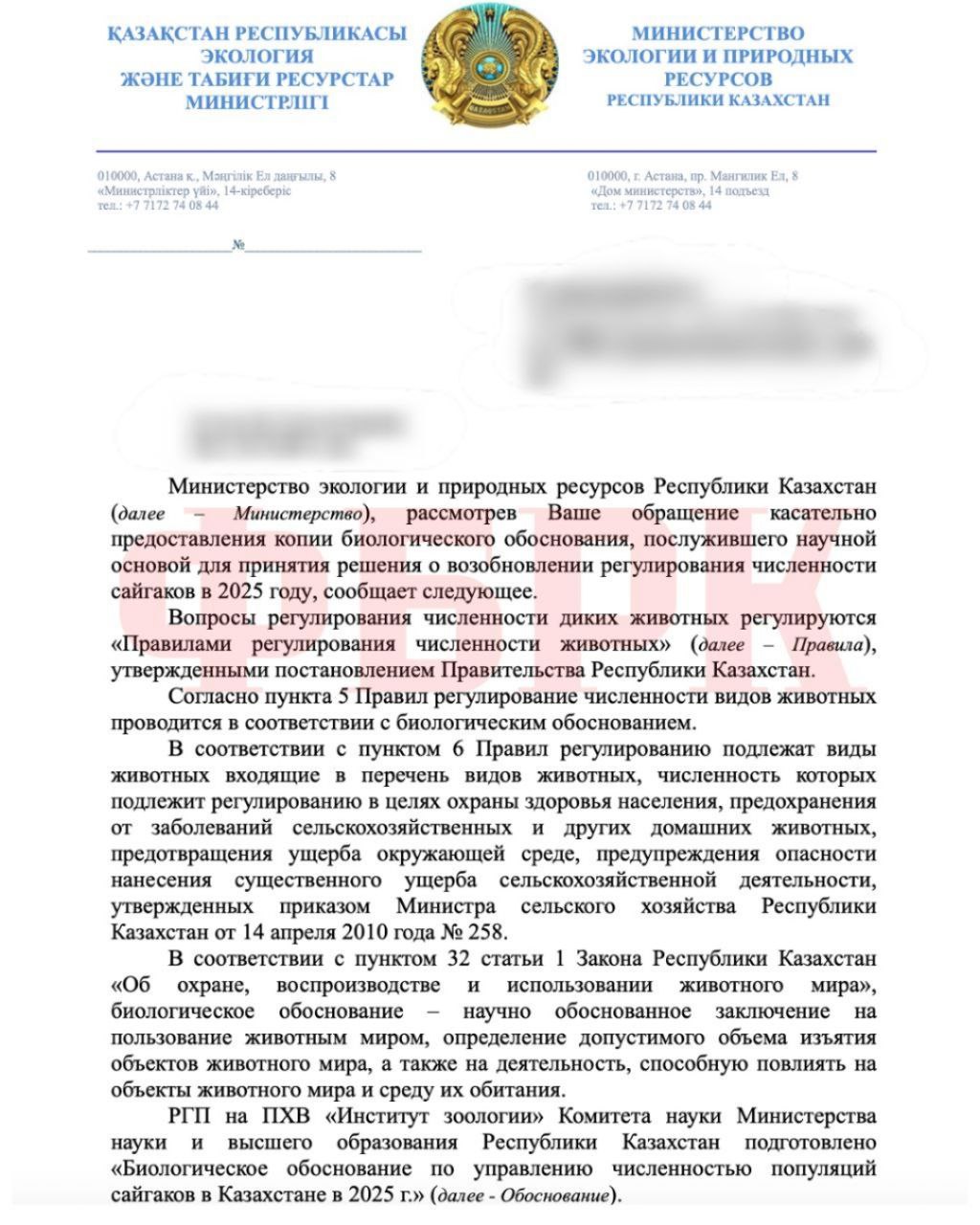
But the real magic begins further on. The Ministry informs us that the RSE 'Institute of Zoology' has prepared a 'Biological Justification for Managing Saiga Antelope Populations in Kazakhstan in 2025', but then immediately makes an astonishing statement: this document cannot be provided due to copyright. This creates a curious situation – a state institution, using public funds, prepares a scientific justification for a government decision, but cannot provide it to society because of... the copyright of the very same state institute.
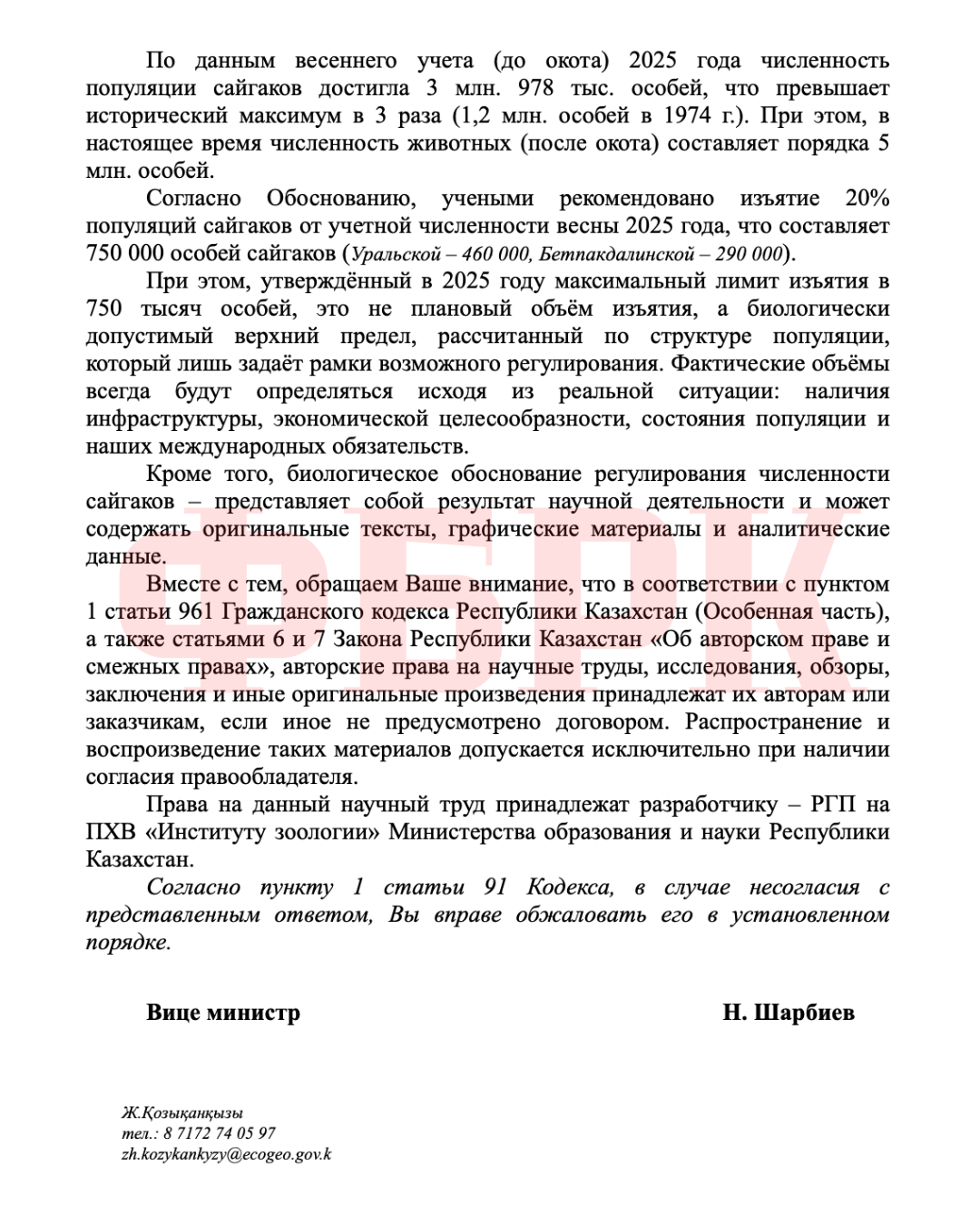
The figures provided by the Ministry are, firstly, nothing new; rather, they simply repeat the official party line, which is easy enough to find without an official request to the Ministry. And secondly, these figures raise more questions than they provide answers. The saiga population supposedly reached 3.978 million in the spring of 2025, which 'exceeds the historical maximum by 3 times'. It then explains that the historical maximum was in 1974 and stood at 1.2 million.
Where does this figure of 1.2 million for the historical maximum in 1974 come from? What is the counting methodology? How accurate is this data, given that counting wild animals over vast territories is an extremely challenging task, even with modern technology? The Ministry of Ecology does not explain.
The statement that after calving the population stands at 'around 5 million' is particularly intriguing. This approximate wording, used in a scientific context, looks strange, to say the least. Can the population really have grown by 25% in a few months? And if the spring count data is so imprecise that it needs adjusting by a million, is it wise to base such radical decisions on it?
The funniest part is that, according to the words of the Vice-Minister of Ecology, Nurken Shabiev, last year before calving there were 2 million 833 thousand in Kazakhstan, and today (after calving) there are already around 5 million. It seems saiga have found a way to reproduce just by looking at each other.
The recommendation to remove 20% of the population – 750,000 individuals – is presented as scientifically substantiated, but no concrete justification is given. Why exactly 20%? Based on what calculations? What factors were taken into account when determining this figure? The Ministry merely states it as a fact, leaving the public to guess at the scientific basis for such a large-scale decision.
The attempt to soften the impact of such a huge number by explaining it as the 'biologically permissible upper limit' looks like an ex-post-facto justification. If 750,000 is just the 'framework of possible regulation', then why was this exact figure approved as the maximum limit? And what does the vague wording mean, stating that 'the actual numbers will always be determined based on the real situation'? It seems the scientific justification is conditional, and real decisions will be made based on 'economic feasibility' and 'infrastructure availability'.
The final flourish of the response – the reference to copyright – raises particular questions. The Ministry quotes the Civil Code and the Law 'On Copyright' in detail, explaining why it cannot provide a document that should be the foundation for public policy. This legal sophistry is, to say the least, baffling: can a scientific justification, prepared by a state institute for state needs, really be kept secret under the pretext of protecting intellectual property?
Incidentally, in 2023, the scientific justification for the bloody culling of rare animals was prepared by the West Kazakhstan Agrarian and Technical University named after Zhangir Khan, with the document being concealed from the public for a long time under the classification 'For Official Use'. Afterwards, our editorial team found a whole range of contradictions within the text of that justification.
Today, the Ministry's response gives the impression of a carefully constructed system of evasion, designed to avoid giving a direct answer to a direct question. Instead of the biological justification, the FBRC editorial team received a legal lecture, a few general figures, and a reference to a document that cannot be provided. Such an approach to information transparency looks particularly suspicious in the context of a decision affecting the fate of millions of animals and generating widespread public outcry.
One gets the impression that the Ministry either does not possess a proper scientific justification, or that this justification contains controversial points it prefers not to bring up for public discussion. Otherwise, it is difficult to explain why such a number of bureaucratic manoeuvres were needed for a simple answer to a direct question.
Furthermore, if the scientific justification is really as impeccable and convincing as they try to make it appear, what prevents it from being made available to the expert community and the public? After all, an open discussion of the scientific data would only strengthen the Ministry's position and dispel the doubts of critics.
Incidentally, in April of last year, President Kassym-Jomart Tokayev promised to ban the culling of saiga, calling them 'symbols of the Kazakh steppe'. It will be interesting to see when the head of state makes a decision on the fate of the current 'population regulation', whether the Ministry will provide him with the full biological justification, or whether they will also hide behind copyright? And if the document is shown to the President after all, why is it being hidden from the public? After all, according to the Constitution, all citizens of Kazakhstan are equal before the law – which obviously includes the right to receive information about government decisions.
One can only hope that the Ministry will reconsider its approach to information transparency and find ways to provide the public with full scientific justifications for its decisions. However, judging by the quality of this response, the only thing the environmental agency has truly excelled at is proving that sometimes what requires the most careful 'regulation' is not the number of saiga, but the number of competent officials in environmental protection departments.