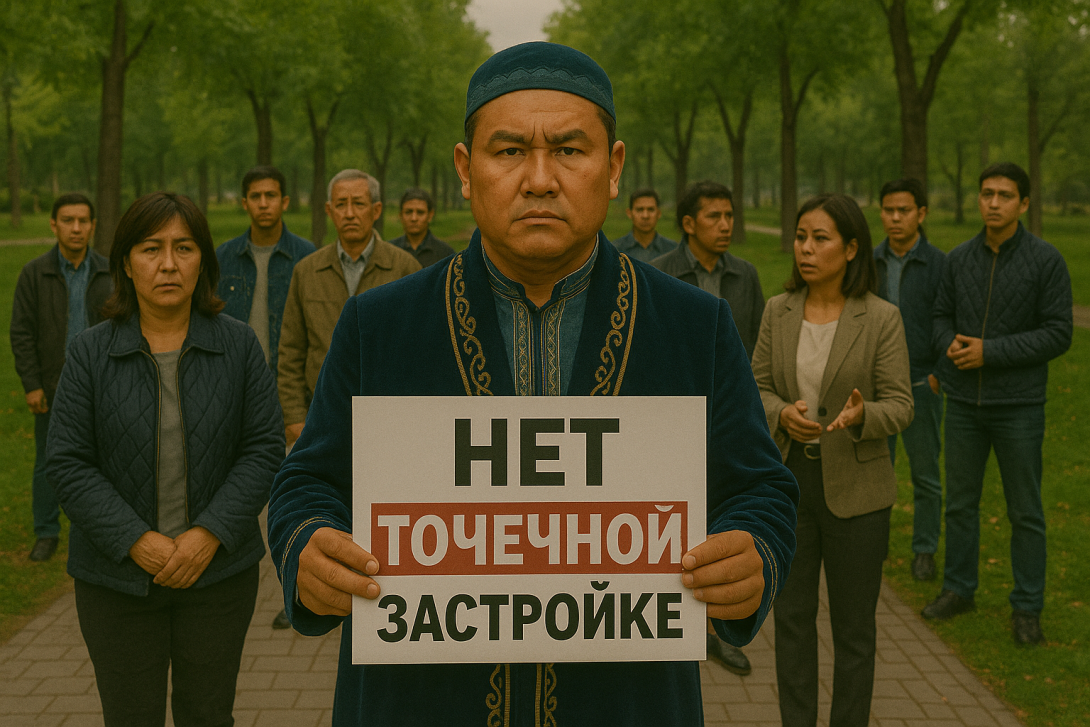
The territory of the former Fata Morgana complex in central Karaganda has become the latest subject of public debate about the future of the city's urban space. The site at 31/2 Erzhanov Street could potentially be turned into a multi-storey residential complex. This case continues a series of conflicts between the interests of developers and city residents that have been observed in recent months.
As we reported in a previous article, Karaganda is going through a turning point, where chaotic development is gradually giving way to a more regulated process. The situation with the former Fata Morgana complex is yet another example of this trend.
This area, previously classified as a public and business zone, contained a variety of facilities: a night karaoke club, a Russian bathhouse, a photo studio, and even a dog hotel. In 2023, the complex was put up for sale, but the listing is now archived, and there is no reliable information about its current status.
City activists, including bloggers Denis Denski and Bella Filimonova, have already expressed concern about potential changes.
"There are workers visible on the roof dismantling it, and through a gap in the gates I managed to see builders working in the courtyard. The roof is being dismantled for now, but it's hard to say for certain whether new buildings will be constructed here. However, there are suspicions to that effect," Denski shared his observations on social media.
Public concern is particularly focused on the possibility of tree felling and the creation of a "gated elite zone".
"Widespread infill development spares neither the city nor its residents. At the heart of it all, as always, is financial gain," the blogger noted.
Interestingly, in the comments under the post, the account of the Karagandy City Akimat soon responded to the situation: "The intended purpose is the operation of a public and business building and an ancillary facility. According to the PDP (Detailed Planning Project - ed. note by FBRK) 'New City,' the construction of a MRC (multi-residential complex - ed. note by FBRK) is not provided for."
It remains an open question whether any public hearings regarding the change of purpose for this territory were planned or held. This aspect is particularly important in light of the growing attention residents are paying to urban planning issues.
THE CONFLICT OF INTERESTS CONTINUES
The situation with the Fata Morgana territory illustrates a broader set of issues facing Karaganda and other cities in Kazakhstan. Developers strive to make the most efficient use of attractive plots in central districts, while residents advocate for preserving the established urban environment and green spaces.
Observations of the city's construction market raise legitimate questions. The company 'Zhiloi Fond' has repeatedly gained access to promising plots in the city, even in situations where the completeness and transparency of the documentation left much to be desired.
At the same time, other market participants are often forced to show greater flexibility in dealing with the public, sometimes to the detriment of their projects' economic efficiency. This raises the question of the need for a more balanced approach: it's important to consider both public opinion and the interests of developers investing in the development of urban infrastructure.
In a broader context, the construction industry in Karaganda is facing the need for comprehensive reform. The transparency of financial flows, the availability of necessary licences, and ensuring proper oversight in the sphere of shared-equity construction — all these aspects require further development and improvement to protect the interests of all parties involved.
The emergence in the market of developers who strive to work in strict accordance with the law and provide guarantees to buyers could contribute to the formation of a more civilised construction market. This is an important step towards creating a system where the interests of all participants in the process, including future residents, are taken into equal account.
City authorities find themselves caught between a rock and a hard place: on the one hand, they need to develop the city and attract investment; on the other, they must consider the opinions of residents and avoid a decline in their quality of life. This is precisely why the Akimat's comment, pointing out the incompatibility of residential construction with the detailed planning project, could signal a new approach to regulating construction in the city.
IN SEARCH OF A COMPROMISE
Experience in resolving such conflicts in various districts of the city could serve as a guide for all interested parties. Transparency of the decision-making process, consideration of residents' opinions, and adherence to all urban planning regulations — these are the principles that could form the basis of a new approach to development.
Perhaps a solution for the territory of the former Fata Morgana complex could be the creation of a multifunctional public space, combining commercial facilities with recreational areas and the preservation of green spaces. Such an approach would allow the interests of the landowners to be taken into account without disrupting the established urban ecosystem.
CONCLUSIONS
The current situation is yet more evidence that the construction industry in Karaganda is at a turning point. Spontaneous development is gradually giving way to a more orderly process in which the public voice plays an increasingly important role.
The confrontation between residents and developers is not merely a conflict of interests, but an opportunity to develop new approaches to the development of the urban environment that take into account the needs of all parties. The role of the city authorities in this process cannot be overstated — it is they who can act as the moderator, helping to find the optimal solution.
The successful resolution of such situations could create an important precedent for the entire construction industry in Karaganda and Kazakhstan as a whole, demonstrating that city development is possible without detriment to its residents or the environment. Ultimately, it is this balance of interests among all participants in the process that holds the key to the harmonious development of urban space.