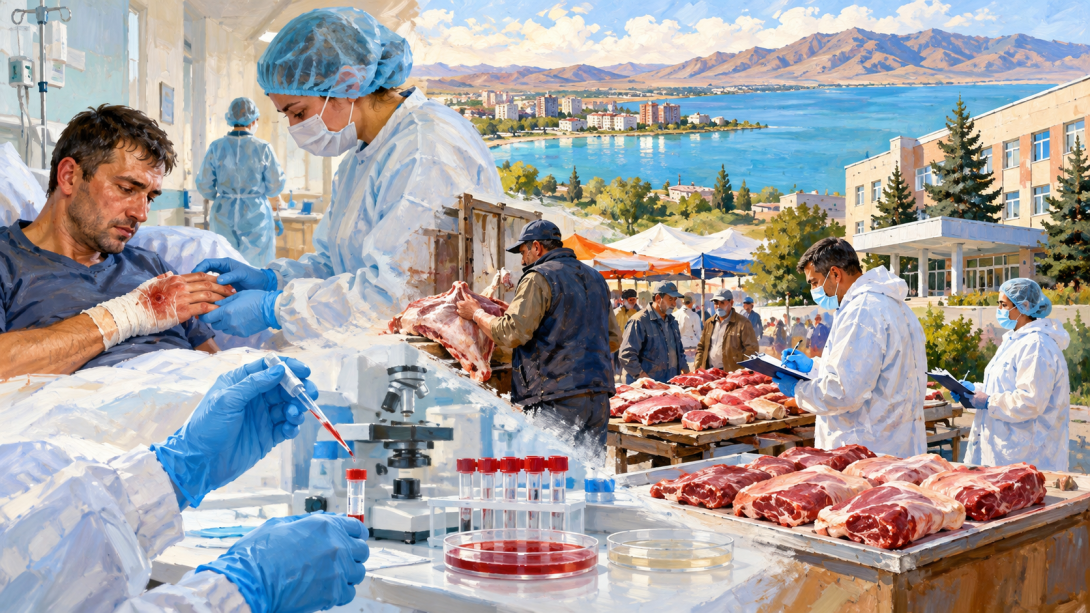
Suspect of anthrax in Balkhash has been dismissed, but this was only established after an appeal to a higher authority, as the hospital itself never responded to FBRK's questions. The Department of Sanitary and Epidemiological Control of the Karaganda Region of the Committee for Sanitary and Epidemiological Control of the Ministry of Health confirmed that on 28 September 2026, a patient was indeed admitted to the multi-specialty hospital in the city with a preliminary diagnosis of "Anthrax, cutaneous form", and explained what happened next: from isolating the patient to checking meat at the market.
WHAT HAPPENED
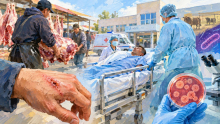
Recall that FBRK recently reported that on 28 September, a man was admitted to the admissions department of the multi-specialty hospital in Balkhash with an infected wound on his left hand, sustained while carrying meat carcasses at the market.
We called the hospital directly, but they refused to comment on the situation, citing medical confidentiality, even though the editorial team did not request any personal data.
FBRK then sent a written request, again stipulating that the patient's personal data was not needed, and that only confirmation or denial of the fact itself was required. We never received a response, and soon turned to the Ministry of Health.
WHAT THE DEPARTMENT SAID ABOUT THE PATIENT AND THE MEASURES
The Department of Sanitary and Epidemiological Control of the Karaganda Region confirmed that the resident of Balkhash had skin lesions on his left hand and forearm, and according to him, shortly before seeking medical help, he had been involved in moving meat products at the market. The man's profession, the department emphasises, is not related to livestock farming, animal slaughter, or the processing of raw materials of animal origin.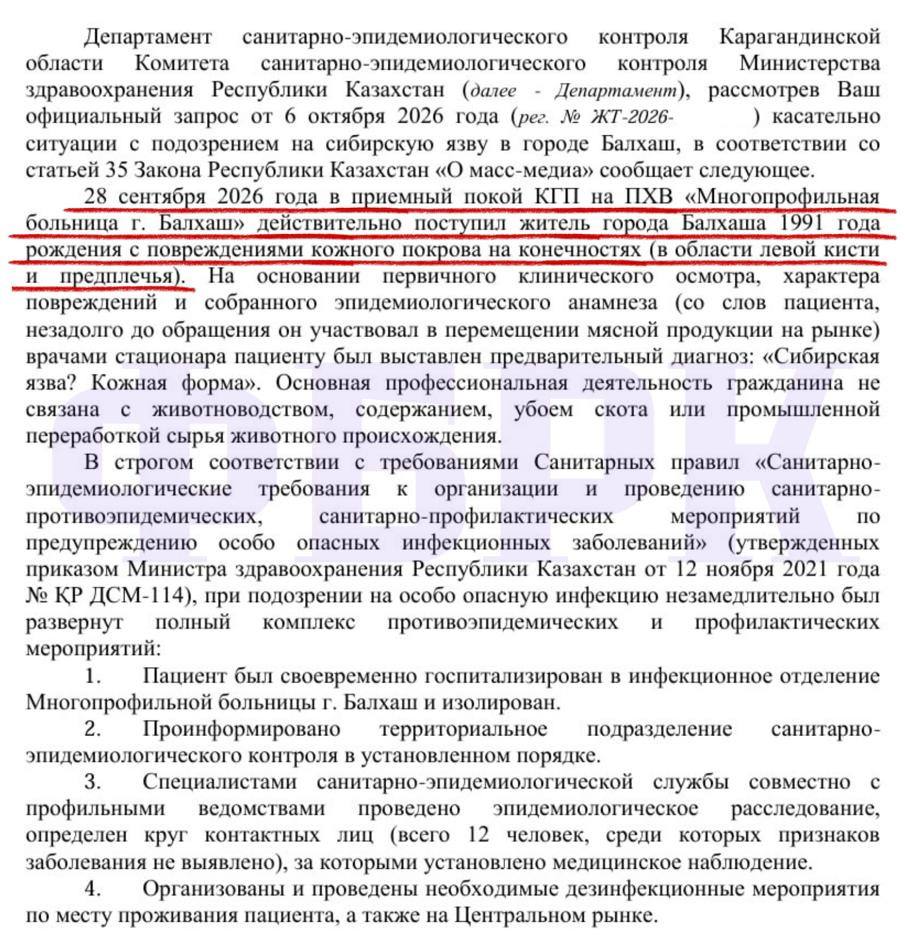
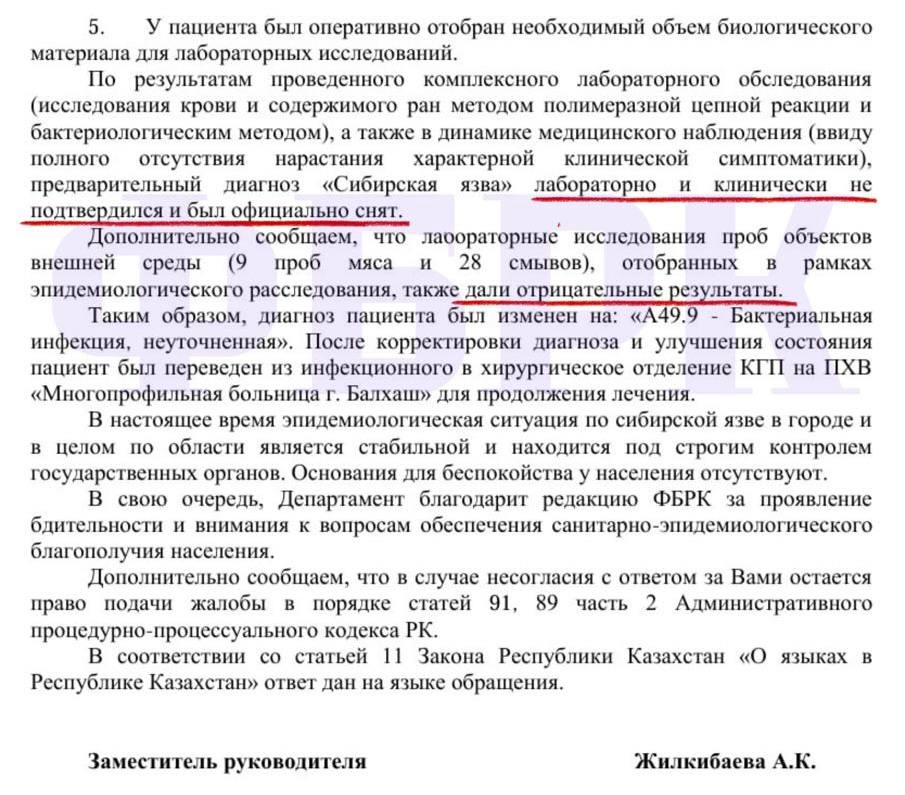
According to the agency, everything that followed was carried out strictly in accordance with sanitary rules. The patient was admitted to the infectious diseases department and isolated, and biological material was collected from him. The epidemiological investigation identified 12 contact persons: they show no signs of the disease, and medical observation was established for them. Disinfection was carried out at the patient's place of residence and at the Central Market.
WHAT THE TESTS SHOWED
Blood and wound contents were tested using the polymerase chain reaction method and the bacteriological method. Anthrax was not confirmed either laboratory-wise or clinically, and the preliminary diagnosis was officially withdrawn. Environmental samples, 9 meat samples and 28 swabs, were also negative. The patient was diagnosed with A49.9 "Bacterial infection, unspecified" and transferred to the surgical department of the same hospital.
The department describes the situation in the city and the region as stable.
WHY SILENCE FROM GOVERNMENT AGENCIES IS DANGEROUS
The alarm turned out to be false, and this is undoubtedly good news. But here is what is unclear: why was the answer to a question of obvious public importance so difficult to obtain?
One could suppose that the hospital was guided by a desire not to sow panic or provoke unnecessary alarm. However, good intentions do not cancel out the consequences of an information vacuum.
A similar logic can be traced in the story involving the Ministry of Agriculture (MoA), which refused to provide FBRK with information about anthrax burials, citing the classification "For Official Use" (FOU).
The Ministry of Culture and Information (MCI) reminded that the FOU classification in itself does not release a state body from the obligation to justify why certain information is restricted from access. However, no substantive assessment of the MoA's refusal ever followed.
There is one common problem in these stories. State bodies often perceive information as their own resource, which they can dispose of at their own discretion.
And yet, when it comes to dangerous infections, epidemiological risks, or potentially hazardous facilities, information is not a privilege of the ministry and not a favour that officials can grant at their own will. It is a tool of public safety - or, at least, it should be.