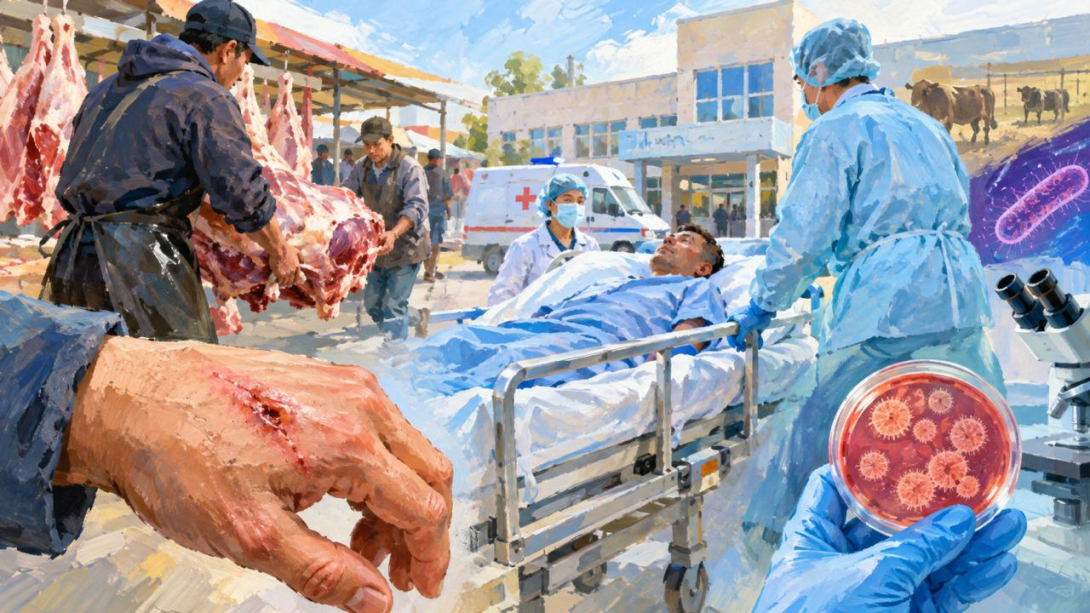
A scratch received while carrying meat carcasses at a market has led a resident of Balkhash to an infectious diseases ward with a preliminary diagnosis of "anthrax". The case has so far not been officially confirmed, and the hospital that admitted the patient is publicly not commenting on it.
HOW THE MAN ENDED UP IN HOSPITAL
According to FBK sources, on 28 September 2026 the patient was admitted to the reception ward of the multidisciplinary hospital in the city of Balkhash. He complained of pain and an infected wound. After examination, a medical worker issued a preliminary diagnosis of "anthrax, cutaneous form" with a question mark, that is, under question. The man was reportedly rushed to the infectious diseases ward as an emergency.
According to sources, a few days before the incident the man had allegedly been helping an acquaintance drag meat carcasses at a market and scratched his left hand, on the back and outer side.
At present, according to FBK sources, the patient is isolated, and anti-epidemic measures and confirmatory diagnostics are being carried out.
WHY THE CASE CANNOT YET BE CONSIDERED CONFIRMED
The FBK editorial team contacted the hospital directly. We were told there that the information requested falls under medical confidentiality. FBK then sent an official request, separately emphasising that the patient's personal data was not required - the matter concerned solely confirmation of the fact itself.
By the time of publication, no response from the hospital had been received.
WHAT REMAINS BEHIND THE SCENES
In stories like this, what is especially alarming is not only what is happening, but also how little people are prepared to say about it. If there really is no cause for concern, one would logically expect a simple and unambiguous denial. So far, there is none.
And this, of course, does not prove the presence of anthrax. But silence in a situation that could potentially matter for public health inevitably gives rise to numerous theories.
If the diagnosis is indeed confirmed, it will no longer be simply a matter of one person's condition. A far more serious question will arise: where did the source of infection come from, and could other people have come into contact with it?
Given that meat carcasses feature in this story, attention will inevitably also be focused on how they were stored, where they came from, and whether they underwent the necessary veterinary control. After all, as is well known, there are certain difficulties with the latter in our country.