Charters and programmes of political parties are legally significant documents. When they contain phrases like "the system must" or a letter is missing from the name of the organisation itself, it is not editorial carelessness: it is a characteristic of how the party works with the documents by which it operates.
The founder of the FBRC, Kirill Pavlov, used Claude AI to check the charters and programmes of all seven officially registered parties in Kazakhstan. The impetus was the President's instruction to intensify work with artificial intelligence. Result: 14 documents, over 230 gross errors.
Pavlov published detailed tables on his Telegram channel, "Kazakh Chuvash". The FBRC is publishing an extended analysis.
WHAT WAS CHECKED AND HOW IT WAS COUNTED
The analysis included the charters and programmes of the "AMANAT" party, the Democratic Party of Kazakhstan (DPK) "Ak Zhol", the People's Party of Kazakhstan (PPK), the People's Democratic Patriotic Party (PDPP) "Auyl", the National Social Democratic Party (NSDP), the "Respublica" party, and the Kazakhstan Green Party "Baitaq".
"Respublica" has two programme documents, the others have one each. Spelling, grammar, syntax, legal-technical formatting (numbering, internal references, consistency of language versions) and layout errors — mixing Cyrillic and Latin scripts — were taken into account.
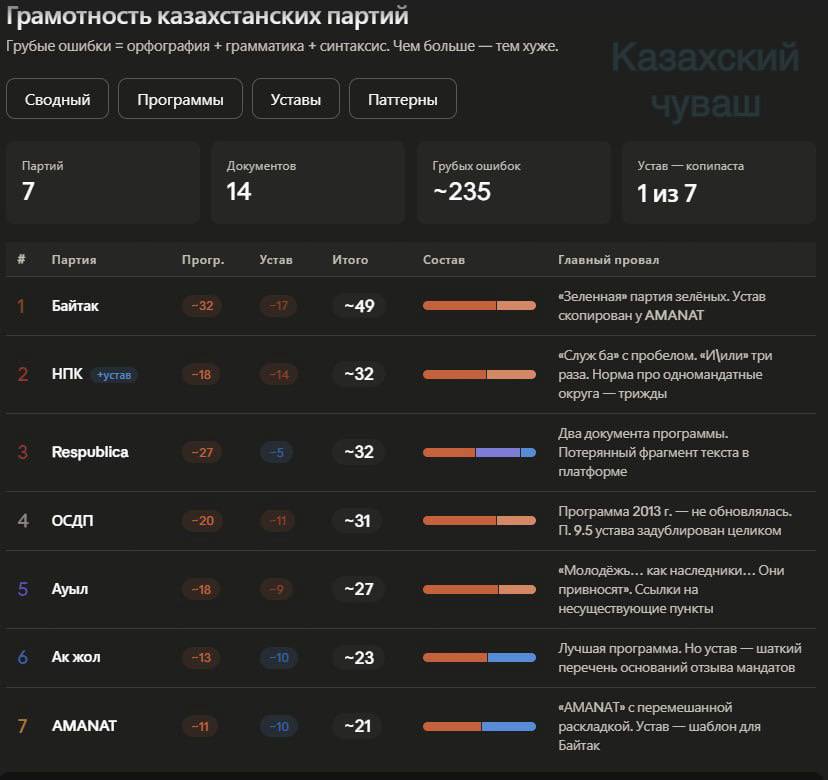
In terms of the total number of gross errors (programme + charter), the anti-rating was led by "Baitaq" (around 49 errors), followed by PPK and "Respublica" (approximately 32 each), then NSDP (31), PDPP "Auyl" (27), and DPK "Ak Zhol" (23). The fewest errors out of the seven was "AMANAT" (21).
"BAITAQ": A GREEN PARTY THAT DOESN'T KNOW HOW TO SPELL "GREEN"
"Baitaq" topped the rating with a total of 49 errors, and this is the result of two completely different types of failure.
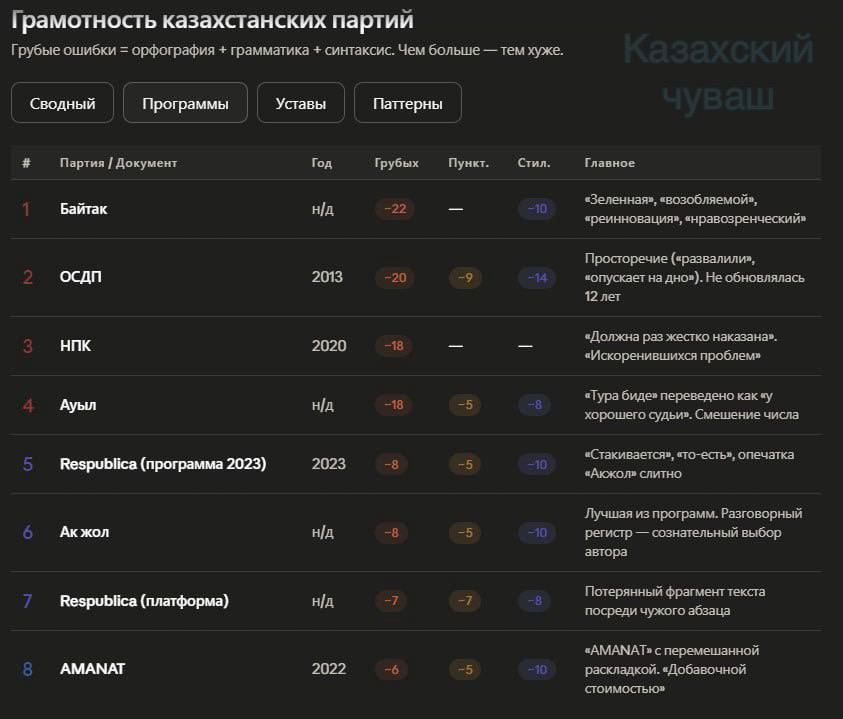
The party's programme contains a pervasive spelling error: the word "green" is written as "green" [with double 'n'] - with two "n"s - throughout the document, several dozen times. "Green economy". "Green technologies". The programme's title: "For a green future of Kazakhstan". This is not a typo or an isolated glitch - it is systematic illiteracy in the party's key word for a party with an environmental agenda.
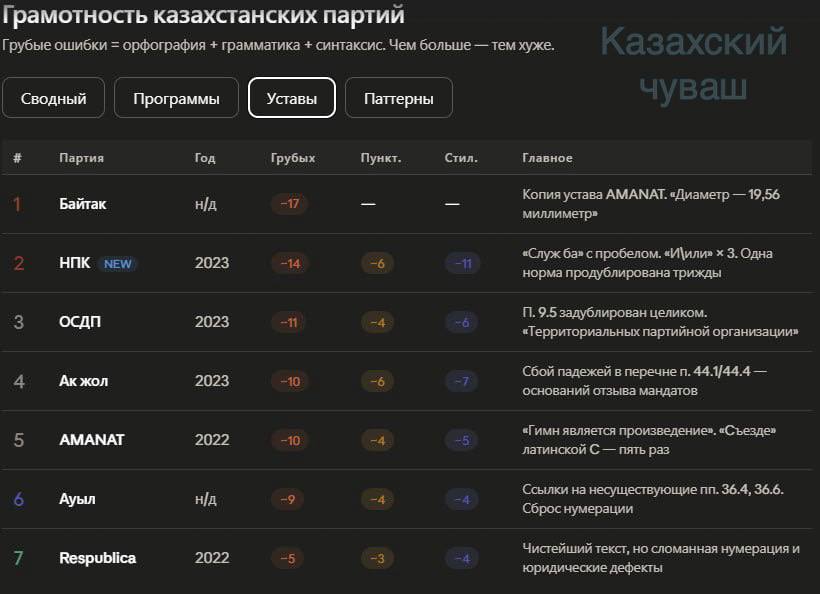
"Baitaq"'s charter revealed another problem: it is practically a word-for-word copy of the "AMANAT" charter, including all the errors of the original. This includes the inherited clause about the party anthem: "is the work" [grammatically incorrect in Russian] instead of "is the composition". To this, "Baitaq" added its own: "are elected the Political Council", "assess quality at its worth", "Diameter - 19.56 millimetre". The fact of textual borrowing is confirmed by the word-for-word coincidence of fragments, including identical errors.
PPK: A CHARTER APPROVED BY THE CONGRESS, WITH "SER VICE" AND A BACK SLASH
PPK scored approximately 32 errors in total and stands out not so much for the quantity as for the nature of the errors.
In the 2023 charter, approved at an extraordinary congress on 3 January 2023, the word "service" is typed with a space: "ser vice". The construction "and\or" with a back slash instead of a forward one appears three times in different parts of the document. The clause on single-mandate constituencies is reproduced in three different places. These are signs of a document that was not read before approval.
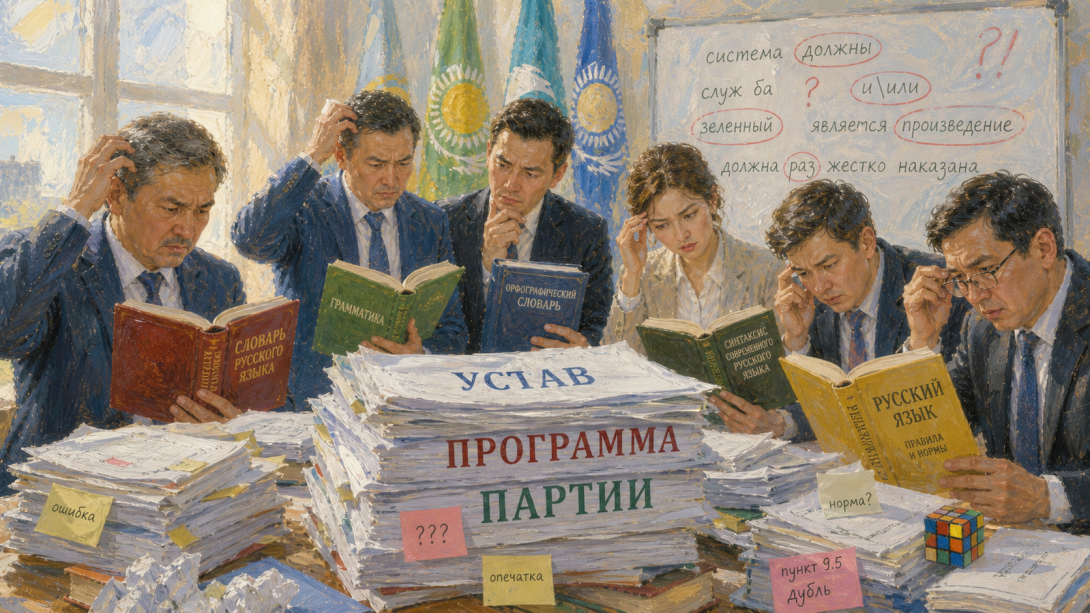
The PPK programme is a separate story. "The judicial system must ensure" [subject-verb agreement error] - a disagreement between subject and predicate. "Reducing the growing risk of poverty" - a logical inversion changing the meaning to the opposite. "Must be severely punished" [typo in the Russian 'punished' - "nakazana" instead of "nakazana"] - a typo that autocorrect wouldn't fix and requires a live proofread. If for most parties there are at least some traces of editorial work, in the PPK programme there are none.
NSDP: A PROGRAMME NOT UPDATED FOR 12 YEARS AND AN ERROR IN ITS OWN NAME
NSDP - 31 errors - demonstrates a combination of two different problems. The party is still working with its 2013 programme: the document is 12 years old, it has not been updated. During this time, it has accumulated colloquialisms, outdated constructions, and syntactic errors.
The charter was re-approved in 2023 at the XXI Extraordinary Congress. However, during re-approval, clause 9.5 was duplicated in its entirety, and no one noticed. Additionally: in clause 1.1 of the charter, in the party's official name, a letter is missing: "democratska" [missing 'i' in Russian "demokraticheskaya"] instead of "democratic". On the website header and elsewhere, the word is spelled correctly. The error is localised precisely in the text of the document approved by the congress.
"AMANAT", DPK "AK ZHOL", "AUYL", "RESPUBLICA": SYSTEMIC BUT DIFFERENT DEFECTS
"AMANAT", despite all criticisms, took the last place in the illiteracy rating, meaning it turned out to be the least illiterate of the seven (21 errors). Layout errors were recorded in its own name: "AMANAT" - where A and T are Cyrillic, but N is Latin. In the economic part of the platform - "added cost" [incorrect term in Russian] instead of "value added". However, the "AMANAT" charter served as a template for "Baitaq".
DPK "Ak Zhol" presents the opposite picture: the best programme of the seven in terms of linguistic purity, and simultaneously the weakest charter in terms of normative accuracy. In clauses 44.1 and 44.4, which establish the grounds for recalling deputy mandates, a systematic failure of case forms in the lists was recorded. This is a potentially vulnerable legal construction. Assessment of the specific legal risks requires a separate analysis.
PDPP "Auyl" has references to non-existent clauses of its own charter (36.4 and 36.6) and broken numbering in several sections. "Respublica" has a lost fragment of text in the middle of someone else's paragraph in the platform, disrupted numbering after the removal of sub-clause 3.6.6 in the 2023 version (the number was kept, the content deleted), and a discrepancy between the Russian and Kazakh versions of the charter.
A SYSTEMIC PATTERN: THE SAME ERRORS IN ALL SEVEN PARTIES
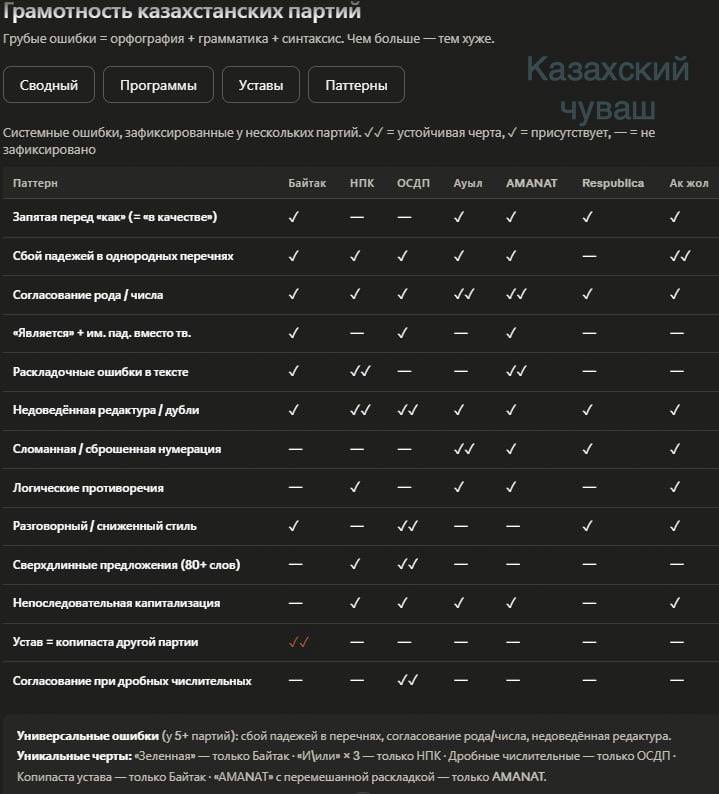
The analysis identified several errors common to most parties. A comma before "as" in the meaning of "in the capacity of" is placed incorrectly in five out of seven parties. Case agreement failure in homogeneous normative lists - in six out of seven. Traces of unfinished editing: breaks, duplicates, broken numbering - in all seven without exception.
As Kirill Pavlov suggested, it is likely that "all parties use the services of one and the same limited circle of lawyer-drafters who move from party to party. And not one of them has hired a proofreader, although some [parties] emerged already in the era of AI".
In other words, the systematic errors point not to individual carelessness, but to a common infrastructural problem in Kazakhstani party document management.
Pavlov separately calls on Kazakh-speaking colleagues to conduct a similar analysis — before the documents are corrected.
POSSIBLE CONSEQUENCES
A significant portion of the identified errors is editorial in nature and does not entail direct legal consequences. Another portion is potentially vulnerable. Case agreement failures in normative lists of grounds for mandate deprivation, references to non-existent clauses, duplicated norms, broken numbering, and discrepancies between language versions of the charter — in procedural disputes within the party or when challenging party decisions, all this could be used as a formal argument. Assessment of the specific legal consequences for each document requires a separate legal analysis.
Beyond legal risks, the quality of the documents raises a question of institutional culture. A charter is not a one-off document: it regulates the life of an organisation for years. A programme is a public statement of intent by which voters judge the party. When a party with an environmental agenda does not know how to spell its key word, and a party claiming to be a systemic opposition operates with a twelve-year-old programme — this is a characteristic of its attitude towards its own documents.