When one department cites copyright and another cites state secrets, it becomes clear: something is not right here. The response from the science committee of the Ministry of Science and Higher Education to the FBRK editorial team's request for the biological justification for culling saiga antelope not only failed to clarify the situation but added new intriguing details to this bureaucratic soap opera.
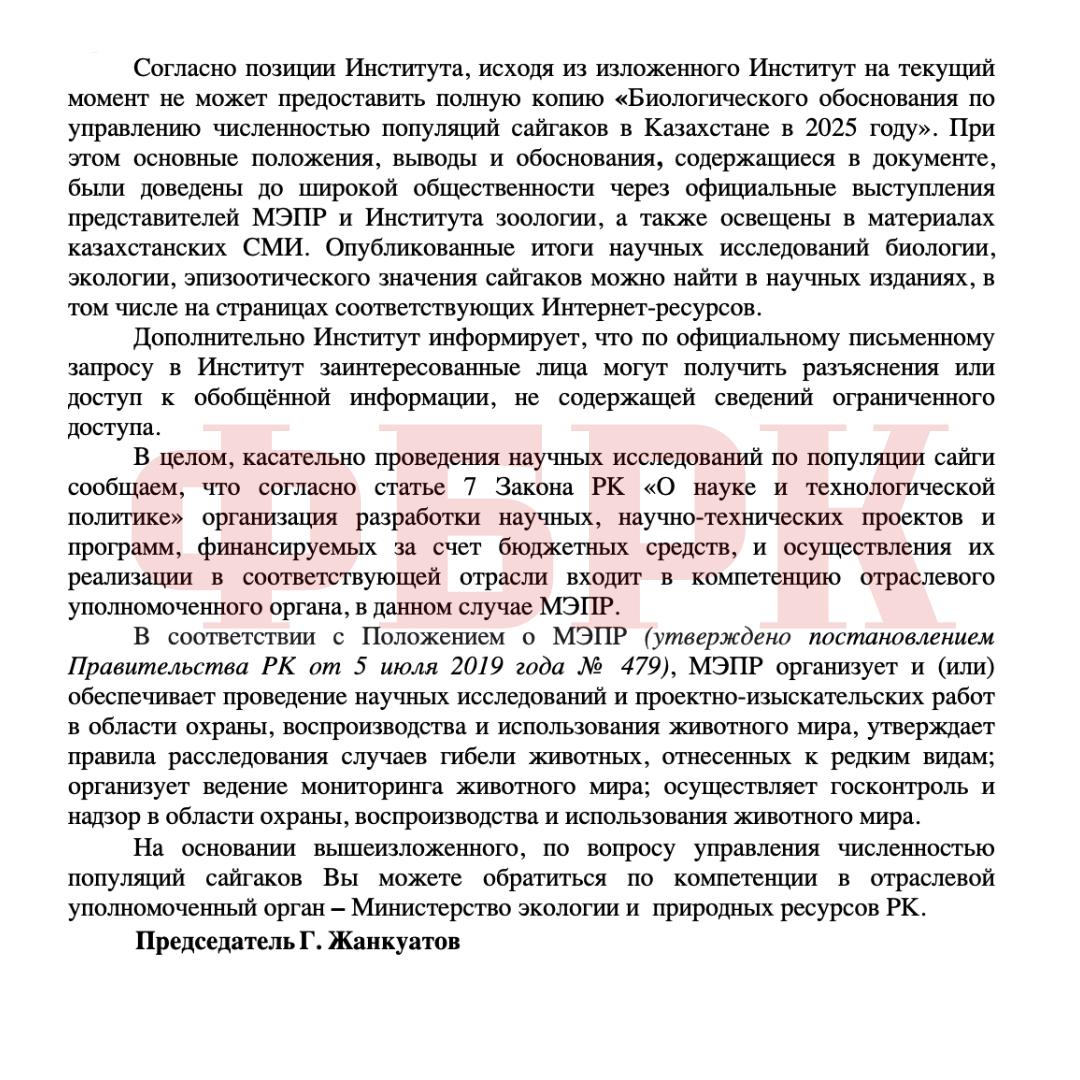
To recall, the Ministry of Ecology previously responded to a similar request for the biological justification by stating the document could not be provided due to the copyright of the Institute of Zoology. Now, the Ministry of Education reports a completely different reason - the document bears the classification "for official use only" and contains information of restricted distribution. Funny, isn't it? Two state departments cannot even agree on the exact reason they are hiding from the public the scientific justification for a state decision.
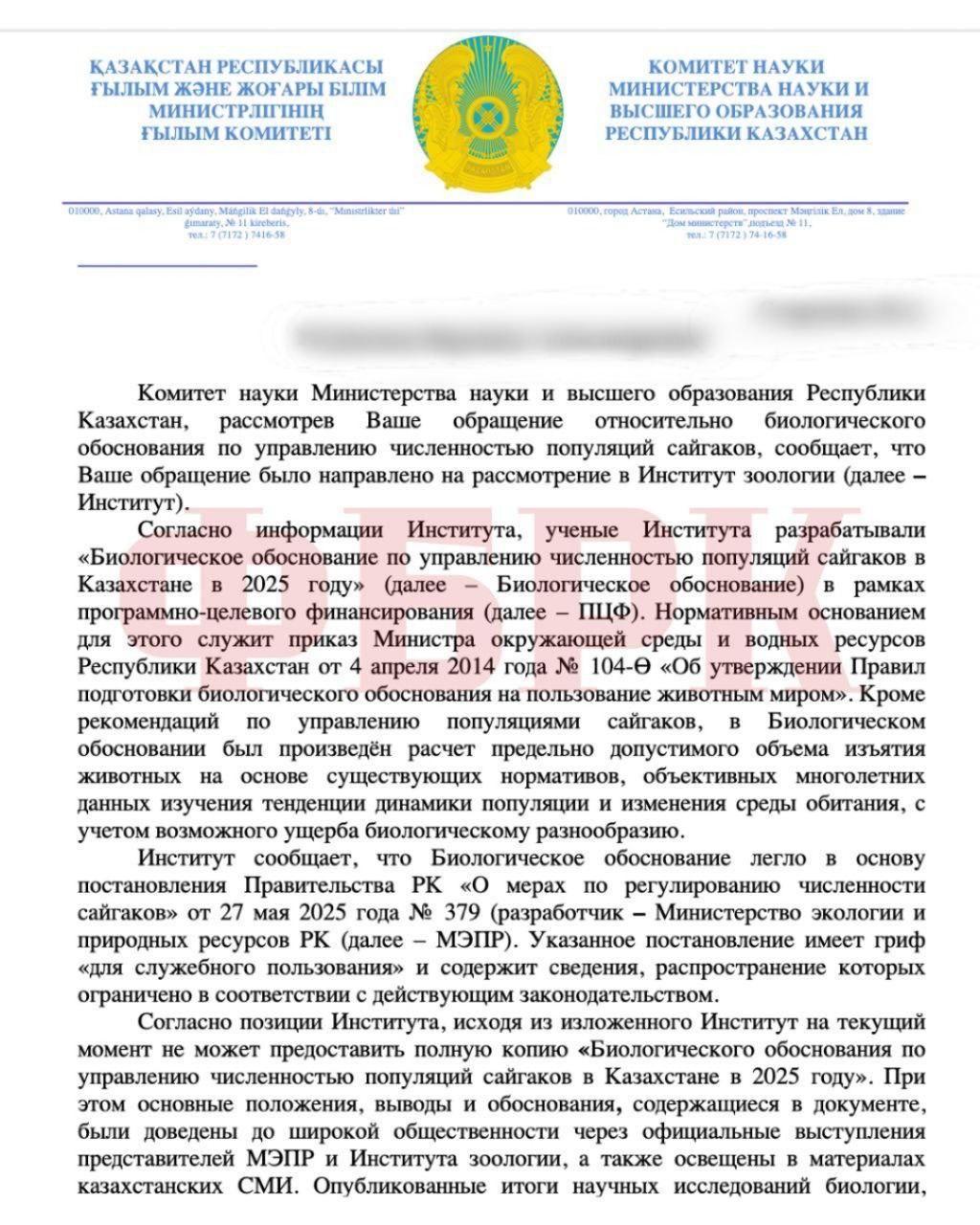
The Ministry of Education reports that the biological justification "formed the basis of the Government of the Republic of Kazakhstan Resolution No. 379 of 27 May 2025, which also bears the classification 'for official use only'".
Just think about it. A government decision on the fate of millions of animals, which sparked widespread public outcry, turns out to be a classified document.
Are the methods for counting saiga antelope really a state secret? Or is the issue that publishing the full text of the resolution could raise awkward questions?
The department's attempt to portray the situation in a positive light looks even less convincing than the verbal acrobatics of the Ministry of Ecology.
"The main provisions, conclusions and justifications were communicated to the general public through official statements by representatives of the Ministry of Ecology and Natural Resources and the Institute of Zoology," the department reports.
Or a classic example of substituting concepts. Instead of providing a scientific document for expert evaluation, the public is offered the retelling by officials. Imagine if dissertations were defended not on the basis of written works, but on candidates' verbal accounts of their research.
It further states that "published results of scientific research on the biology, ecology, and epizootic significance of saiga antelope can be found in scientific journals".
The ministry is effectively suggesting that journalists and experts independently piece together information from various sources, rather than providing the specific justification for a specific decision.
It is akin to saying: "Want to know why we decided to demolish this house? Read textbooks on construction; it's all in there."
According to the department's response, the Institute of Zoology is ready to provide "clarifications or access to summarised information that does not contain information with restricted access".
Again, the same story - instead of a complete document, some kind of truncated retelling is offered. But if the information is so secret that it cannot be made public, on what basis is it used for making decisions that affect the interests of the entire society?
Meanwhile, it becomes clear from the ministry's response that the biological justification was developed within the framework of programme-targeted financing - that is, at the expense of the state budget, taxpayers' money. In other words, citizens finance scientific research, the results of which are used for decisions that directly affect them, but they cannot access these results under any pretext.
The impression is created that the system of state governance has built a veritable wall of secrecy around the issue of saiga antelope. The scientific justification is classified, the government resolution is classified, and society is offered only general phrases from officials' speeches. Such a level of opacity would be understandable if it concerned military developments or diplomatic negotiations, but we are talking about the scientific justification for an environmental decision.
So if the biological justification is indeed scientifically impeccable and convincingly proves the need for culling saiga antelope, why hide it?
So what do we end up with? Not just a reluctance to provide a specific document, but a fundamental failure to understand the principles of information transparency and government accountability to society. When scientific research, conducted with public funds and serving as the basis for state decisions, becomes the subject of departmental games of hide-and-seek, it points to serious problems within the system of state governance.
The only thing that can be stated with absolute certainty today is that Kazakhstani bureaucracy has achieved truly outstanding heights in the art of evading straightforward answers to straightforward questions. But when officials lie so ineptly that they cannot even coordinate their versions of the lie amongst themselves, is it reasonable to trust them with the fate of an entire species? One gets the feeling that would be criminally foolish.