
Parents of pupils at a school in Astana are being given forms before routine vaccination in which medics have filled in the consent box in advance, the vaccine is written in abbreviated form, and they are asked to answer questions about the child's health only "yes" or "no". The school is served by Salauatty Astana LLP, one of the capital's largest private clinics operating on medical insurance funds. An examination of a single sheet of paper shows how a tool devised to protect a child turns into a formality, and informed consent ceases to be informed.
WHAT PARENTS OF SCHOOLCHILDREN IN ASTANA RECEIVED
Parents of pupils at a school attached to Salauatty Astana LLP approached the FBRK. The form is passed on through the children. On one side of the sheet is a consent form for vaccination, on the other a refusal form, and on both the same questionnaire about the child's health. In the consent box, medics write in the name of the vaccine by hand, in abbreviated form, in advance. The same box on the refusal form remains empty. There is no explanation of which diseases the vaccine protects against. According to the parents, they were told that the option "don't know" is not permitted.
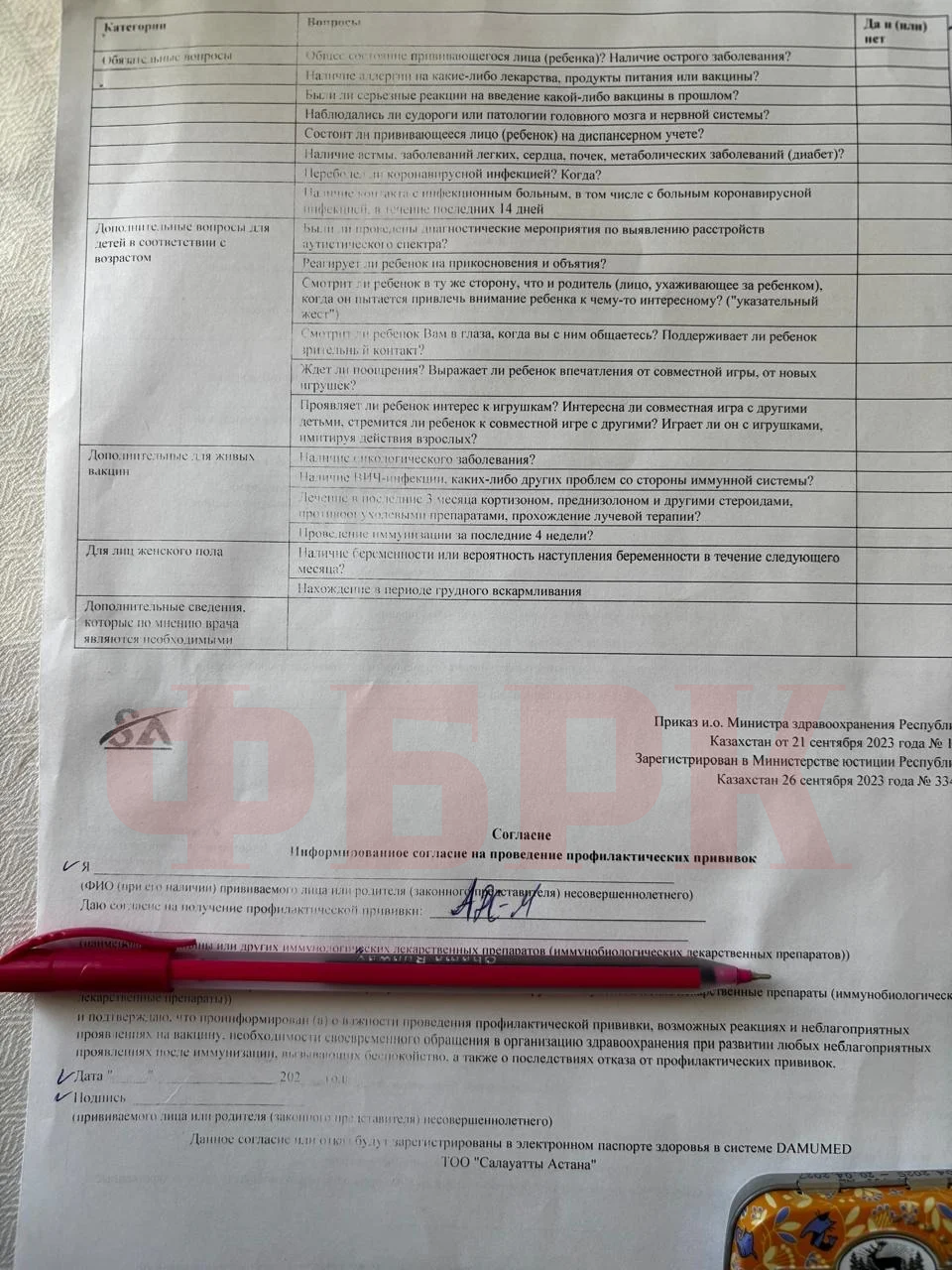
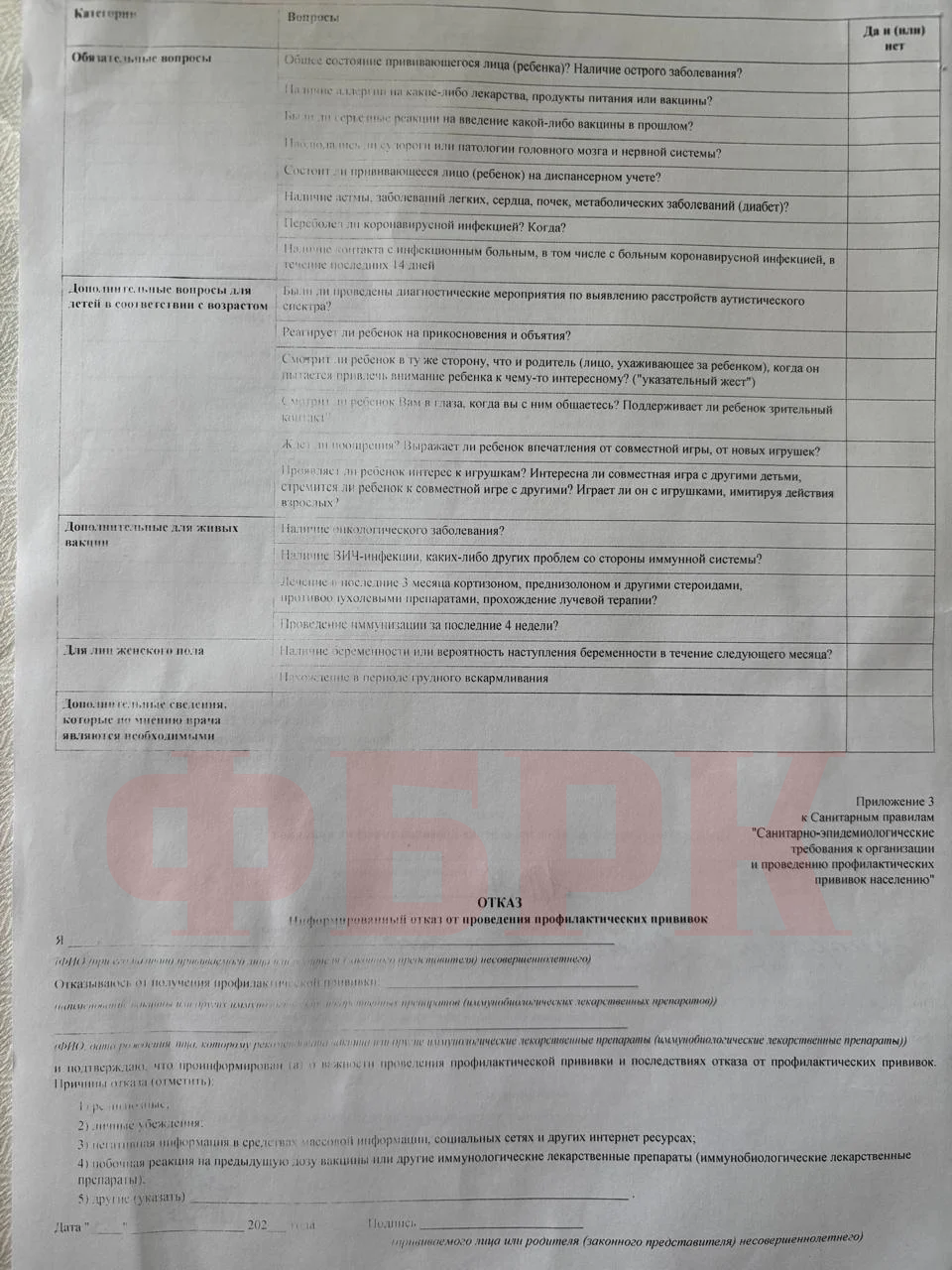
The clinic did not devise the texts of the forms. They are annexes to the Sanitary Rules "Sanitary and Epidemiological Requirements for the Organisation and Administration of Preventive Vaccinations to the Population", approved by order of the acting Minister of Health of 21 September 2023 No. 150. But how the forms are filled in and handed out is determined by the medical organisation.
A QUESTIONNAIRE FOR THE DOCTOR THAT PARENTS FILL IN
The main detail is hidden in the rules themselves. The questionnaire is called "Questionnaire for medical workers for interviewing the person being vaccinated or their parents". Paragraph 15 of the rules states directly that the interview before vaccination is conducted by a medical worker using this questionnaire. That is, a conversation is intended: the doctor asks, clarifies and decides for themselves whether an answer matters. The last line of the questionnaire is called: "Additional information which, in the doctor's opinion, is necessary".
In practice, the questionnaire goes home through the child and comes back filled in without any involvement by a medic. Wording intended to be clarified in conversation, the parent is forced to interpret alone.
WHAT QUESTIONS PARENTS ARE ASKED AND WHY THEY CANNOT ANSWER THEM HONESTLY
Most of the questions are medically justified: they are needed to identify contraindications. The problem is how they are worded for a person without medical education, who is forbidden from answering "don't know".
Questions a parent cannot know the answer to. They are required to confirm "contact with an infectious patient, including a patient with coronavirus infection, within the last 14 days". A schoolchild is among hundreds of people every day, and the word "known" contact is not in the form. At the same time, paragraph 13 of the same rules states directly: contact with an infectious patient is not a contraindication to vaccination. Parents are asked whether the child has had coronavirus and when, although many children have had it without a test. They are asked about "serious reactions" to past vaccinations given in infancy, without explaining what counts as serious.
Questions the clinic itself has the answer to. Whether the child is on the dispensary register, whether they have had vaccinations in the last 4 weeks, what reactions there were previously: this information is held in the medical record and the clinic's information system. The parent is asked to confirm in writing what the medical organisation knows better than they do.
Questions with blurred boundaries. "Presence of allergy to any medicines, food products or vaccines" does not specify whether it means a current allergy or a reaction in early childhood. "Problems on the part of the immune system" are not defined: it is unclear whether frequent colds count. In the question about treatment with "cortisone, prednisolone and other steroids", a parent may not understand whether hormonal ointments and inhalers count, and wrongly answer "no".
Questions not for this age. A separate block is devoted to signs of autism spectrum disorders: does the child respond to hugs, do they look you in the eye, do they follow a "pointing gesture", are they interested in toys. These are questions of early developmental screening for toddlers; autism is not a contraindication to vaccination. For a teenager, an honest answer of "does not play with toys" leaves a false picture in the documents. The block "for females" asks to state the "likelihood of pregnancy occurring within the next month". It is unclear from the form to whom the question is addressed: to the schoolgirl or to the mother filling in the sheet. A parent of a 15-year-old daughter is asked to assess in writing something they cannot assess.
Questions whose applicability was not explained to the parent. An entire block is headed "Additional for live vaccines", but the form does not state whether the vaccine is live. The block for children is marked "in accordance with age", but for which age is not stated.
The form of the answer. A single line often contains two to four questions and one cell. The first question, "General condition of the person being vaccinated (child)?", does not envisage a "yes" or "no" answer at all. The column is called "Yes and (or) no".
WHAT A PARENT SHOULD KNOW BEFORE SIGNING
Under Article 134 of the Code "On Public Health and the Healthcare System", medical care is provided after obtaining informed consent. Paragraph 13 of the Sanitary Rules specifies: before vaccination, a doctor or feldsher takes a history, examines the child with temperature measurement and provides the parent with information about the vaccination, possible reactions and adverse events, and also about the consequences of refusal.
By signing the form, the parent confirms that all of this was communicated to them. In fact, all the information they receive is an abbreviation written by hand. A pre-filled consent box with an empty refusal box makes the choice unequal: to consent, a signature is enough; to refuse, you must write in the name of an incomprehensible preparation yourself.
"SALAUATTY ASTANA": AUDIT, MEASLES AND FINES
Salauatty Astana LLP has been operating since 2012. According to BES.media, which reviewed a fragment of a report by the Supreme Audit Chamber (SAC), for 2022-2023 the clinic received 9.1 billion tenge from the Social Health Insurance Fund (SHIF). Auditors recorded ultrasound and medicine sales at branches without the necessary documents, a day hospital without a sanitary opinion and surgery without a post-operative ward.
There have already been complaints about how the clinic completes vaccination documents. In November 2025, the sanitary and epidemiological control authorities conducted an investigation after a child was posthumously diagnosed with "bacterial infection of an extremely severe degree" with an accompanying "measles, probable case". According to the protocol of 4 December 2025 held by the editorial team, the clinic did not report the suspected measles in a timely manner, formally monitored family contacts, did not organise vaccination of the affected children and did not carry out emergency vaccination of contacts. The inspectors also established that the parents' refusal of vaccinations had not been properly documented, and that refusals at the clinic were generally not completed on the approved form. A representative of the clinic agreed with the violations. The protocol does not establish a link between the violations and the child's death.
In August 2026, the Astana department of the Committee for Medical and Pharmaceutical Control established that a patient with type 1 diabetes and a disability was not issued consumables for an insulin pump, although they were in the clinic's pharmacy, and that in 2025 he had not had a single examination by a therapist or endocrinologist. In total, since December 2025, the clinic has paid four fines imposed by the health and sanitary-epidemiological control authorities amounting to about 9.4 million tenge, without contesting them.
FROM A SAFETY TOOL TO A SIGNATURE IN IGNORANCE
Responsibility here is divided. The content of the questionnaire is determined by the Ministry of Health: a single form for all ages and all vaccines inevitably contains questions inapplicable to a schoolchild, and even a question about contact with infectious patients, which the rules themselves do not consider a contraindication. The procedure for its use is determined by the clinic, and it is precisely this that turns a questionnaire for the doctor into a form that the parent fills in alone.
In such a scheme, the questionnaire ceases to work as protection for the child. If a parent answered "no" at random and there was a contraindication, their signature stands under incorrect information. Whether this releases the medical organisation from liability, the rules do not say. The editorial team has sent this question to the Ministry of Health.
POSSIBLE CONSEQUENCES
For children, the main risk lies in missed contraindications: a formal "no" answer replaces a conversation with the doctor. For parents, it is a signature under information they could not verify, and unequal conditions of choice between consent and refusal. For the vaccination system, a formal approach is dangerous because it gives grounds to doubt vaccinations where the complaints are in fact about paperwork.
Questions about a child's health before vaccination are needed, but they should be asked by a medic, not by a form passed on through a school backpack. Consent completed on the parent's behalf and unaccompanied by comprehensible information about the preparation is not informed. The Ministry of Health should revise the form with account for age and type of vaccine, and clinics should restore the interview to the form envisaged by the rules.
The FBRK has sent enquiries to Salauatty Astana LLP and the Ministry of Health. No response from the LLP arrived by the deadline and had not been received at the time of publication. The editorial team will follow whether the procedure for completing consents in schools changes.