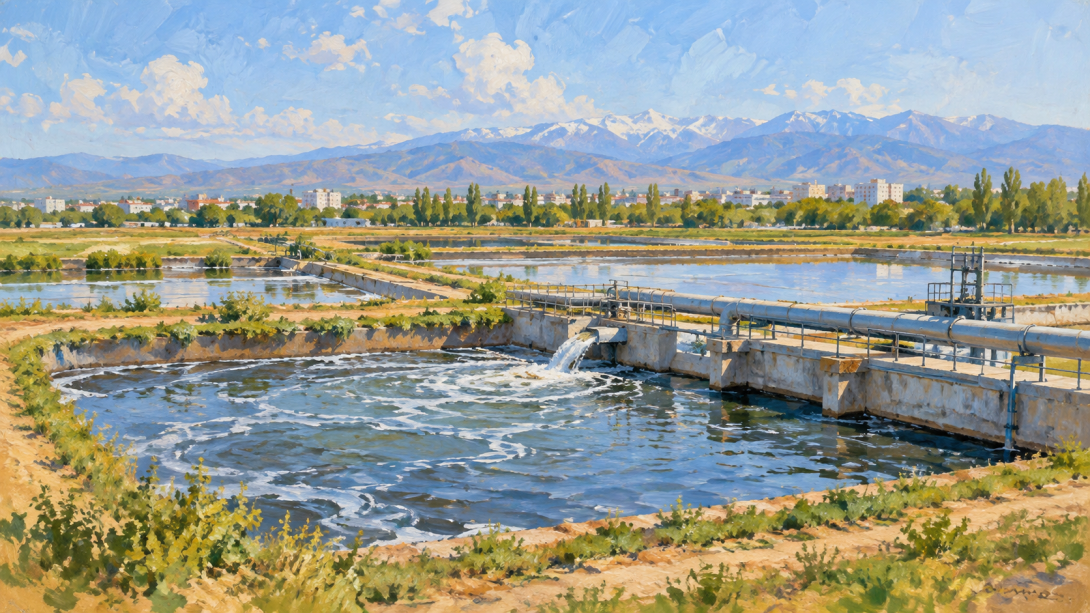
In Taraz, 217 hectares of land are occupied by sewage filtration fields that do not undergo full treatment. Some of the effluent evaporates, and some seeps into the soil, which, according to a specialist, creates a risk of groundwater contamination.
HOW THE TREATMENT SYSTEM IS STRUCTURED
According to Atameken Business, Taraz has gone 64 years without proper treatment facilities. Sewage is directed to filtration fields, where it accumulates and settles.
Over the past eight years, the akimat has dug another 20 basins. This is linked to the growth in effluent volumes after 14 villages and 16 microdistricts were annexed to the city. Taraz's population is now around 500,000 people, and approximately 80,000 cubic metres of effluent enters the sewer system daily. The networks are designed for half that volume.
Seven basins up to 4 metres deep are already completely full. The continuously incoming effluent is redirected to other areas.
WHAT RESIDENTS ARE COMPLAINING ABOUT
The filtration fields are located next to populated areas. Resident of Kostobe village Raikhan Sarsenbekova said that at night a pungent smell spreads from the effluent, because of which residents cannot sleep with their windows open.
According to her, worms have appeared in the well water. Due to the expansion of the filtration fields, residents have allegedly stopped using part of the land for sowing and grazing livestock. The problem affects residents of five villages.
WHAT SPECIALISTS WARNED ABOUT
Chief Engineer of the State Municipal Enterprise "Zhambyl-Su" Darkhan Kultasov reported that the concrete channels built back in the 1960s are deteriorating, and the pipelines need replacing. According to him, exceeding the design load on the filtration fields creates a high risk of effluent entering the Asy River.
Doctor of Technical Sciences, Professor Altai Musayev noted that only mechanical treatment takes place at the site. After that, some of the water evaporates, and the remaining water seeps into the ground. He linked this process to contaminants entering groundwater.
The problem had already affected natural water bodies before. About 50 years ago, the collapse of the filtration fields' dam led to contamination of Lake Bilikol, after which fishing there was banned. According to a hydrologist, even five years ago, sewage continued to flow into the irrigation canal.
THE TREATMENT FACILITY PROJECT HAS PASSED EXPERTISE
Over the past 20 years, documentation for the construction of treatment facilities has been developed four times. According to the akimat, the current project, worth 47.6 billion tenge, has passed expertise and is 85% ready.
The project envisages the construction of a complex on 40 hectares. Construction is planned to begin in 2027 and be completed within two years.
Akims of Taraz Bakytzhan Orynbekov called the project a modern complex with three-stage treatment: the treated water could be used by industrial enterprises and agriculture.
ANOTHER SITE REMAINS CONTAMINATED
On another outskirts of Taraz, there is another large sewage field where two enterprises discharge effluent. It is separately reported that there are plans to create a green zone on this territory.
At the same time, according to the estimate given, restoring the land and underground water sources will take at least 25 years. The total area around the city that needs to be cleaned of effluent is more than 330 hectares.
CONTEXT
The issue of building proper treatment facilities for Taraz has already been raised at the level of state audit. In 2025, the Supreme Audit Chamber (SAC) reported on the results of an audit of the effectiveness of the use of budget funds and state assets in Zhambyl Region.
Auditors found that the regional development programme for 2021–2025 did not contain key measures and targets for a number of pressing problems. Among them, the SAC specifically noted the absence of treatment facilities in Taraz.