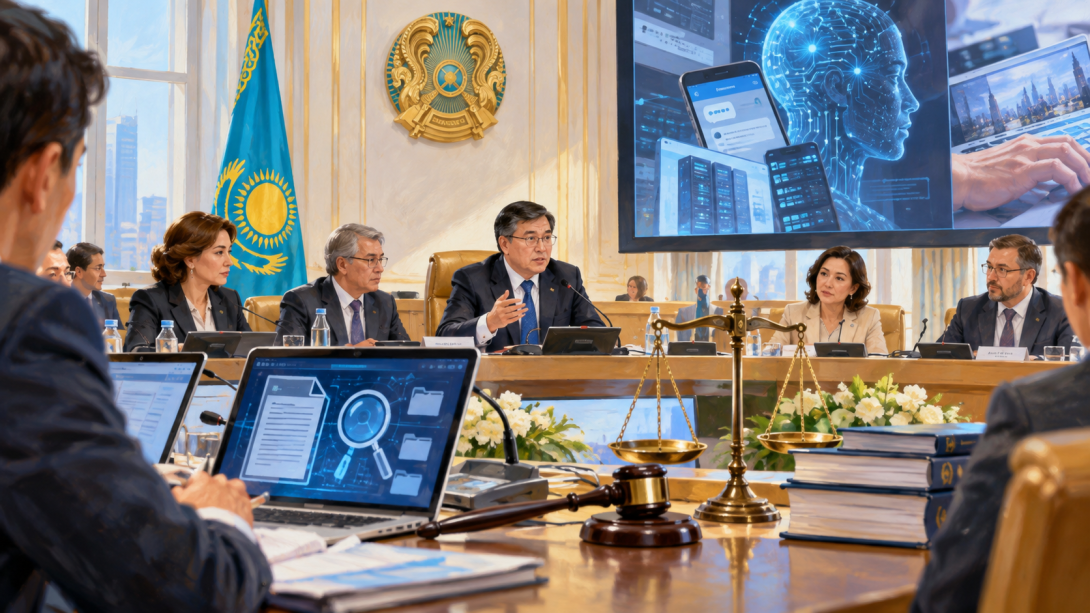
The Supreme Court discussed criteria for assessing electronic evidence, including screenshots, messenger correspondence and content created by artificial intelligence (AI). Following an international round table, the participants prepared recommendations on improving procedural rules and forming a uniform judicial practice.
WHY THE NEED FOR NEW STANDARDS AROSE
The international round table was chaired by the Chairman of the Judicial Collegium for Civil Cases, Nurserik Sharipov. The event was attended by representatives of judicial bodies, lawyers, notaries and international experts from Kazakhstan and other countries.
According to Nurserik Sharipov, digital traces feature in more than 80% of court disputes. In this connection, he stressed the need to enshrine in procedural legislation the criteria for the admissibility of electronic evidence.
WHAT RISKS WERE IDENTIFIED IN ASSESSING DIGITAL MATERIALS
Supreme Court Judge Yelena Maksyuta drew attention to several problems arising from the use of electronic evidence. Among them are the assessment of one-sided screenshots, the recording of rapidly deleted messages in messengers and difficulties in challenging notarial protocols.
The participants separately discussed errors by notaries that could lead to the annulment of judicial acts. This was described by local court judges Zhanar Zhailebayeva and Aigul Tagazhayeva.
HOW NOTARIAL RECORDING AND EXPERT EXAMINATION WERE DISTINGUISHED
Nurserik Sharipov stressed that a notarial protocol confirms the existence of information, for example the content of a web page or correspondence, but does not in itself establish its authenticity.
To identify signs of manipulation or falsification of metadata, a full technical expert examination is required. The head of the judicial collegium also noted that courts need to verify the origin of digital materials and not rely solely on screenshots.
WHAT INTERNATIONAL EXPERIENCE WAS REVIEWED
Judges from Azerbaijan, Uzbekistan, Germany and Kyrgyzstan, as well as a notary from Belarus, presented the practice of certifying electronic evidence in their countries.
The participants also examined the legal specifics of the operation of crypto exchanges and approaches to assessing content created by AI. Recommendations on the latter issue were presented by Professor Seul Hon of Maqsut Narikbayev University.
WHAT SOLUTIONS WERE PROPOSED FOLLOWING THE MEETING
Following the round table, the participants prepared recommendations that will become the basis for the development of procedural rules and the formation of a uniform judicial practice.