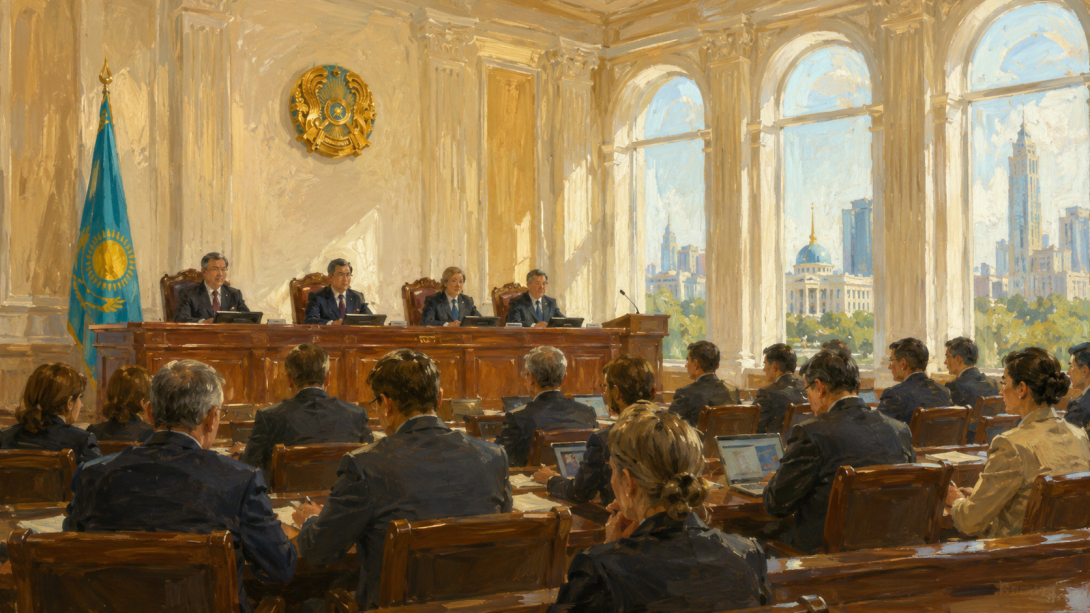
The Supreme Court of Kazakhstan has summarised the results of the administration of justice for the first half of 2026. At an expanded meeting, indicators of court performance, changes in judicial practice, the results of constitutional reforms and tasks for the near future were discussed.
WHO TOOK PART IN THE MEETING
The expanded meeting was chaired by Aslambek Mergaliyev. The discussion was attended by the Deputy Head of the Presidential Administration, Yerzhan Zhienbayev, the Chairman of the Supreme Judicial Council, Dmitry Malakhov, the leadership of the boards of the Supreme Court, the Judicial Administration, cassation, regional and equivalent courts, as well as judges from across the country via video conferencing.
HOW COURT PERFORMANCE INDICATORS CHANGED
In the first half of 2026, the country's courts received over 1 million cases and materials, which is 13.7% more compared to the same period in 2025.
In civil proceedings, the number of incoming cases increased by 73%. The number of completed cases grew by 24.7% — from 304,000 to 380,000, and the number of decisions issued was 206,000 compared to 173,000 for the same period last year. Furthermore, 47.6% of cases eligible for mediation ended in a settlement between the parties.
In criminal proceedings, the number of incoming cases decreased by 1.9% — from 17,500 to 17,200, and the number of convicted persons fell by 3.1% — from 15,700 to 15,200. It is noted that this is linked to a 13.3% reduction in crime.
Following amendments to the Criminal Code of Kazakhstan, the number of cases heard with the participation of jurors halved — from 130 to 68. Meanwhile, the share of penalties in the form of fines and community service increased to 22.9% compared to 21.8% a year earlier.
It was also reported that the approval rate for motions to authorise pre-trial detention decreased from 63.4% to 60.1%.
WHAT WAS REPORTED ABOUT THE JUDICIAL SYSTEM
Aslambek Mergaliyev highlighted the significance of constitutional reforms, which, in his words, strengthened the independence of the court, guarantees for the protection of citizens' rights, and created the foundation for further modernisation of the judicial system.
The Chairman of the Supreme Court also announced that, since 1 July 2025, 21 regulatory rulings have been updated, and methodological support is being provided to courts to ensure uniformity in judicial practice.
According to him, the demand for the new cassation instance is confirmed by the increase in the number of appeals: from 9,700 in the first half of 2025 to 16,200 in the second half of 2025. In the first half of 2026, the cassation courts received 11,600 appeals. At the same time, the number of returned complaints decreased from 6,700 to 5,000.
WHAT DATA WAS PROVIDED ON ADMINISTRATIVE CASES AND TRUST IN COURTS
The number of cases of administrative offences decreased by 6.2% — from 211,800 to 198,800. The Supreme Court attributes this to the decriminalisation of certain offences and the application of the European Accident Statement in cases of traffic violations on the court's initiative.
The number of administrative claims increased by 14% — from 17,100 to 19,500. This growth is linked to increased public trust in administrative justice due to rulings in their favour. The rate of satisfaction for administrative claims, excluding private bailiffs, stood at 59%, and 54.2% of disputes were resolved in favour of businesses. The number of investment disputes rose by 15.5%.
Results from a study by the Bureau of National Statistics were also presented, showing that the level of full public trust in the judiciary reached 63.2% compared to 55.2% in 2023.
WHAT INSTRUCTIONS DID THE CHAIRMAN OF THE SUPREME COURT GIVE
Summing up the meeting, Aslambek Mergaliyev instructed to ensure the uniform application of new constitutional norms, the prompt, objective and impartial consideration of disputes, including those related to elections to the Kurultai, as well as to maintain a balance between the rights of property owners and the social guarantees of citizens.
It was separately noted that the criminal amnesty, adopted in connection with the new Constitution, will affect 15,000 people, and the administrative amnesty will affect around 1 million fines.