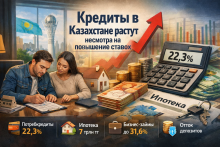
More than 70% of Kazakhstanis have credits or loans, and almost half of borrowers spend over half of their monthly income on repayments. A survey of the country's residents on the issue of over-indebtedness also revealed that consumer loans and instalment plans remain the most common financial obligations, and there were more supporters of tightening lending conditions than opponents.
WHAT THE SURVEY SHOWED
According to DEMOSCOPE, 1,100 people from 17 regions and cities of republican significance — Astana, Almaty and Shymkent — took part in the study. The survey was conducted using telephone interviews among citizens over 18 years old.
The results of the study showed that loan obligations are widespread among the population. 72.7% of respondents have credits or loans. Of these, 39.7% have one active credit or loan, and a further 33% have several. 27% of study participants remain without loan obligations.
Among respondents over 60 years old, 32.8% of those surveyed have one active credit or loan. At the same time, 49.6% of representatives of this age group reported having no credits or loans.
WHAT TYPES OF LOANS ARE MOST COMMON
The most common financial product turned out to be a consumer loan. It is used by 70.4% of borrowers. 45.7% of survey participants have an instalment plan.
Other types of loans, including funds obtained from relatives, friends or pawn shops, are held by 22.1% of respondents. Car loans are used by 14.4%, and mortgage loans by 13% of those surveyed.
Furthermore, the study showed a high debt burden among borrowers. 46.7% of respondents spend more than half of their monthly income on servicing credits.
Another 24.5% spend between a quarter and half of their income on payments, while 20.3% allocate less than 25% of their monthly income to debt repayment.
WHY KAZAKHSTANIS TAKE OUT CREDITS
Most often, respondents took out credits to buy household appliances — this option was chosen by 24.2% of survey participants. Loans for home repairs or construction were taken out by 18.9%, and due to a shortage of funds before payday — by 17.4%.
Credits were also used to purchase a car (13.7%), repay other loans (9.4%), pay for medical treatment (8.2%), develop a business (7.8%), host large family events (6.7%), and pay for education (6.6%).
HOW STUDY PARTICIPANTS ASSESS THEIR FINANCIAL SITUATION
39.1% of respondents are completely confident in their own financial well-being over the next 12 months. Another 24.2% stated that they are rather confident in their financial future.
At the same time, 16.2% of respondents reported that they are rather not confident in their financial stability, and 13.9% stated they are completely uncertain.
48.3% of respondents rated their level of financial literacy as good or rather good. 36.8% noted an average level, and 12.7% of survey participants rated it as poor or very poor.
HOW KAZAKHSTANIS VIEW THE TIGHTENING OF LENDING
According to the study, support for tightening the conditions for issuing consumer loans from 1 July 2026 was expressed by 52.5% of respondents. Of these, 31.1% fully support such measures, and 21.4% rather support them.
At the same time, 13.8% of survey participants rather do not support the changes, 23.7% are categorically against them, and 10% found it difficult to answer.