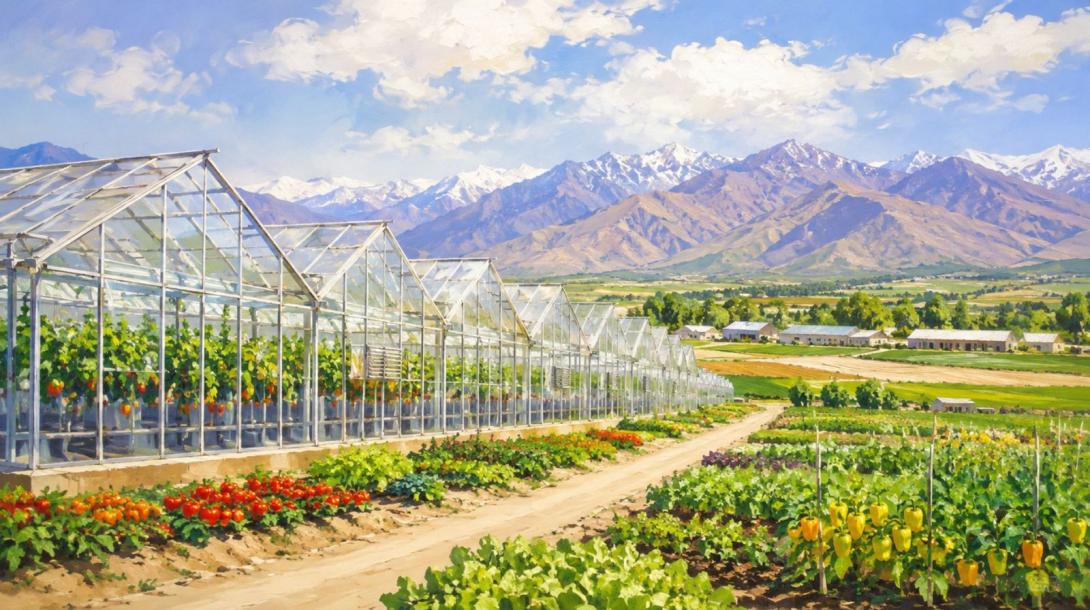
In the Turkestan region, three major investment projects are being implemented to build modern industrial greenhouse complexes with a total cost of 534.2 billion tenge. Once these facilities are operational, it is forecast that the production of greenhouse products in the region will increase by 102,000 tonnes per year, and 1,225 permanent jobs will be created.
WHICH PROJECTS ARE BEING IMPLEMENTED
According to the Ministry of Agriculture (MoA), three modern industrial greenhouse complexes are under construction in the region, with a total cost of 534.2 billion tenge. It is expected that their launch will fully meet the demand for fresh vegetables during the off-season period.
Once these facilities are operational, the volume of greenhouse product output is expected to increase by 102,000 tonnes per year. It is also planned to create 1,225 permanent jobs.
WHAT ARE THE REGION'S INDICATORS
The report notes that the Turkestan region remains Kazakhstan's leader in the development of greenhouse farming. The area of protected ground is 1,006.7 hectares, which corresponds to 72% of the national total.
In 2025, the region's greenhouse complexes produced over 113,000 tonnes of vegetables, providing 45% of the domestic market's needs during the off-season. In the first four months of 2026, farmers had already harvested 38,200 tonnes of greenhouse-grown produce.
WHICH CROPS ARE BEING GROWN
In addition to traditional vegetables, the region's greenhouse farms are expanding their product range and introducing modern technologies. By the end of 2025, 13,000 tonnes of strawberries, 3,200 tonnes of lemons, and 550 tonnes of bananas were grown in protected ground.
The MoA reported that it continues to implement measures to develop the greenhouse industry, support domestic agricultural producers, attract investment in the agro-industrial complex, and introduce modern water-saving technologies.
CONTEXT AND SIGNIFICANCE
Against the backdrop of large-scale projects in the agricultural sector, water supply issues remain one of the key topics for the Turkestan region.
Specifically, a pilot project for artificial rainmaking is being implemented in the region, with the stated aim of replenishing reservoirs and providing water for agricultural areas.
At the same time, the project has previously sparked public debate. Farmers from the Zhetysay and Maktaaral districts linked crop losses following prolonged May rains to its implementation. The akimat of the Turkestan region stated that the precipitation was caused by natural atmospheric processes, while project representatives reported that the technology is used in a limited area and did not link it to the rains in the southern districts of the region.