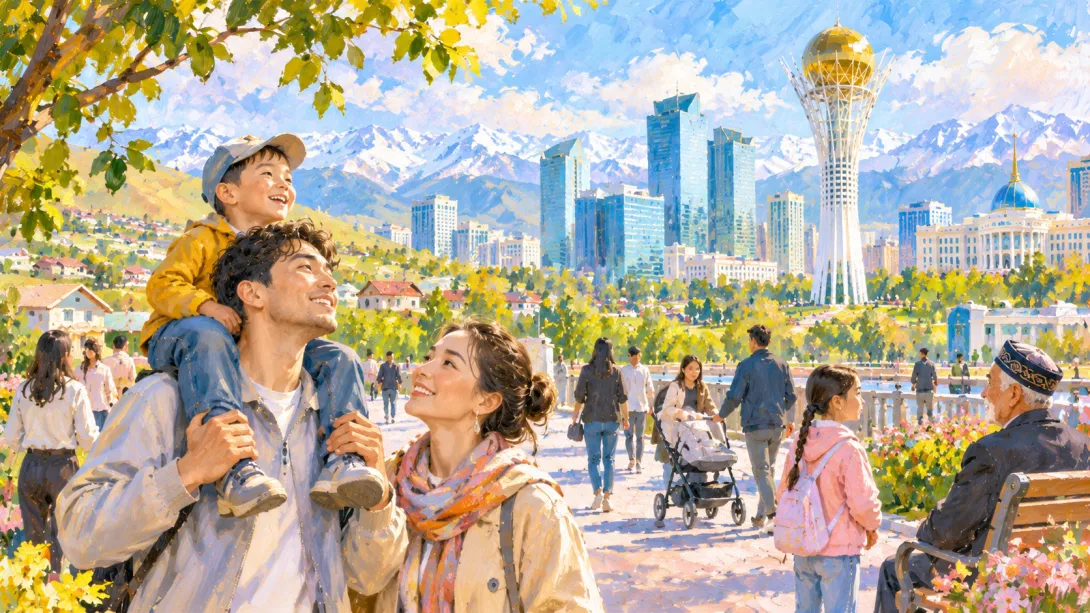
By 1 October 2026 the population of Kazakhstan had reached 20.6 million people. Since the start of the year, the number of urban residents has increased by 169,000, while the rural population has decreased by 35,300. As a result, the overall increase amounted to 133,700 people. Behind the overall positive trend lies a notable redistribution of the population: cities are growing, while rural areas are losing residents.
WHY URBAN GROWTH TURNED OUT TO BE GREATER THAN THE OVERALL INCREASE
According to data from the Bureau of National Statistics, over the first nine months of 2026 the country's population increased from 20.5 million to 20.6 million people, or by 0.65%.
At the same time, the urban population grew from 13 million to 13.2 million people (+1.29%), while the rural population declined from 7.4 million to 7.38 million (-0.48%). It follows that the growth of the urban population exceeded the overall growth for the country: the decline in the number of rural residents partially offset the increase in the number of urban dwellers.
Migration plays an important role in this dynamic. Over January–September the natural increase of Kazakhstan's population amounted to 128,300 people, while the positive net migration was only 5,400. However, behind the overall figure lies a substantial difference: in urban areas net migration stood at +90,300, while in rural areas it was minus 84,900 people.
HOW ASTANA ACCOUNTED FOR HALF OF THE POPULATION GROWTH
The most noticeable growth was recorded in the capital. Since the start of 2026, the population of Astana has increased by 67,974 people and reached 1.7 million. This is around 51% of Kazakhstan's total population growth.
The main part of the increase is linked to migration: its positive net balance amounted to 52,741 people, while natural increase was 15,233.
In second place is Almaty, where the population grew by 44,002 people, to 2.39 million. Here net migration amounted to 30,567 people, and natural increase to 13,435.
In Shymkent the population increased by 26,693 people, reaching 1.32 million. Unlike the two largest cities, here the main contribution came from natural increase — 15,457 people against 11,236 from net migration.
Thus, the country's three largest cities together added almost 139,000 residents — more than the total population growth of Kazakhstan over the same period.
WHICH REGIONS ARE LOSING POPULATION
Among the regions, the most noticeable decline was recorded in Turkistan Region — minus 7,796 people. At the same time, the region retains the highest natural increase among the regions — 24,224 people. However, the negative net migration amounted to 32,020 people, meaning that migration loss exceeded the natural gain.
In Zhambyl Region the population decreased by 6,082 people, in Abai Region — by 5,560, in Zhetisu Region — by 5,541. Declines were also observed in Karaganda, Kostanay, Pavlodar, North Kazakhstan and East Kazakhstan Regions.
At the same time, there are regions with positive dynamics. In Almaty Region the population increased by 21,890 people, in Akmola Region — by 6,637, in Aktobe Region — by 3,214. Positive growth was also recorded in Atyrau and Mangystau Regions.
WHAT THE DEMOGRAPHIC PICTURE SHOWS
The statistics for the nine months of 2026 show that the increase in Kazakhstan's population is accompanied by a pronounced concentration of growth in large cities. The role of migration is particularly noticeable in Astana and Almaty, while in certain regions even a high natural increase does not make it possible to offset migration loss.