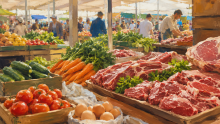
In summer, vegetables and fruit in Kazakhstan traditionally get cheaper, but this barely affects overall inflation: it has remained at a double-digit level for months now. The reason is not the harvest, but the prices of medicines, services and utilities, which are rising noticeably faster than average.
WHY THE SEASONAL FALL IN PRICES DOES NOT HELP
According to the latest report from the Bureau of National Statistics, over the year (July 2026 compared with July 2025) cucumbers fell by 31.6%, tomatoes by 26.5%, and beetroot by 23%. But their share of the household budget is small, so this has little effect on the overall index: it rose by 10.2%. Core inflation (excluding fruit, vegetables, petrol and coal) turned out to be even higher, at 11.3% over the year. Without seasonal discounts, prices in the country are rising even faster.
MEDICINES ARE GETTING MORE EXPENSIVE FASTEST OF ALL
The biggest price rise of all was in healthcare – up 14.6% over the year. Some individual products have multiplied in price: activated charcoal – up 71.7%, acetylsalicylic acid – up 73.7%, No-Spa – up 55.8%. Healthcare contributed 0.59 percentage points to overall price growth, which is quite a lot for a category with a small share of household spending. Next come recreation and culture (+16.6%) and personal care (+14.7%).
PRICES ARE RISING UNEVENLY ACROSS THE REGIONS
Prices rose fastest over the year in North Kazakhstan Region (+12.8%), in the Ulytau Region (+12.7%) and in Zhetysu (+12.6%). The slowest rises were in Almaty (+9%) and Astana (+9.8%). It seems that in the big cities, competition among sellers is holding back price growth.
The difference in prices is also noticeable on shop shelves. A loaf of wheat bread in July cost on average 230 tenge across the country, but in Almaty it was 308 tenge, while in Oral the price was 185 tenge. A similar spread is seen for sugar, grains and meat. A kilogram of granulated sugar costs from 388 tenge in Taraz to 514 tenge in Oskemen, buckwheat – from 327 tenge in Konayev to 539 tenge in Shymkent, and a kilogram of beef on the bone – from 3,402 tenge in Aktobe to 4,150 tenge in Almaty.
WHAT THIS MEANS
The figures speak for themselves. With official inflation at 10.2%, core inflation is already reaching 11.3%, and it is precisely this gap that deserves close attention. The core measure does not include what was pulling the overall figure down – the seasonal fall in prices of vegetables and fruit. Since, without these, price growth is even higher, 10.2% is not the peak but a smoothed picture. As soon as the harvest season ends and vegetables begin to get more expensive towards winter, the overall index will most likely catch up with core inflation, rather than the other way round.
Just as important is where the growth is concentrated. Healthcare (+14.6%) and recreation and culture (+16.6%) are getting more expensive almost twice as fast as food (+10.1%). These are categories that are hard to replace or cut back on: you cannot buy medicines more cheaply at the shop next door, and you cannot forgo treatment if you need it. The result is that inflation hits hardest not the things you can trim from your budget, but the things you most often have to buy anyway.
Finally, the regional spread shows that the overall national figure conceals significant inequality. In some regions, the purchasing power of money is falling almost a third faster than in others.