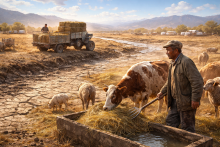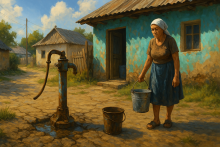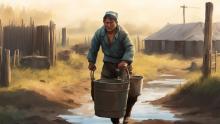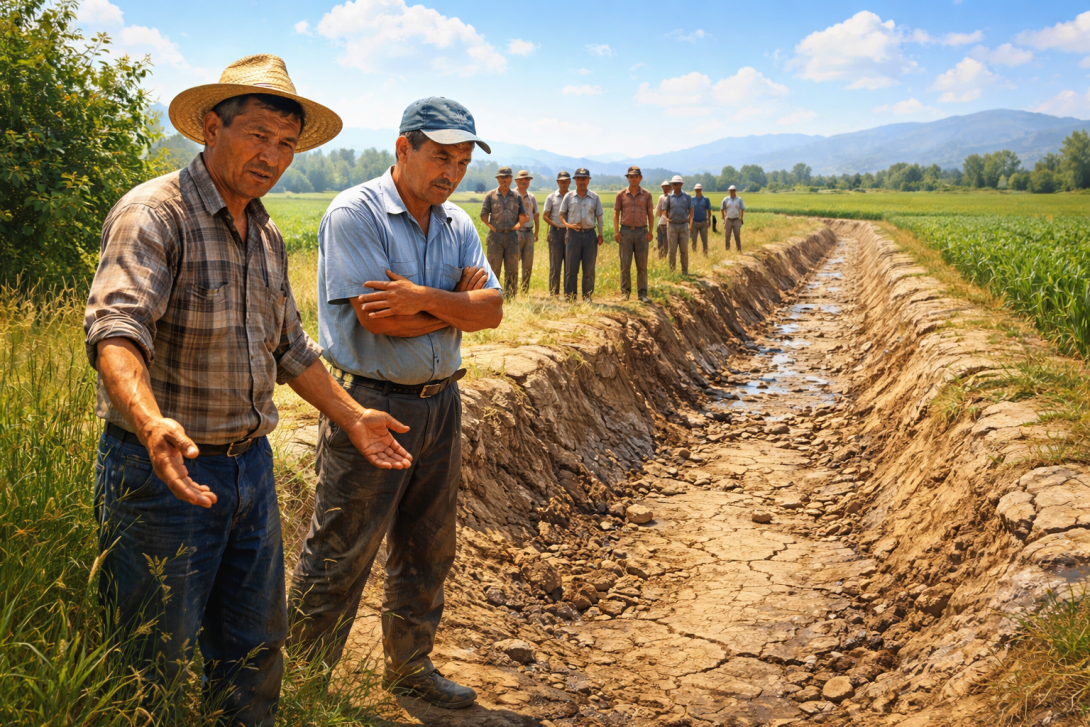
Peasants from the Stepnoye rural district of the Korday district in the Zhambyl region have been left without irrigation water on the eve of the sowing season, despite prepared fields and purchased seeds, jeopardising agricultural work and the future harvest.
WHAT HAPPENED
According to the KTK TV channel, employees of the RSE «Kazvodkhoz» refused to sign a contract for the supply of water via the «Right Branch» canal with the district's farmers. Representatives of the peasant farms (PFs) claim they received no explanation for the refusal and could not secure negotiations.
A representative from the PF «Voskhod» Nikolai Cherpak stated that farmers had prepared for the season in advance: they purchased seeds, treated the land, and acquired equipment on lease. However, the lack of water has jeopardised the entire sowing cycle.
WHAT THE AUTHORITIES SUGGEST
After the farmers' appeals, officials proposed switching to less water-intensive crops. However, according to the farmers, changing the crop structure is no longer possible as the season has already begun.
A representative from the PF «Ruslan» Bakhtiyar Musayev noted that the window for revising the sowing campaign has passed, and further actions remain uncertain.
WHY THE WATER SHORTAGE OCCURRED
The Zhambyl region is approximately 80% dependent on water resources flowing from neighbouring Kyrgyzstan. As explained by the Zhambyl branch of the RSE «Kazvodkhoz», a water deficit is expected this year.
Deputy director of the branch Bagdat Beisenkulov reported that restrictions could affect around 1,000 peasant farms in the region, including those in the Baizak, Talas and Zhambyl districts. In the Korday district, some farmers may gain access to water via alternative canals, but not all have this option.
HOW MUCH WATER IS LACKING
According to preliminary data, the Orto-Tokoy reservoir in Kyrgyzstan has accumulated approximately 100 million cubic metres less water than a year earlier. The total volume of resources to be distributed is about 350 million cubic metres.
Water services note that existing reserves are insufficient to support all agricultural land, especially those located further from water supply sources.
WHAT CONSEQUENCES ARE EXPECTED
Farmers traditionally grow corn and alfalfa, which require regular irrigation. Under water deficit conditions, the harvest of these crops is threatened. Meanwhile, the farmers themselves point out that in previous years they managed to obtain water despite difficulties.
The materials also indicate that the water shortage could affect the food situation, though specific consequences are not detailed.
CONTEXT AND SIGNIFICANCE
The water supply problem in the Zhambyl region recurs annually. According to water services, new reservoirs could partially alleviate the situation, but their construction is still in its early stages.