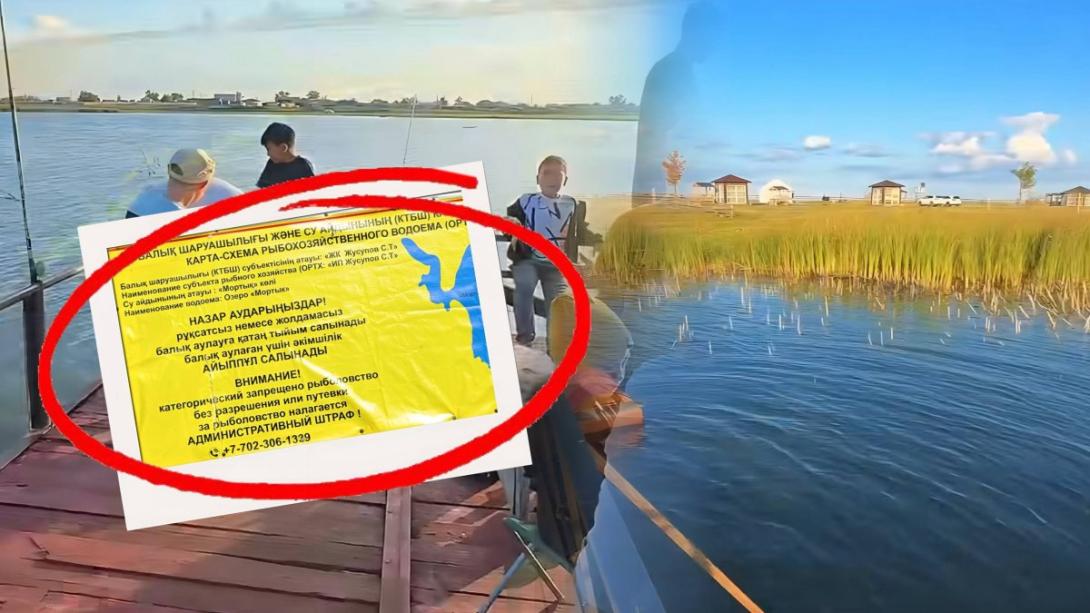
Residents of the village of Mortyk in the Tselinograd district of the Akmola region claim they have lost access to the only lake in the area after it became private property. According to the villagers, the new owner has started charging for fishing and hiring gazebos, and attempts to reach the water for free result in fines.
According to Ulysmedia.kz, residents state that the lake, located approximately 60–70 metres from the village, had long served as the only source of water for gardens and livestock, as well as a spot for recreational fishing. Fish had always been plentiful there, and villagers freely caught them for their own needs. After the arrival of a private owner, access was blocked.
Posts on social media are circulating offering to pay 3,000–4,000 tenge for 12-hour fishing, with rods and hooks provided, as well as gazebo hire costing between 15,000 and 40,000 tenge per day. The lake is located roughly 70 kilometres from Astana.
Lawyer Talgat Kusdauletov, who represents the residents' interests, claims that the auction for leasing the lake for 49 years was based on a scientific survey report that raises questions.
The document states that the survey was carried out by the V. I. Vernadsky Ecological Foundation, Astana-Finance Group LLP, and three village residents — G.M. Mekhnova, R.S. Karabchuk, and Ye.Y. Borisov. However, according to the lawyer, the villagers themselves stated in notarised explanations that they had not conducted any research and only had secondary education.
Kusdauletov notes that under the law, scientific surveys of water bodies can only be carried out by organisations with accredited laboratories and a team of specialists — ichthyologists, hydrobiologists, ecologists, and hydrochemists.
Meanwhile, it is noted that the Committee for Science and Education officially clarified that the Vernadsky Foundation was accredited to participate in grant programmes, but not to conduct scientific research on water bodies.
Astana-Finance Group LLP, according to open sources, is engaged in security activities and has no connection to science.
The lawyer stated that he requested the full set of documents from the court to confirm the legality of the survey. According to him, the court granted the request, but the defendants did not submit a single document.
Residents have appealed to various authorities, including regional administrations and ministries. As Kusdauletov claims, the Minister of Ecology, Yerlan Nysanbayev, promised to look into the matter, but no significant results have been seen so far.
Representatives of the regional administration and the Department of Natural Resources stated at a meeting that they saw no violations. The prosecutor's office also stated that the villagers' claim should be rejected.
The villagers and their lawyer believe the dispute over the lake has an economic motive. It is noted that, by order of the Minister of Ecology, the state compensates between 30% and 50% of costs for entrepreneurs engaged in fish farming: from feed and fish stocking material to equipment and maintenance of breeding stock.
According to the lawyer, the entrepreneur has not yet received subsidies due to legal disputes but may receive them after the proceedings conclude. Meanwhile, verifying the actual stocking of the lake is difficult.
"How can you prove they stocked the lake? That's a very significant, painful question that I think carries a risk of corruption," says Kusdauletov.
For his part, the lake's owner, Serik Zhusupov, stated that "the cost of the lake was 30,000 or 70,000 tenge" and spoke of investors' plans to invest around 300 million tenge in a fish farm.
"We wanted to farm trout. But people started lobbying for their own interests; there are local peasants who are stirring things up, collecting money from residents, hiring lawyers, and trying in every way to ruin my business," said Serik Zhusupov.
According to Zhusupov, investors from Novosibirsk abandoned the project after threats, including statements about potential car arson.