On 24 November 2026, the United States Agency for International Development (USAID) published around 250 internal documents on countering disinformation. Kazakhstan is mentioned in a memo for the agency's then head, Samantha Power, written after the January 2022 events. On social media the archive is already being presented as an "exposé" of Kazakh grant recipients, although it contains no names. The documents do, however, show what the US spent money on in the region's media, and for what purpose. They also examine how Russian TV accused USAID of organising the unrest.
WHAT USAID PUBLISHED
A section called USAID Files has appeared on the usaid.gov homepage. According to a count by the American publication The Boston Report, it contains 248 files: memos, letters, chats and briefings. Most concern the agency's contacts with Meta, YouTube and Google. USAID's current leadership explains the publication by saying that previous administrations used the agency for a "radical agenda".
The FBRK editorial team examined the key document for Kazakhstan in the original. It is a package of briefings for Power dated 22 February 2022 on Ethiopia, Nepal, Ukraine and Central Asia. The section on our region is a memo dated 7 February 2022 marked "For Official Use Only" (FOUO). It was prepared by Karen Freeman, then acting assistant administrator for Asia at USAID.

HOW MUCH USAID SPENT ON MEDIA IN KAZAKHSTAN
The memo states that by April 2021 USAID had allocated around $3.9 million to counter disinformation in four countries at once: Kazakhstan, Kyrgyzstan, Tajikistan and Uzbekistan. The money went on media literacy, fact-checking, countering trolls and training journalists. The document gives no breakdown by country. It also states that Kazakhstan and Uzbekistan are "requesting assistance" in developing media literacy and journalism. It does not specify who exactly made the request, governments or organisations.
The main programme in Kazakhstan was the Central Asia Media Program (MediaCAMP). It was run by the American organisation Internews from 1 October 2018 to 30 September 2023, with a budget of $15 million. In the appendix to the memo, this sum appears under the subheading "Kazakhstan", so it has already been dubbed "Kazakhstan's". However, the same document states plainly that the programme covered three countries: Kazakhstan, Tajikistan and Uzbekistan. The documents do not disclose how much of the $15 million went to Kazakhstan. Nor is it explained how this sum relates to the $3.9 million.
MediaCAMP provided money and advice to independent media outlets and authors who produced material in Kazakh and Russian. USAID described this content as a counterweight to fakes, rumours and clickbait. According to Internews's own data, over the course of its work the programme trained 3,375 specialists and supported 673 projects in the three countries. As part of MediaCAMP, in 2020 a media literacy quiz, "Media-City", was also held for students in Kazakhstan and Uzbekistan.
WHAT USAID WROTE ABOUT "THE KANTAR"
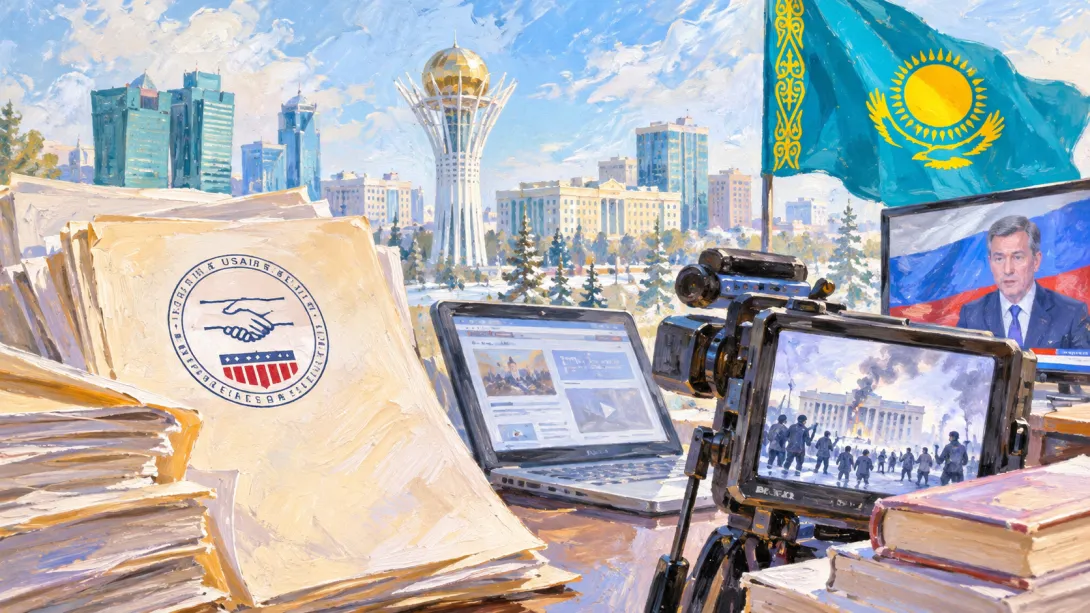
The memo was prompted by the January events. According to USAID, after them a number of Russian-language media outlets spread the claim that the US was involved in the unrest. The main example cited is a report by the state television channel "Rossiya-24", presented as an investigative piece of journalism.
It claimed that USAID had directed the protests and "bribed loyal Kazakhs". Supposedly this was how a force was created and, at the right moment, directed towards violence, including terrorist attacks. The broadcast showed the name and contact details of an American USAID employee in Kazakhstan, as well as the contact details of the director of the agency's mission in Kyrgyzstan. There was also a claim that, under the cover of humanitarian aid, USAID gathers information for the CIA.
USAID called the report "pure disinformation" that puts employees at risk. The agency's leadership was due to discuss staff security with the regional mission on 14 February 2022.
After "Qantar", MediaCAMP planned to produce more material on combating disinformation. Assistance to vulnerable journalists (equipment, security training) was still only under discussion. From October 2023, the agency was planning a new regional programme: fact-checking organisations, work with bloggers and grants for journalistic investigations.
Reaction to the current publication also came from Moscow: the head of the Russian Direct Investment Fund (RDIF), Kirill Dmitriev, wrote that "USAID is atoning for its guilt".
WHAT THE INVESTIGATION IN KAZAKHSTAN ESTABLISHED
The version about the "hand of Washington" during "Qantar" was heard not only on Russian TV. The Ministry of Foreign Affairs (MFA) of Russia called the events an attempt "inspired from outside", and Russia's ambassador to the United States, Anatoly Antonov, a new attempt at a "colour" revolution. According to calculations by American researchers from the Alliance for Securing Democracy, over six days accounts of Russian diplomats and state media wrote 3,210 tweets about Kazakhstan, promoting the thesis of external interference. White House Press Secretary Jen Psaki called such statements "crazy" and "absolutely false".
The Kazakh investigation reached different conclusions. The investigation named the former chairman of the National Security Committee (KNB) of Kazakhstan, Karim Massimov, as the main organiser of the events. The court found him guilty of high treason and an attempted seizure of power and sentenced him to 18 years in prison.
WHAT THE USAID ARCHIVE PROVES AND WHAT IT DOES NOT
In Kazakh social media, the archive is already being presented as proof that “public figures” received grants for “dubious operations”. Economist Olzhas Khudaibergenov stated that the materials could be of interest to foreign intelligence services, and that those who abused the grants should answer for it. The memo on Central Asia does not name a single Kazakh grant recipient, journalist or activist, only programmes and sums.
But that does not mean there were no recipients. MediaCAMP, by its very design, distributed grants to local media outlets and authors, while the register of the State Revenue Committee (SRC) recorded the recipients of foreign money by name.
The figures do not add up to a dramatic picture either. In February 2025, the White House stated that $4.5 million had been allocated to counter disinformation in Kazakhstan. The published documents give different sums and do not make it possible to verify how much money went specifically to Kazakhstan.
The memo itself is written from the donor's perspective on the region. According to USAID's assessment, Channel One is consistently among the most watched in the region, and local newsrooms take news from Sputnik and RT because it is free and in a language they understand. One of the agency's responses was to pay for free licences and translations from Western agencies such as AP. China is mentioned separately: the official newspaper of the Chinese Communist Party, Renmin Ribao, is now also published in Kazakh.
Most importantly, the memo states its objectives: the media programmes were not merely support for journalism. “Offering alternatives to the Russian media narrative in Central Asia”, as the document says, is included among the priorities of the implementation plan for the US Strategy for Central Asia for 2019-2025, approved by the US National Security Council. Among the tasks listed there are growth in the share of local independent media and “demonstrating alternative narratives about the United States”. In other words, the money for Kazakh media was part of US foreign policy, and the donor itself did not hide this.
The memo also contains an example that directly bears on the dispute about “censorship”. In neighbouring Kyrgyzstan, USAID trained “cyber activists” from among journalists to compile lists of suspicious accounts and report them to social networks. The document presents this as a success: “hundreds” of troll accounts were deactivated. The memo does not say who decided, and by what criteria, that an account belonged to a troll.
WHAT THIS MEANS FOR NGOs AND THE MEDIA IN KAZAKHSTAN
In USAID’s assessment, governments in the region use the fear of a “colour revolution” as a pretext to tighten laws on NGOs and scrutinise their funding.
After USAID was wound down in 2025, a proposal was made in the Mazhilis to adopt a foreign agents law. MP Irina Smirnova claimed that around 200 NGOs receive foreign funding, and that 70% of it comes from American sources. MP Magerram Magerramov also took up the issue. In a request to Minister of Culture and Information Aida Balayeva, he demanded full transparency on foreign funding of NGOs and the media, citing the “register of foreign agents”.
CONCLUSION
The USAID archive does not corroborate the Russian TV version that the American agency organised “Qantar”. But nor does it dispel questions about the programmes themselves. The documents show that media projects in Kazakhstan were part of the US foreign policy strategy. The donor has now disclosed its aims, but who exactly received the money, and for which projects, still has to be pieced together bit by bit.