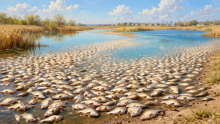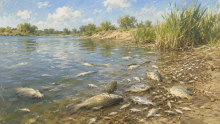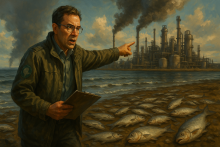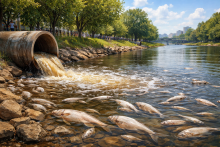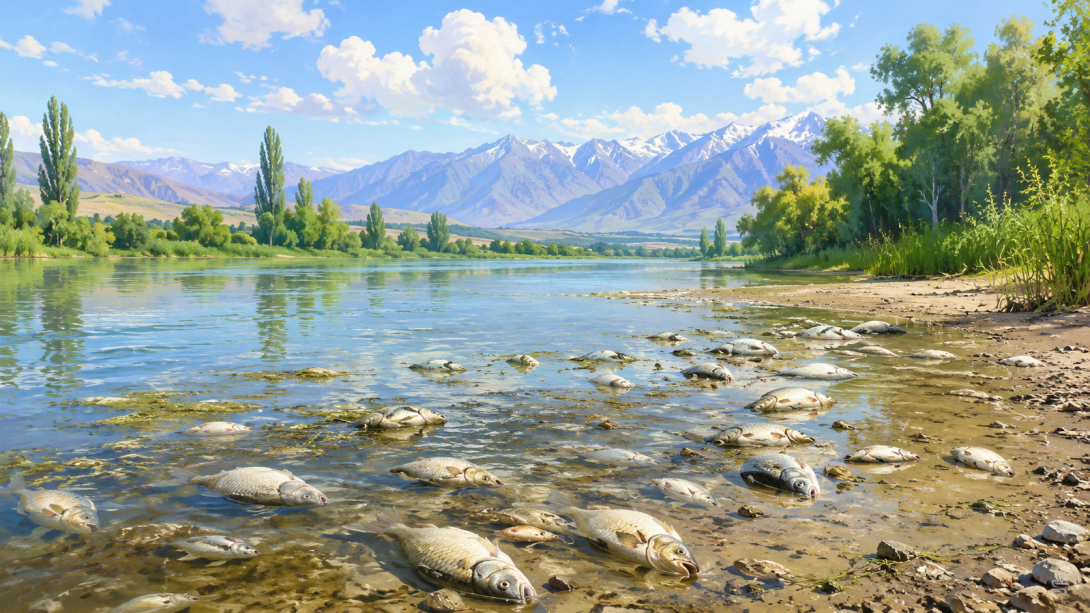
In 2026, reports of mass fish die-offs came in from several regions of Kazakhstan at once, with similar footage also published in Uzbekistan, China and Russia. On the surface, the incidents look the same: dead fish pile up along the shores, the water darkens or develops an unpleasant smell. However, inspection results show that there is no single cause - the fish are dying due to shallowing and oxygen deficiency, freezing of water bodies, heat, algal blooms, and municipal and industrial discharges. In some cases, laboratory tests have not yet been completed, so drawing conclusions about who is to blame is premature.
FACTUAL BASIS
In Kazakhstan, one of the most recent cases occurred in the Birsuat channel in the Irgyz district of the Aktobe region. In early August, local residents filmed dead carp, pike, perch, bream and large numbers of juvenile fish. The district agriculture department reported that the channel is not replenished from other sources and the water level in it continues to drop; water and dead fish have been sent for testing, so the die-off cannot be linked to a specific pollutant until the results are published.
In March, dead fish - mainly young crucian carp - were found in the Aidyn and Sary Aidyn water bodies near the village of Zhanakazan in the West Kazakhstan region (WKR). According to the preliminary version, the channel connecting them, 0.5-1 metre deep, could have frozen to the bottom during winter, leaving the fish without enough oxygen. As FBRK previously reported, the final cause should be established from the results of water and fish samples.
In Shymkent, after a sewer pipe burst on the territory of the special economic zone "Ontustik", wastewater entered the Badam river. According to ecologists, 902.6 kg of fish died, causing 2.3 million tenge in damage to the state. The company StroyGarant XXI LLP was held administratively liable and ordered to remedy the violations.
In August, holidaymakers reported dead fish on Lake Alakol. The Balkhash-Alakol interregional basin inspectorate launched an inspection; the agency has not yet published its findings, so theories about heat, pollution or disease remain speculation.
In Uzbekistan, in May, a mass fish die-off was recorded in the Achchisai channel in the Zangiata district of the Tashkent region. The State Environmental Control Inspectorate established that the water level in the fish farm lake of Damachi balik LLC had been unjustifiably lowered, causing an oxygen deficiency; an employee of the enterprise dumped the dead fish, weighing 200-300 grammes each, into the channel. Analysis of the wastewater revealed exceedances of ammonium and nitrite nitrogen, dry residue and total phosphorus. The enterprise was charged compensation of 92 million soums, administrative protocols were drawn up against those responsible, and the channel was cleared of dead fish.
In China, at the end of June, large numbers of dead fish were found off the coast of the village of Xixiu on the island of Hainan. A joint inspection by local authorities and agricultural services confirmed that after prolonged heat, a red tide occurred in the coastal waters - a rapid bloom of microscopic algae. Specialists from the provincial marine monitoring centre determined that the massive growth of phytoplankton reduced the dissolved oxygen content, causing fish in nearby farms to suffocate. The dead fish were collected and disposed of, and residents were advised not to pick them up or eat them.
In Russia, in the Tyumen region, on 15 July, specialists from Rosrybolovstvo (the Federal Fisheries Agency) and VNIRO (the Russian Federal Research Institute of Fisheries and Oceanography) took samples from the Tura river after a mass fish die-off: dissolved oxygen was found to be less than 1 mg/dm³ - roughly six times below the fisheries standard - and toxicological tests found no acute poisoning. According to Rosrybolovstvo's conclusion, in June Tyumen received 257% of the monthly rainfall norm, and temperatures were 2.9 degrees above normal; the flood washed large amounts of soil and other organic matter into the river, the oxidation of which consumed almost all the dissolved oxygen, and the situation was compounded by the chronic load from industrial discharges and storm sewers.
Tyumen resident Vladimir Karovets, who has been monitoring the river's condition, described the same mechanism:
"The water rose sharply and simply washed away everything that was on the banks, including what had not been washed away for 50 years. The water entered the swamps and floodplain meadows. It all mixed together and began to rot actively."
In his estimation, the recovery of fish stocks could take 5-10 years - this is the opinion of the interviewee, not an approved scientific forecast: the actual timescale depends on the area affected, the condition of spawning grounds, water quality and whether similar events recur.
A separate incident occurred in Perm, where oil products entered the Pyzh and Mulyanka rivers; boom barriers were installed to contain the spill, after which the cleanup of the water, sediment and bank vegetation continued. This episode is direct oil pollution, not the oxygen deficiency caused by organic matter seen on the Tura, and conflating the two would be incorrect.
CONTEXT AND BACKGROUND
Fish die-offs in these regions have been recorded before, and the current cases in Kazakhstan, Uzbekistan, China and Russia show that outwardly similar incidents can have fundamentally different causes.
Dissolved oxygen enters water from the atmosphere and is produced through photosynthesis by aquatic plants, while it is consumed by fish, microorganisms and the decomposition of organic matter. Warm water holds less oxygen, so heat increases the risk of die-offs. When heavy rain washes vegetation, manure, fertilisers or municipal waste into a river, microorganisms begin actively breaking down this mass and consume oxygen faster than it can be replenished. Nitrogen and phosphorus additionally stimulate algal blooms, and after the algae die off, their decomposition further increases oxygen consumption.
ANALYSIS AND INTERPRETATION
The cases listed cannot be lumped together into a single "wave of poisonings". In Shymkent, the pollution source has been identified and legally classified as an administrative violation. In the WKR, winter oxygen deficiency due to freezing is being considered. In Birsuat, the situation is linked to shallowing. On Alakol, the inspection is still ongoing. What all the incidents share is the outcome: a water body quickly loses its ability to support life when its oxygen level drops or a toxic load appears - regardless of what exactly triggered it.
The Chinese incident on Hainan is telling in that the official conclusion found no direct chemical discharge: the trigger was heat, and the deaths occurred through the same chain typical of many fish die-offs - algal growth, oxygen consumption by biological processes, and hypoxia. This confirms that the visual similarity of footage showing dead fish does not in itself indicate a single cause.
For Kazakhstan, the transboundary aspect also matters. The Tura flows into the Tobol already on Russian territory, so pollution from it cannot move against the current and directly reach Kazakhstan. The significance of the Tyumen case lies elsewhere: it demonstrates the vulnerability of the entire transboundary basin to a combination of extreme rainfall and accumulated pollution. Kazakhstan depends on transboundary rivers, which means joint monitoring, prompt exchange of test results, control of discharges and compliance with water protection zones are important for the country. However, domestic control plays an equally important role: the case on the Badam has already shown that a single sewer burst is enough to kill nearly a tonne of fish in a short time.
The mere fact of a mass fish die-off does not make it possible to identify the culprit from video footage. Reaching a conclusion requires measurements of oxygen, temperature and water acidity, as well as tests for oil products, heavy metals, pesticides, nitrogen, phosphorus and microbiological indicators. Until such results are available, editorially it is correct to speak only of theories.
POSSIBLE CONSEQUENCES
Fish die-offs have happened before, but climatic fluctuations are making water bodies more sensitive: heat accelerates biological processes and reduces oxygen solubility, drought causes shallowing, and heavy rain washes accumulated pollution into rivers. At the same time, water consumption by cities, agriculture, industry and digital infrastructure is growing.
A separate factor in the growing pressure on freshwater is data centres serving cloud services and artificial intelligence systems. According to an estimate by the Environmental and Energy Study Institute (EESI), a large data centre can use up to 5 million gallons, or around 19 million litres, of water per day - comparable to the daily, not monthly, consumption of a settlement with a population of 10,000 to 50,000 people. The consumption of a particular facility depends on its size, climate and cooling technology.
With regard to Kazakhstan, First Vice-Minister for Artificial Intelligence and Digital Development Rostislav Konyashkin said that the planned data centres are expected to use not water-based but immersion cooling with special liquid mixtures, so direct water consumption will be small. However, data centres can affect the water balance indirectly - through increased electricity consumption, since water is also used to generate power at thermal plants. Data centres are not linked to the fish die-off cases listed above - they are a separate example of how competition for fresh water is growing. For arid Kazakhstan, the question is not about abandoning digital infrastructure, but about transparent accounting of water use, choosing sites with the water balance in mind, and using closed-loop cooling systems or treated industrial water.
If the trend continues, episodes of mass fish die-off will likely become more frequent - as an indicator of growing pressure on water bodies, rather than isolated accidents.
EDITORIAL OPINION
The cases of mass fish die-offs in Kazakhstan, Uzbekistan, China and Russia have different immediate causes - from freezing and shallowing to industrial discharges and red tides - but they share one common precondition: the vulnerability of water bodies to oxygen deficiency under the pressure of heat, pollution and growing water consumption. This is not a single "wave of poisonings", but a recurring signal that a water body quickly loses its ability to support life when its oxygen level drops.
The editorial board considers it unacceptable to publicly accuse specific enterprises or agencies before laboratory tests and official conclusions are completed. The main task is not to seek a single explanation for all the videos, but to secure the publication of laboratory results and eliminate the specific source of risk in each individual water body, while increasing the transparency of sampling, speeding up inter-agency data sharing on transboundary water bodies, and assessing in advance the water load of new industrial and digital facilities.