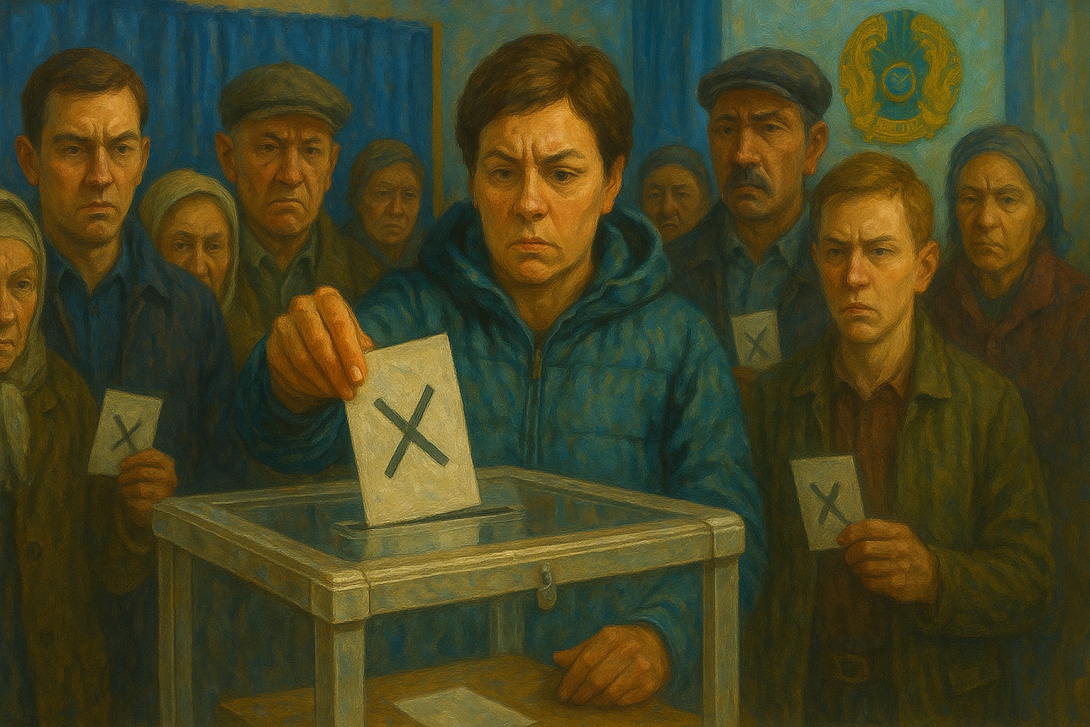
In the village of Kanay in the Burlin District of the West Kazakhstan Region, residents have expressed dissatisfaction with the results of the akim election held on 22 June. In a video message published by the Instagram channel Uralsk_week, they stated that they do not recognise the new akim and consider the election procedure itself to be a formality.
According to residents, the candidate for whom 64 voters cast their ballots was declared the winner, despite 91 people selecting the option 'against all'.
'Why are we not being heard? What is the point of the "against all" box on the ballot paper then?' ask the participants in the address.
It is reported that this is not an isolated case in the region. In a number of settlements in the area, citizens have begun actively using the opportunity to vote 'against all' as a form of peaceful protest. Instead of boycotting the elections, as often happened in the past, voters are turning up at polling stations and consciously expressing their disagreement with the proposed candidates.
The main reason for the lack of trust is restrictions on the formation of candidate lists. According to local residents, mainly representatives of the current akimats are allowed to stand, while self-nominated candidates face various barriers. This creates a feeling among citizens that the procedure is a mere formality and its outcome predetermined.
For context, in the summer of 2022, self-nominated candidate Olzhas Nurmagambetov became the akim of Shchuchinsk. Prior to this, he worked at a locomotive and wagon repair depot, was a karate coach and a director of a small company — he had no experience in municipal administration. In August 2023, he found himself at the centre of a scandal following an online report on his work. The akim's subordinates forgot to end the live broadcast, and city residents witnessed the mayor rudely refusing to answer their questions.
Later, the official published a denial, claiming that he had not made any negative remarks towards the citizens, but an internal investigation was launched against him. In the end, Nurmagambetov was relieved of his post on the basis of a personal statement, while the district akim awarded him a letter of thanks for his contribution to the city's development.
The story of Olzhas Nurmagambetov shows that it is not enough simply to be a 'man of the people' — effective city management requires professional skills, the ability to work with people and to accept public accountability. However, this does not mean we should reject alternative candidates. It is important to find a balance between popular choice and professional competence, rather than creating artificial barriers for self-nominated candidates.