(9 February 2026 | Source: Telegram channel 'They've Already Come for Us')
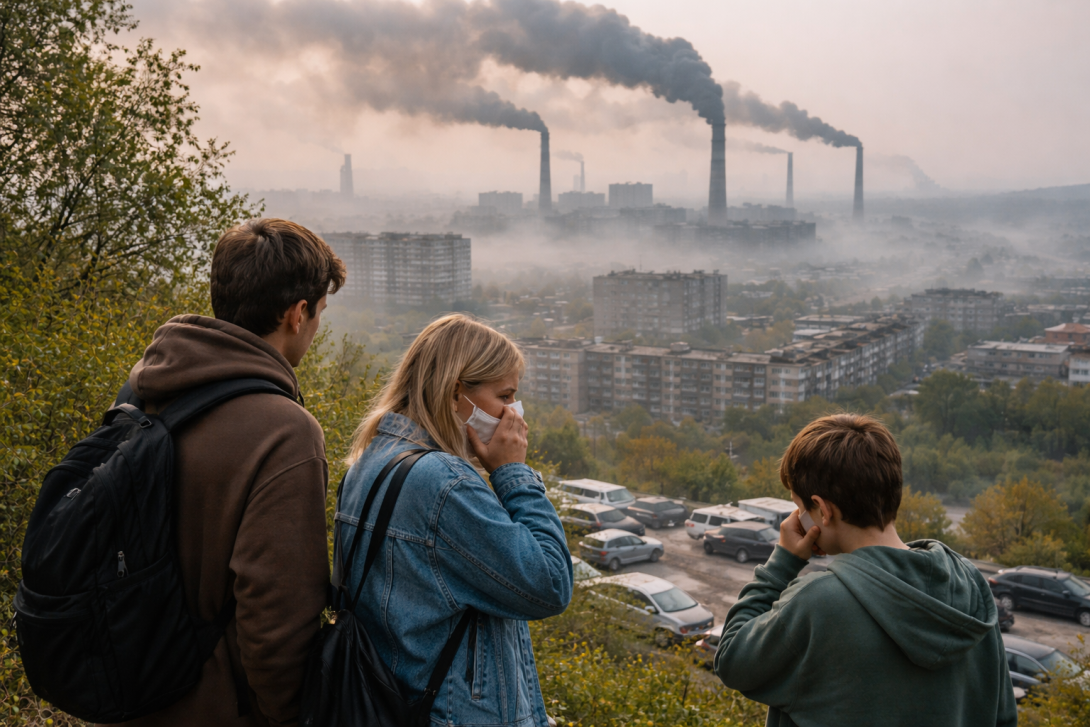
Temirtau remains one of the most polluted cities in Kazakhstan. Residents report a persistent chemical smell and black dust on windows and cars. Ecologists note that almost all air pollution is generated by three large industrial plants, and measures to reduce emissions affect only a small proportion of the sources.
HOW THE SITUATION DEVELOPED
According to the Telegram channel 'They've Already Come for Us', in 2025, data from Kazhydromet showed that in Temirtau, standards for dust, suspended particles PM2.5, carbon monoxide, nitrogen dioxide, hydrogen sulphide and phenol were exceeded dozens and hundreds of times. The latter indicator was recorded more than 800 times.
WHO IS RESPONSIBLE FOR EMISSIONS
Specialists from the Karaganda Regional Ecological Museum conducted an analysis of pollution sources. It turned out that 97% of all emissions come from industry. The main contribution comes from three enterprises: the Karmet Metallurgical Plant, KarGRES-1 and the cement plant. Cars and stove heating make only a small contribution.
FEATURES OF THE POLLUTION
Ecologists note that most emissions come from low-level sources, which directly affects people's respiratory tracts. Furthermore, purification systems are installed on only one in ten sources. Even during the Covid quarantine, when air quality in Almaty and Astana improved, the situation in Temirtau remained critical because the factories continued to operate.
LIMITATIONS OF OFFICIAL STATISTICS
Calculations are based on official reports from enterprises. Illegal or unaccounted emissions are not recorded, so the real air pollution situation could be even worse. Ecologists warn that even if all proposed measures are implemented, emissions will be reduced by only a few percent.
AIR POLLUTION IN ATYRAU
Residents of Atyrau have also repeatedly complained about a suffocating smell and visually noticeable clouds over the city, especially in the outskirts and suburbs.
As reported by the TV channel KTK, instruments from Kazhydromet recorded hydrogen sulphide concentrations up to 30 times above the norm in the area of the Khimposyolok settlement and up to 17 times in Taskala. Ecologists indicated that the main suspected source of pollution could be Atyrau Oil Refinery LLP (ANPZ), although the enterprise officially denied any involvement.
A little later, ANPZ explained that the visible clouds over the plant are water vapour formed during the operation of cooling towers, and that laboratory measurements did not reveal any exceedances of maximum permissible concentrations of pollutants in the sanitary protection zone. Nevertheless, the results of independent checks by state bodies did not match the plant's data, and control measures are planned against ANPZ to verify the actual level of pollution.
THE AIR SITUATION IN UST-KAMENOGORSK
Residents of Ust-Kamenogorsk, like those of the Atyrau region, have repeatedly complained about heavy air and thick 'fog'. According to Kazhydromet, on 22 October, the concentration of sulphur dioxide in the atmosphere exceeded the norm by almost 3 times, and hydrogen sulphide by 1.8 times.
The Akim of the East Kazakhstan Region Nurymbet Saktaganov promised to solve the main environmental problems of Ust-Kamenogorsk within five years. An action plan worth 10.5 billion tenge has been approved for the next three years.
The authorities intend to demand from industrial enterprises the regular updating of purification systems and the installation of new filters. 25 stationary monitoring posts have already been installed for air monitoring, and industrial enterprises have been granted the right to control and take measurements on their factory premises.