
In February 2023, the Land Resources Management Committee of the Ministry of Agriculture of the Republic of Kazakhstan entered into a contract with JSC "NC "Kazakhstan Garysh Sapary", worth 1.14 billion tenge, for services related to the use of space objects for remote sensing of the Earth. These services involved aerial photography to create digital agricultural land maps.
However, there are reasons to believe that JSC "NC "Kazakhstan Garysh Sapary" is simply reselling images, purchasing them at a lower price from a foreign supplier. Kazakhstan Garysh Sapary acts as a customer for ultra-high-resolution satellite images for the Turkestan, Aktobe, Atyrau, Kostanay, East Kazakhstan and West Kazakhstan regions. These are precisely the regions specified in the technical specification of the contract between the LMRC of the Republic of Kazakhstan and NC "KGS".
It turns out that instead of taking images with its own satellites, which are under its direct control, Kazakhstan Garysh Sapary simply buys satellite images from a foreign supplier while hiding behind the status of a national spatial data operator, which allows it to sign a single-source contract.
It is assumed that the supplier of the images was the Chinese satellite image sales company China HEAD Aerospace Technology Co, which is under US sanctions for supplying satellite images of Ukrainian territory to organisations linked to the Wagner Group PMC.
Earlier, journalist and public figure Kirill Pavlov repeatedly stated that Kazakhstan Garysh Sapary provides incorrect satellite data on the country. Given that, for example, KGS does not conduct its own analysis of fires, but for a fee provides government agencies with data from foreign satellites that is publicly available - the question of why information is published with a delay, and why the data differs from real-time indicators, answers itself.
Imagine how many risks, losses and wasteful spending of budget funds could have been avoided on fires alone if the Ministry of Emergency Situations of the Republic of Kazakhstan had up-to-date data.
Also recently, KGS released information stating that more than 81% of crops are in a poor state - in reality, the information turned out to be the exact opposite. This raises the question - who actually uses these geo-services?
It turns out that Kazakhstan annually invests billions in satellite monitoring, which not only fails to meet its objectives but outright fails them. It is enough to recall how the fires in the Abai and Kostanay regions, methane emissions in Buzachi, or the floods that annually become news for the akimats were missed.
According to the public procurement website, Kazakhstan Garysh Sapary also concluded contracts for land digitisation with the Department of Digital Technologies of the Zhetisu Region. At the beginning of 2023, a contract was signed to create a digital land balance based on remote sensing data for the Koksu, Eskeldi, Karatal, and Aksu districts, and the city of Taldykorgan. Six months later, a similar agreement was concluded for the digitisation of the territories of the Alakol, Kerbulak, Panfilov and Sarkand districts, and the city of Tekeli. In total, NC "KGS" received about 300 million tenge from the Zhetisu Region.
Furthermore, JSC "NC "Kazakhstan Garysh Sapary" concluded a number of single-source contracts with regional Departments for Emergency Situations for the provision of space monitoring services, which costs the regions an average of 6 million tenge. Additionally, NC "KGS" has a contract with the Ministry of Defence of the Republic of Kazakhstan for the provision of satellite monitoring navigation services, the cost of which is about 8 million tenge.
Moreover, the Republican Methodological Centre for Phytosanitary Diagnostics and Forecasts annually purchases access to a geographic information system for hydrometeorological observation and environmental monitoring from space from Kazakhstan Garysh Sapary for 22 million tenge.
This would all be fine if it were not for the fact that Kazakhstan Garysh Sapary itself acquires all these services from foreign suppliers. Just this year, NC "KGS" paid approximately $611,415 to the American company Maxar Intelligence Inc. for the provision of satellite imagery services, and $940,000 to another American company, Planet Labs, for a subscription service for access to data from its Data Access satellite constellation.
This once again confirms that NC "KGS", hiding behind its status as a national spatial data operator and the existence of Kazakhstani images, often simply acts as a reseller, a role that could be filled by any other organisation with access to the foreign market.
According to the 2022 financial statements of JSC "NC "Kazakhstan Garysh Sapary", revenue from contracts for Earth remote sensing space system services and scientific research services amounts to approximately 3.6 billion tenge. It turns out that KGS had the funds to carry out this work in 2023, yet additionally received money from state bodies for these services.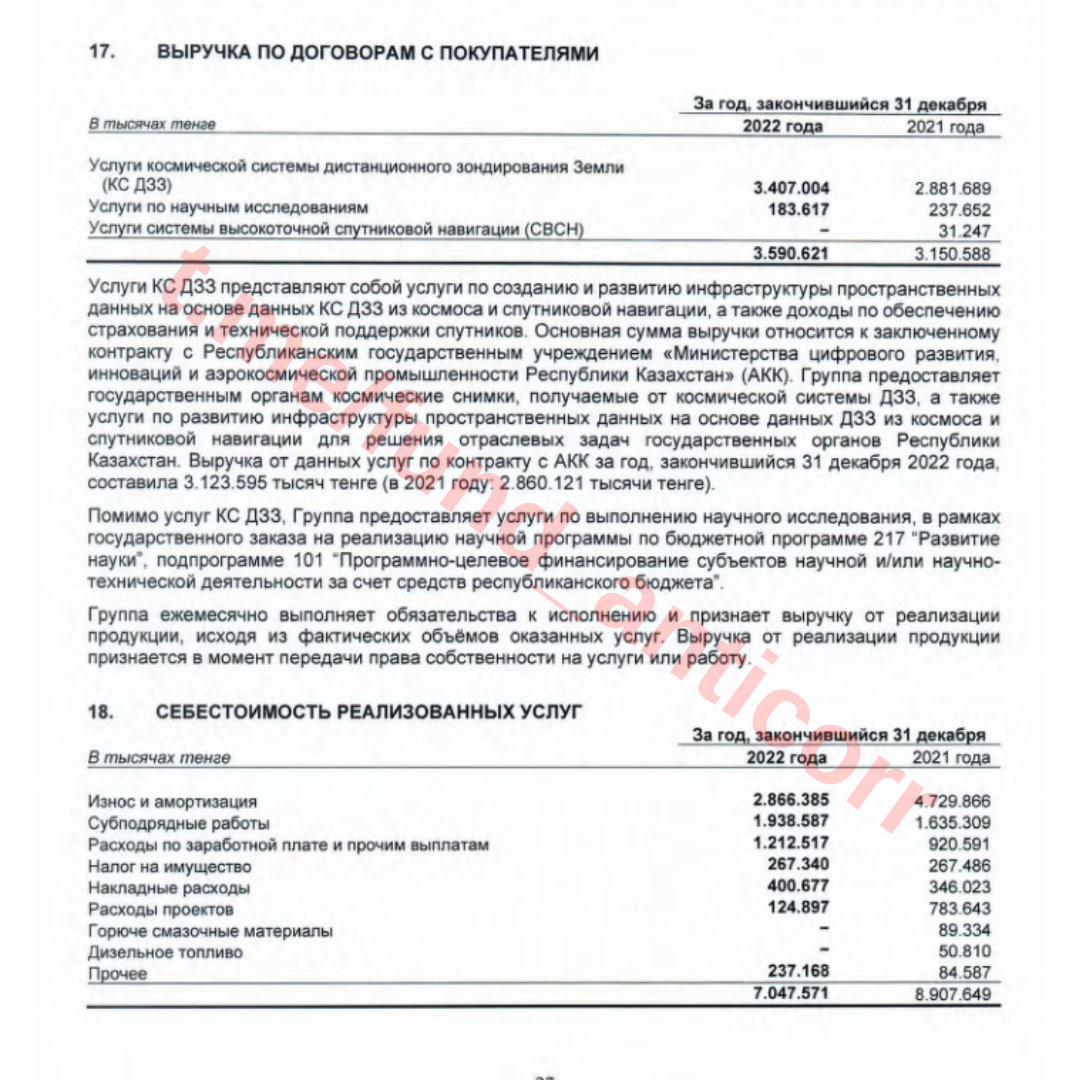
It is worth noting that on its official website, Kazakhstan Garysh Sapary states that the entire territory of Kazakhstan, including 100% of arable land and forest land, has been digitised. However, at the end of 2022, the depreciation and amortisation of the satellite in monetary terms amounted to almost 2.9 billion tenge, which KGS wrote off as company losses.
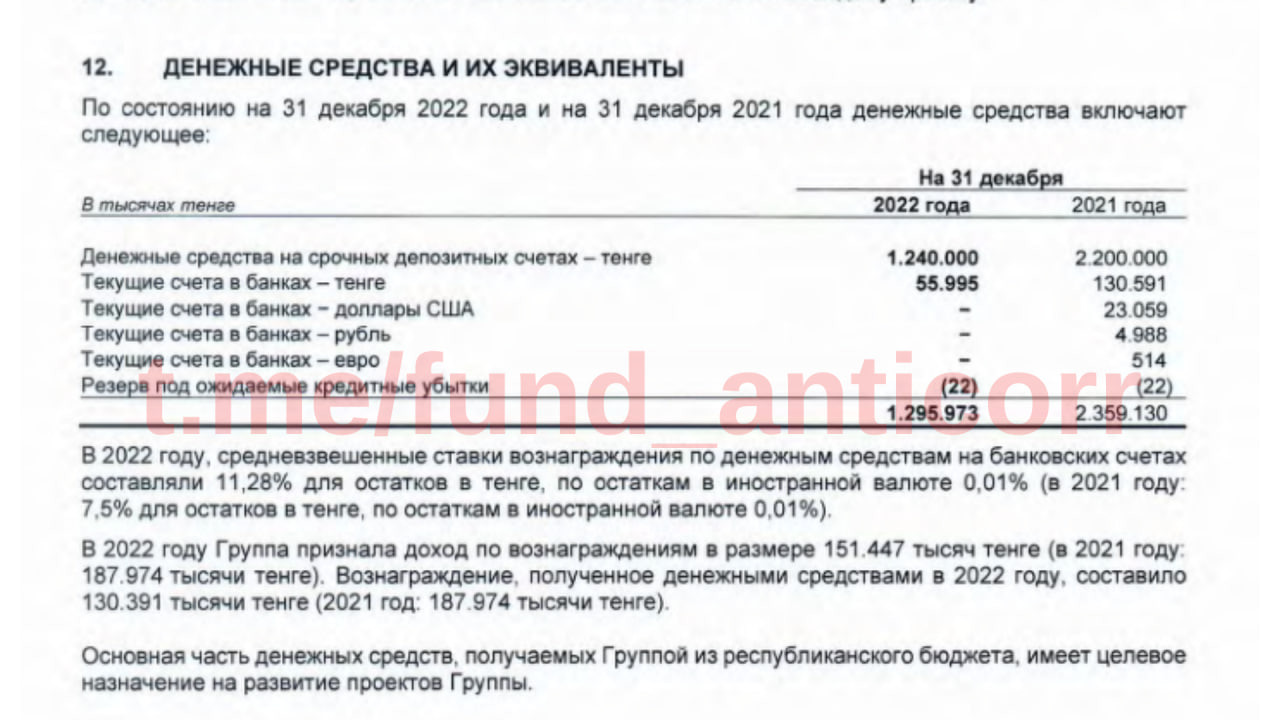
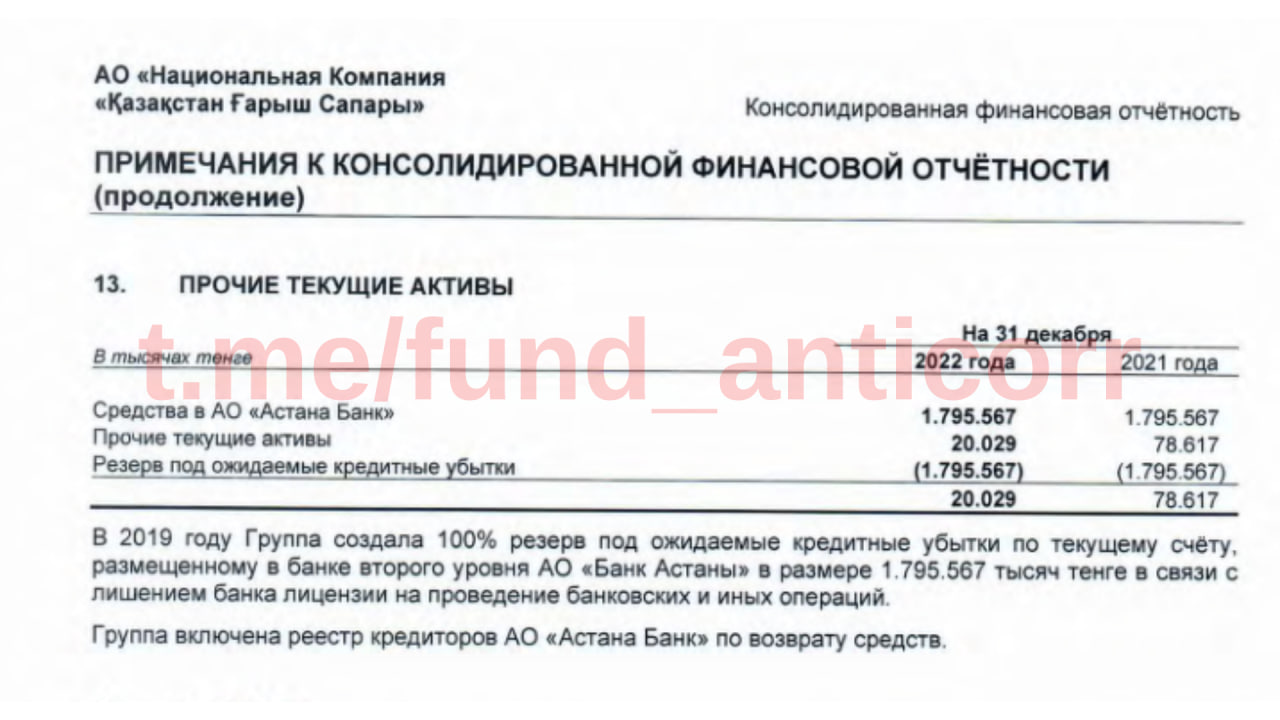
Furthermore, as of 31 December 2022, Kazakhstan Garysh Sapary had 1.24 billion tenge in fixed-term deposit accounts. Revenue amounted to about 150 million tenge and was recognised as income of the JSC. Another 1.8 billion tenge of the company's funds were held in accounts at JSC "Astana Bank", which later had its banking license revoked, but which pledged to return the money.
The company's management, constituting key management personnel of 4 people, in turn received remuneration totalling 94 million tenge for the 2022 financial year. In 2021, the total remuneration amounted to approximately 89 million tenge with the same personnel composition. It is noted that the remuneration consists of salaries and other short-term benefits.
The editorial board of the FBK believes that all operations concerning the commercial relations of the space industry should be publicly available. We also believe that the national company Kazakhstan Garysh Sapary should carry out its activities in line with its stated purpose, instead of hiding behind Kazakhstani satellites and their supposedly high-quality functionality to resell images from foreign spacecraft to the state.