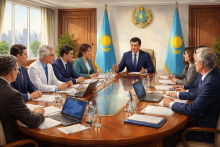
(20 February | Source: official WikiLeaks page on platform X, Kazakhstan Today)
Following a recent statement by WikiLeaks founder Julian Assange, attention has once again turned to the work of USAID in Kazakhstan. According to him, the agency's projects, declared as humanitarian aid and civil society development programmes, may have influenced political and media structures.
HOW THE USAID PROGRAMME DEVELOPED
The programmes of the United States Agency for International Development (USAID) in Kazakhstan were implemented through grant mechanisms aimed at supporting civil society and human rights initiatives.
Agency materials list two projects: 'Strengthening Civic Participation in Kazakhstan' with a budget of $2.350 million and 'Strengthening Human Rights and Equality' with a sum of $3.350 million. The aim of the latter was to build the capacity of LGBT organisations in Kazakhstan and Kyrgyzstan.
In 2025, USAID announced the winding down of some of its foreign programmes, including initiatives in Kazakhstan, leaving a number of questions about how grant funds were actually used and what effect the projects had on local structures.
STATEMENTS BY JULIAN ASSANGE
In a post on platform X, the WikiLeaks founder (an international non-profit organisation that publishes classified information obtained from anonymous sources or through leaks - editor's note from FBRK) noted that the idea of an 'organic civil sector', free from the influence of the state and private business, does not correspond to the reality of recent decades.
According to him, since the 1970s, traditional institutions such as trade unions and churches have come under pressure from the market economy, and 'civil society' has gradually turned into an instrument for pursuing political interests through international non-profit organisations (NGOs).
Assange claims that a significant portion of international programmes, including grants, conference trips and networking events, were politically funded and may have helped promote certain agendas.
He also mentions organisations like Freedom House (a non-governmental human rights organisation headquartered in Washington - editor's note from FBRK), where, in his view, staff focused on human rights violations outside the West, leaving local cases without attention.
CONTEXT AND SIGNIFICANCE
We believe that Julian Assange's words are intended, among other things, to remind us of the full complexity of assessing the impact of international grant funding on the local civil sector.
To date, information on the specific results of USAID projects in Kazakhstan is lacking, and the stated goals and activities require analysis of official documentation and reports.
Nevertheless, Assange's publications quite rightly draw attention to the fact that foreign funding of civic initiatives may come with political influence, something which should not be forgotten.
Let us recall that since February 2025, information has been coming to light about funds directed towards supporting the LGBT movement through various foreign structures, including the 'Norwegian Helsinki Committee', 'ILGA-Europe', 'Eurasia Foundation Central Asia' and other organisations.
Details have entered the public domain regarding 160 million tenge received by LGBT activists through international funds. As it became known, in August 2024, an international platform for LGBT communities of Central Asia was even held in Almaty under strict confidentiality, organised precisely thanks to USAID initiatives.