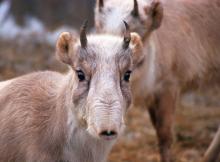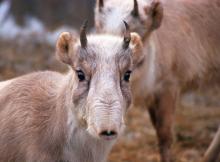
Farmers in the southern districts of the West Kazakhstan Region have reported a shortage of fodder, which could lead to livestock deaths. According to them, the cause is drought and an increase in the saiga antelope population. A state of emergency has been declared in two districts of the region.
According to the Telegram channel "Azattyq - Азаттык", farmers gathered at the regional agriculture department in Uralsk for a meeting with deputies of the Senate, the Majilis, and representatives of the akimat.
"In the southern districts, Bokeyorda and Zhanybek, there is practically a 100 percent problem with fodder. Nobody is taking any measures in this situation, and we have set up a headquarters of four districts — two more, Akzhaik and Taskala, have joined. We appealed to state bodies, negotiations went on for a very long time, we met with the regional akim," said farmer Bauyrzhan Sabanov from the Zhanybek district.
Shortly before the meeting with the deputies, an initiative group of farmers submitted a notification to hold a rally, but it was not approved.
It was also reported that they launched an online petition calling for a state of emergency in four districts of the region, which has not yet collected the required number of votes for consideration.
It has become known that, due to the fodder shortage, a state of emergency has been declared in the Bokeyorda and Zhanybek districts. In the Kaztalovka and Akzhaik districts, the regime is in effect partially.
"All necessary procedures under the law are currently underway following the introduction of the state of emergency. We have gathered here to further resolve the problem with the saiga. At the moment, none of the departments, ministries of ecology or agriculture are taking measures. We can regulate the saiga ourselves," Sabanov also stated at the meeting.
The meeting also raised the issue of the lack of a support mechanism for farmers.
"The akimat suggests reducing the livestock. Over the past 30 years, there were so many programmes, subsidies and soft loans to increase it. Now, after all this effort, we are being told to get rid of our livestock practically for nothing," said Yerkin Zhabanov, a farmer from the Bokeyorda district.
In turn, Deputy Akim of the West Kazakhstan Region, Kaliyar Aitmukhambetov, stated that the farmers' problems are gradually being resolved.
"You are upset with us, but in fact everything is slowly being resolved and looked into. The state of emergency was declared in two districts out of necessity, but it will not completely solve all the problems. This year, the issue with the saiga remains unresolved: whether we will catch them or not, the issue of subsidies for fences has not been resolved, which is why we were forced to introduce the state of emergency," reported Kaliyar Aitmukhambetov.
To recall, in July 2023, the West Kazakhstan Agrarian and Technical University named after Zhangir Khan submitted to the Ministry of Ecology a so-called biological justification for "managing saiga populations", in which our editorial team found numerous fundamental contradictions.
In October 2023, it became known that the Ministry of Ecology had begun hiring hunters to shoot saigas in the West Kazakhstan Region. The average cost of the service was 4,000 tenge per head of killed saiga.
In early November of the same year, the ministry established the permitted hunting period for saigas, regardless of their sex, age or habitat: from October 1 to November 15. At the same time, in the West Kazakhstan Region, mass livestock deaths were recorded. Hundreds of animals died from an infectious disease at that time.
In April of this year, President Kassym-Jomart Tokayev announced that he would revoke the Ministry of Ecology's decision to shoot saigas and ban the so-called 'removal' of the saiga population, calling them symbols of the Kazakh steppe.
Also in March, the Border Service Department of the National Security Committee of the Zhetysu region detained three citizens of Kazakhstan in the border zone while attempting to export 1,382 saiga horns. The damage to the state was then estimated at over 3.5 billion tenge. Incidentally, according to our data, one horn costs around $2,000 on the black market.