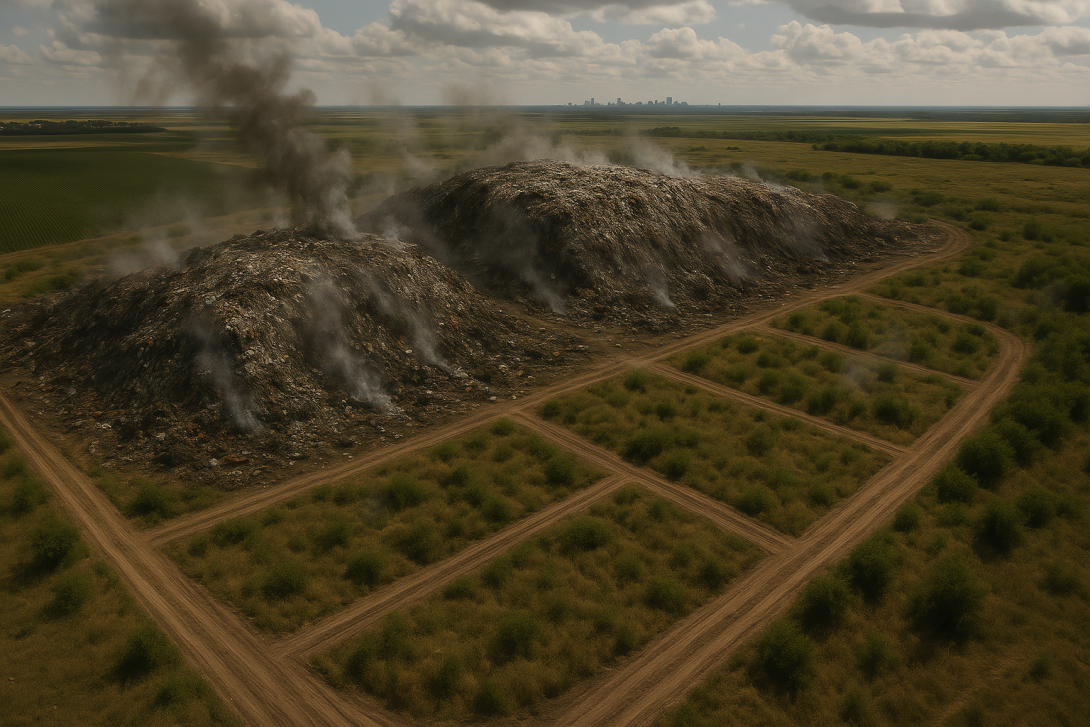
The Department of Land Resource Management (DLRM) of Akmola Region found no violations in the conversion of an indivisible agricultural plot of 40 hectares near the village of Koyandy into a landfill and its subsequent division into ten separate plots. This was the response received by the editorial board of the FBRK to its official inquiry regarding the legality of the land transformation that occurred over the last four years.
At the end of January, we reported that initially, the land plot near the village of Koyandy in the Tselinograd district of Akmola Region, covering 40 hectares with cadastral number 01-011-014-2692, was indivisible and designated for agricultural production.
However, over four years, the plot was transformed into ten separate plots with various designations, including a landfill, raising questions about the legality of changing the land's designated purpose and the procedure for its division. In this regard, we sent an official inquiry to the DLRM of Akmola Region requesting clarification on the legality of the plot's division and the change in its designated purpose.
According to the department's response, this land plot was provided to LLP "Arka-Zher-1" in exchange for land expropriated for state needs. According to a resolution of the akimat of Tselinograd district dated 8 October 2015, the plot was intended for the creation of a sanitary protection green zone for Astana.
In July 2020, entrepreneur Yerlan Ryskulov purchased this plot from LLP "Arka-Zher-1" under a purchase and sale agreement. The land was legally classified as indivisible and designated for agricultural production.
The first significant change in the plot's status occurred in December 2022, when the akimat of Tselinograd district authorised the change of designated purpose for a quarter of the plot (10 hectares) to waste storage and processing. In June 2023, the owner received permission to change the designated purpose of the entire plot.
Later, on 2 April 2024, a resolution of the akimat of Tselinograd district officially changed the designated purpose of the entire plot from "commercial agricultural production" to "storage, sorting, processing of construction and household waste". According to the department's response, the procedure was carried out with a buyout on an instalment plan over 1 year.
During this same period, the original plot was divided into two parts: 24.4 ha (cadastral number 01-011-014-33-48) and 15.6 ha (cadastral number 01-011-014-33-49). Yerlan Ryskulov sold the larger plot to Kairat Ryskulov, and the smaller plot was subsequently divided further into nine parts ranging in size from 1 to 5 ha.
As noted in the department's response, the initially indivisible land plot became divisible on a legal basis. According to Article 51 of the Land Code of the Republic of Kazakhstan, "a divisible land plot is one which, without changing its designated purpose and without violating fire safety, sanitary, environmental, construction and other mandatory norms and rules, can be divided into parts, each of which, after division, forms an independent land plot".
The department emphasises that "due to the fact that the designated purpose of the land plot was changed, there are no violations in its division". The response also states that, according to paragraph 3-1 of Article 97 of the Land Code of the Republic of Kazakhstan, "the division of agricultural land plots into plots with areas below the minimum sizes is not permitted." However, after changing the designated purpose from agricultural to another use, this restriction ceased to apply to this plot.
In October 2024, a lease agreement was concluded between Yerlan Ryskulov and SP "Marushchak V.V." for the plot with the old cadastral number, which by that time had already been divided. Later, the new owner, Kairat Ryskulov, concluded an additional agreement with the same tenant to use 1 hectare of land for sorting solid household waste.
Currently, the territory is divided into ten plots with different designated purposes: one plot of 24.4 ha is intended for waste management, and the remaining nine are intended for the construction of production facilities and business operations.
The case of transforming an indivisible agricultural plot into a landfill, followed by its division into several independent land plots, demonstrates the peculiarities of applying Kazakhstan's land legislation.
As the official response from the department shows, such changes are possible provided the legally established procedures for changing the designated purpose of land plots are followed. However, this situation raises the question of how effectively current legislation protects the designated purpose of agricultural land.
In effect, existing norms allow interested parties to consistently "tailor the documentation" to suit their desired goals and transform land of virtually any designation into commercially viable assets. It is enough merely to observe the formal procedures, and land originally allocated for agricultural needs and the creation of a sanitary protection zone can, on perfectly legal grounds, be turned into a landfill.
The question remains open as to how far such practices align with the long-term interests of the state and society in preserving valuable agricultural land.