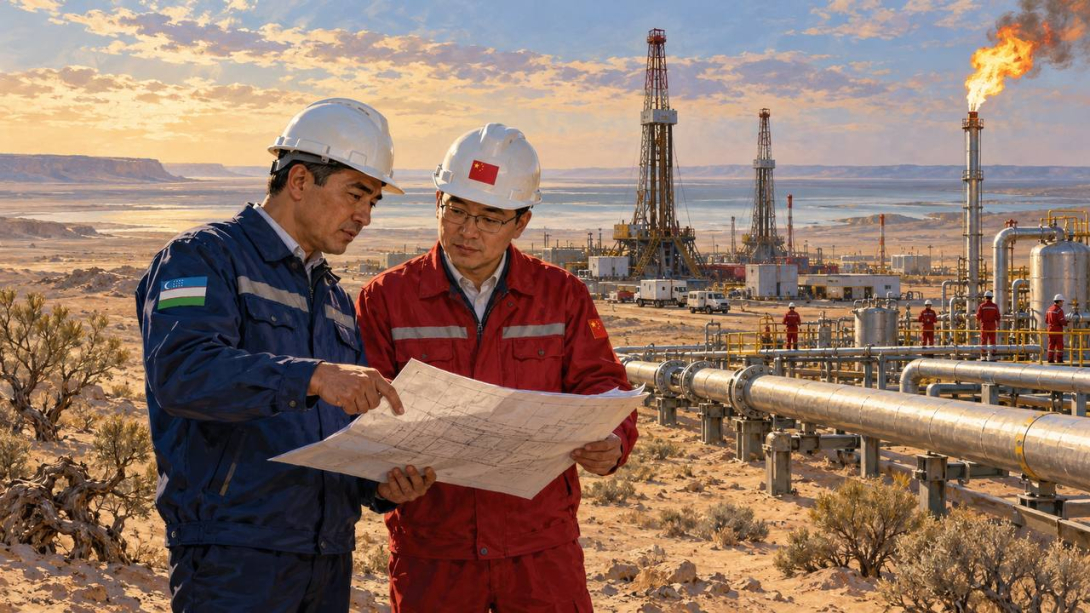
Uzbekistan and the Chinese CNPC discussed supplies of petroleum products, geological exploration and new projects in the oil and gas sector. At the same time, the previous project to search for hydrocarbons in the Uzbek part of the Aral Sea was deemed economically unviable and was wound up in 2017.
WHAT THE COMPANIES DISCUSSED
As reported by Gazeta.uz, on 20 October 2026 the head of Uzbekneftegaz, Abdugani Sanginov, met with representatives of the Chinese CNPC.
The parties discussed exploration of fields, well drilling and long-term supplies of petroleum products. A separate topic was the accident at the M-25 gas field, where an uncontrolled gas release continues. The aftermath is planned to be dealt with in the first half of 2027.
The publication does not provide information on the signing of new contracts or specific supply volumes.
HOW CHINA GAINED ACCESS TO THE ARAL'S RESOURCES
On 30 August 2006, Uzbekistan signed an agreement on production sharing for the exploration and development of oil and gas fields in its part of the Aral Sea.
The consortium included Uzbekneftegaz, LUKOIL, CNPC, Petronas and KNOC. The agreement was concluded for 35 years and came into force in January 2007.
In 2010, LUKOIL reported the discovery of gas at the Western Aral area. However, in 2017 the project participants decided to liquidate the joint venture Aral Sea Operating Company.
WHAT KAZAKHSTAN HAS TO DO WITH IT
On 8 July 2005, Kazakhstan adopted Law No. 68 on production sharing agreements for offshore oil operations. The document applied to the Kazakh sections of the Caspian and Aral Seas and was signed by Nursultan Nazarbayev.
WHAT ENVIRONMENTAL RISKS EXIST
On the former Vozrozhdeniya island in the Aral Sea, a testing site for biological weapons was located during Soviet times.
The founder of the FBRK, Kirill Pavlov, drew attention to the environmental problems of the Aral region in his Telegram channel "Kazakh Chuvash". He noted that Uzbekistan is planting saxaul on the dried-up bed of the Aral Sea to strengthen the soil and slow desertification.
Pavlov also proposed that Kazakhstan gradually reduce rice cultivation in favour of drought-resistant plants. In his estimation, this would save around 1 billion cubic metres of water per year, restore land and generate income from carbon credits.
WHAT IS HAPPENING NOW
In April 2026, Uzbekneftegaz agreed with a CNPC division to drill 30 exploration and appraisal wells in the Ustyurt region during 2026–2028.
These arrangements confirm the continuation of the companies' cooperation in Uzbekistan's oil and gas sector, but do not indicate a resumption of the previous project in the Aral Sea. There is no confirmation in the sources studied of the start of commercial production in the Aral area in 2026.


