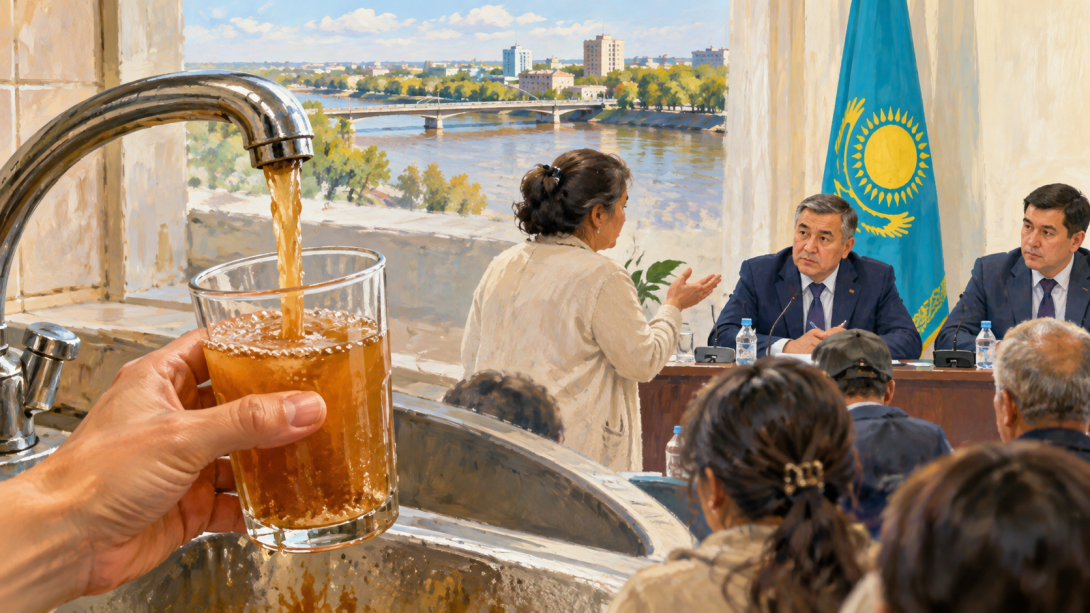
A resident of the village of Daryinskoye complained to the Minister of Water Resources and Irrigation, Nurzhan Nurzhigitov, about the quality of drinking water in the West Kazakhstan Region (WKR). Representatives of the akimat acknowledged the problem and spoke about the work being carried out.
WHAT THE MINISTER REPLIED
According to Uralskaya Nedelya, during the meeting on 25 September, a resident of Daryinskoye reported that water quality problems persist both near Uralsk and in remote villages of Baiterek District.
She noted that hundreds of millions of tenge are allocated to water supply, yet residents still receive water with a rusty tint from their taps.
Minister Nurzhan Nurzhigitov explained that the reconstruction of water pipelines, the construction of new networks and ensuring water quality fall mainly within the competence of local akimats. He then passed the question to Deputy Akim of the WKR, Miras Mulkay.
WHAT WORK IS BEING CARRIED OUT IN THE REGION
Miras Mulkay did not deny the existence of the problem, but reported an improvement in water quality. According to him, in the Trekhino area the head water intake is being reconstructed, and a water conduit with a diameter of 1000 mm is being built towards Uralsk.
In addition, around 23 wells are being drilled in the region and water treatment facilities are being installed.
At the same time, the wear of Uralsk's water supply networks has reached 60%. Under a national project, this figure is to be reduced to 40%. The work will be carried out in stages.
WHAT DRINKING WATER TESTS SHOW
Data from the WKR Department of Sanitary and Epidemiological Control indicate that most of the water samples tested comply with sanitary and chemical standards. However, this does not rule out a change in its colour in the distribution and in-house networks.
In the first half of 2026, specialists tested 101 samples of centralised water supply. One of them was found to have a microbiological non-compliance. No exceedances of sanitary and chemical indicators, including iron content, were found.
In 2025, out of 238 microbiological samples, one failed to meet the standards, while in 2024 — six out of 332.
The department links the change in the colour of the water to deposits and stagnation in the pipes, and also recommends flushing it before use.
HOW MANY NETWORKS NEED REPLACING
According to Batys Su Arnasy LLP, the total length of Uralsk's water supply networks is 483.5 km. Of these, 292.03 km require replacement, and the wear of the system has reached 60.4%.
Over the past three years, the utility company has replaced around 20 km of pipes. A further 2.7 km is planned for replacement in 2026.
Water supply problems are also reflected in the number of complaints from city residents. In 2025, the company registered 86 complaints about water quality, and in the first seven months of 2026 — another 70. Over the same period, utility workers recorded 102 accidents on the city's networks.
WHEN THE WATER TREATMENT FACILITIES WILL BE RECONSTRUCTED
Uralsk's water treatment facilities have been in operation since 1963. No full-scale reconstruction has been carried out since they were commissioned.
The company is currently developing design and estimate documentation for the reconstruction. Its final cost is unknown. For 2026, around 94.9 million tenge has been earmarked for repairing the facilities, and a further 204.6 million tenge under an investment programme.
Despite the fact that most samples comply with the standards, some residents buy bottled water.
CONTEXT
In July, residents of the village of Kushoky in the Karaganda Region appealed to President Kassym-Jomart Tokayev, stating that after almost two weeks of disruptions, dark water with a pungent odour had begun flowing from their taps.
Later, the akimat of Bukhar-Zhyrau District reported that the temporary deterioration in water quality was linked to the commissioning of new water supply networks.
Residents of Shchuchinsk also complained about problems with the quality of tap water. A measurement carried out by the FBK editorial team using a portable TDS meter showed a mineralisation level of 431 ppm. The figure is within the norm, although on household scales the water may have an unpleasant taste.
In response to FBK's enquiries, the sanitary authorities did not give a direct answer as to whether the specific indicator met the requirements.