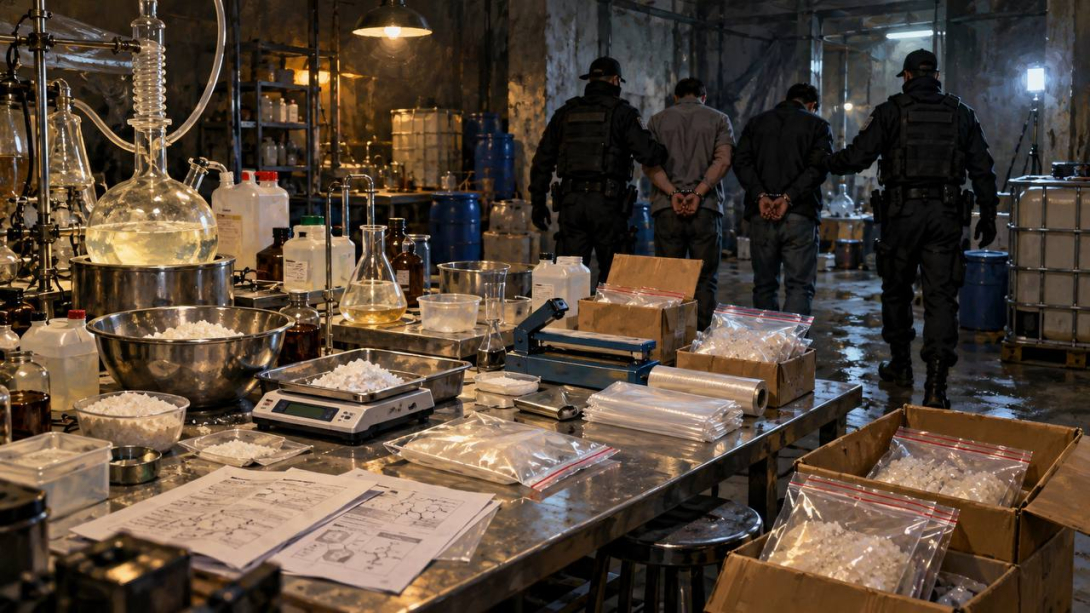
The cassation court increased the sentence of two Almaty residents convicted of manufacturing analogues of psychotropic substances for the purpose of sale. Initially, the men received 8 years and 7 years 6 months of imprisonment. After the case was reviewed, the terms were increased to 10 years 6 months and 10 years respectively.
WHAT WAS FOUND IN THE UNDERGROUND LABORATORY
According to the Prosecutor General's Office of the Republic of Kazakhstan, two Almaty residents set up an underground laboratory for manufacturing analogues of psychotropic substances.
Law enforcement officers found specialised equipment, scales, packaging materials and instructions in the premises. The total mass of the manufactured substance was almost 3.9 kg.
The court established that the men acted by prior conspiracy with the aim of subsequently selling the prohibited substances.
WHY THE INITIAL SENTENCES WERE REVIEWED
Initially, one convicted person was sentenced to 8 years of imprisonment, the second — to 7 years 6 months.
The punishment was determined under the new version of Article 297 of the Criminal Code of the Republic of Kazakhstan ("Illegal acquisition, storage, transportation for the purpose of sale, forwarding or sale of narcotic drugs, psychotropic substances, their analogues"). However, since the beginning of 2025, the manufacture of drugs and their analogues for the purpose of sale was separated into a separate Article 297-1.
The Prosecutor General's Office stated that the new law was not subject to application, since it did not improve the position of the convicted persons. The punishment should have been imposed under the version of Article 297 of the Criminal Code of the Republic of Kazakhstan in force at the time of the commission of the crime.
That version provided for the manufacture of analogues of psychotropic substances from 10 to 15 years of imprisonment.
WHAT DECISION THE CASSATION COURT MADE
The Prosecutor General's Office filed a protest against the judicial acts. The cassation court reviewed the case and increased the terms of punishment for both convicted persons.
The first man was sentenced to 10 years 6 months of imprisonment instead of 8 years. The second had his term increased from 7 years 6 months to 10 years.
Thus, each convicted person had 2 years 6 months of imprisonment added.
The exact dates of the commission of the crime and the delivery of the initial verdicts are not specified in the message from the Prosecutor General's Office.