What Shenzhen means for middle powers and who finds life easier in a nuclear-free world.
Continued from the article "The Middle Class of the World Order".
The first meeting in history between Donald Trump, Xi Jinping and Vladimir Putin at one table ended with a "declaration of peace" that mentions neither Ukraine nor Iran. Xi called nuclear weapons a sword of Damocles hanging over humanity, but left responsibility for peace to the three largest nuclear powers. We examine what this means for middle powers and why Kazakhstan will not have to prove its right to be in the room in this story.

THREE MEN AT ONE TABLE
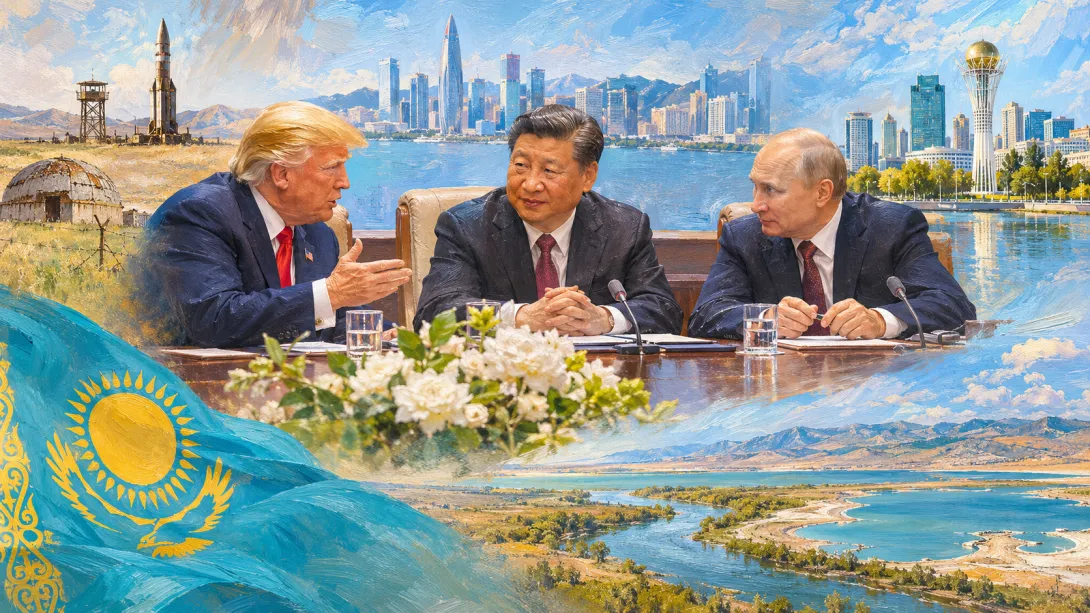
On 19 November in Shenzhen, on the sidelines of the APEC summit, Trump, Xi Jinping and Putin gathered at one table for the first time in history. The conversation lasted about an hour and a half and ended with a "declaration of peace".
Let us call things by their names: this is not a peace treaty but a symbolic declaration. It contains four points: reform of the UN, more petroleum products on the market, a warning to the International Criminal Court and a reduction in the risk of nuclear war. There is not a word about Ukraine in the text. Nor is there any mention of Iran: the document mentions neither the Ukrainian war nor the Iranian one, although, according to Trump, both topics were discussed at the meeting. Reports on the nuclear part diverge: PBS writes of a first promise of formal talks, while Reuters notes that plans for arms control talks were never announced.
A building where the concierge has gone on holiday saw that the penthouse owners had finally sat down at one table. Good news. The bad news is that, judging by the outcome, what they discussed was their own fear, not the residents.
THE SWORD THAT HANGS OVER EVERYONE
The strongest word in Shenzhen was spoken by Xi. According to reports, he called nuclear weapons a sword of Damocles hanging over humanity and called for them to be banned and ultimately destroyed. For the leader of a country from the nuclear triad which, according to Moscow Times estimates, holds around 90% of the world's arsenal, these are categorical words.
But they are worth reading carefully. According to NBC, the same Xi said that responsibility for peace lies with the three largest nuclear powers. That is, a world without weapons is to be built by those who have them. And the last treaty that limited the arsenals of Russia and the US, New START, expired on 5 February 2026. The fine phrase about a complete ban rings out against the backdrop of an empty space where the rules used to stand.
THOSE WHO REFUSED
Here a window opens for middle powers, and precision is needed. It cannot be said that all middle powers have always lived without nuclear weapons: India, Pakistan and Israel have them. But the core of the argument is stronger than the general formula. Among middle powers there are many who have renounced weapons or never built them: Brazil and Argentina, South Africa, Indonesia.
Kazakhstan is a special case here. It inherited from the USSR one of the largest arsenals in the world, closed the Semipalatinsk test site and renounced the bomb. In September this year, the states of the Central Asian Nuclear-Weapon-Free Zone adopted a joint statement marking the 20th anniversary of the treaty signed in Semipalatinsk. And Kassym-Jomart Tokayev has for several years called the threat of the use of nuclear weapons the most destructive of all those facing humanity.
But this story has a bitter flip side. Ukraine, too, once gave up an arsenal in exchange for guarantees. We know how the paper guarantees of the nuclear powers ended for those who gave up the bomb. So the Shenzhen question, for middle powers, sounds like this: if everyone is supposed to disarm, then who will vouch for those who disarm first?
A GUARANTOR WITHOUT A BUTTON
The answer suggests itself: the one who has neither a bomb of their own nor an interest of their own in someone else's. But the word "guarantor" is easily misunderstood here.
The middle class does not guard the house by force. It does something else: a notary certifies the deal, a judge settles the dispute, a juror decides the case. None of them is armed, but without them a contract is not worth the paper it is written on. A middle power can be precisely such a notary of the world order:
- A venue. A place where the parties can meet without losing face. Astana proved this on the Syrian track.
- Verification. A technical arbiter trusted by both sides. The IAEA's low-enriched uranium bank operates in Ust-Kamenogorsk not by chance.
- Reputation. A country with nothing to hide on this issue, because it has already made its choice.
The bodyguards will remain those same three. The notary of the deal can be us. Tokayev was speaking precisely about this when he described middle powers as bridges within the UN while the great powers are divided. And at the environmental summit in Astana he reminded his audience that the UN Charter cannot be applied selectively, like a menu from which one picks only what one likes.
A BRIDGE WITH A SPECIFIC ADDRESS: WATER
Big words about a world without the bomb are all very well, but a middle power proves its right to the role not through declarations but through problems that can be solved. The nuclear question is closed to a middle player today: it is decided by three. But water is open.
Kazakhstan knows this subject from the inside: the Aral, the shrinking Caspian, transboundary rivers. In December 2025 in Ashgabat, Tokayev proposed creating an International Water Organisation within the UN structure: there is no narrowly specialised structure dealing solely with water in the system. The current UN-Water, according to the assessment of Times of Central Asia, coordinates dozens of structures but has neither its own mandate nor a budget. The essence of the proposal is to turn it into a full-fledged agency that would bring together disparate mandates.
The scale of the problem was recorded in figures by the FBRK: the Caspian has dropped to its lowest level in 48 years, having lost about 2.5 metres over 30 years. And in the Northern Aral, as Tokayev said at the eco-summit, around 36% has been restored, and this is that rare case when a country has not a slogan but a demonstrable result.
The idea did not remain in the speech alone. The first round of consultations took place in Astana on 23 April 2026 at the Regional Environmental Summit. It was then presented in New York, at UNESCO and in Nairobi, and Tokayev called on the SCO countries to support it. The next major venue: the UN Water Conference in Abu Dhabi on 8–10 December.
This is the same bridge, only with a clear load. Here no bomb is needed and there is no need to ask permission from three people at one table: it is enough to know the subject and be ready to lead the agenda. The trust earned on water will later be useful also where the stakes are higher. Let us add soberly: for now these are consultations, and the decision to create the organisation is taken by member states, so Abu Dhabi will show how viable the idea is.
But the organiser of the global water agenda also has homework of its own, and the FBRK has described it. 90% of Kazvodkhoz's canals fall into the second category, they need major repairs, and the agency has been unable to assess the size of the shadow water market. Kazakhstan's Ministry of Water Resources and Irrigation and the Prosecutor General's Office are launching measures against illegal water abstraction, and an audit of the Nura Group Water Pipeline uncovered damage of more than 40 million tenge. A notary who is trusted starts with his own office: a reputation on global water is built on transparent water at home.
THREE "BUTS"
The notary is invited by the parties. In Shenzhen there were three at the table, and they did not invite a fourth. A middle power cannot declare itself a guarantor: it becomes one when it is asked to be.
A declaration without Ukraine and Iran. A document about peace that omits the two hottest wars, the Ukrainian and the Iranian, leaves the notary with no material to work with. As with the "Istanbul Formula 2.0" from the first part: a mediator without leverage gets a polite "thanks, but no". Iran is no abstraction for Kazakhstan: the FBRK has written about how the halt of the CPC terminal after attacks on tankers slashed the country's oil output, and disruptions to supplies from the Persian Gulf because of the situation around Iran are redrawing the European market, where Kazakhstan remains one of the largest suppliers. The war that is absent from the declaration is present in our oil balances.
Middle powers are not a bloc. India, Turkey, Brazil and Kazakhstan take different views of both the bomb and the UN. A common voice will have to be assembled over years, and it must not become a club of like-minded interests.
IN LIEU OF A CONCLUSION
Shenzhen has shown that the big players are ready to talk about fear, but not yet about disarmament. That leaves a place at the table for those whom both sides will trust. Yet trust is not decreed, any more than middle-power status is. It is earned: through deeds, patience, and by being there when it matters, rather than up on the podium.
A world without nuclear weapons remains a beautiful goal. But if it ever comes to that, three will have to sign, and, it seems, the rest will have to bear witness.
But sooner or later the world will most likely get there: an order that rests on the possibility of mutual annihilation looks too costly, too fragile and too accidental. And it is gratifying to know that Kazakhstan will not have to prove its right to be in the room in this story. It closed the Semipalatinsk test site, gave up one of the world's largest arsenals and, together with its neighbours, created a nuclear-weapon-free zone.
It is hard to call it a pioneer of the idea: it has too many authors. But a heavyweight — that is, a country whose word on this issue carries more weight than its formal size — it quite certainly can be. Not by the number of warheads, but by the right to speak about what has been paid for it. It is precisely that kind of weight, and not a declared status, that makes a power truly middle-sized.
Author: Kirill Pavlov