A BUILDING WITHOUT A CONCIERGE
The old world order resembled an apartment block with a concierge. The residents squabbled, the rubbish was not always taken out on time, but by the entrance sat a man who knew who was going where and could shush a troublemaker. Today the concierge is on indefinite leave, the lift is broken, and two penthouse owners are settling scores right there on the landing, and so loudly that the rest cannot hear their own thoughts.
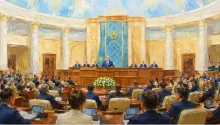
Tokayev describes this state of affairs without diplomatic cosmetics. At the opening of the first session of the Kurultai he spoke of events that are avalanche-like, chaotic and hard to predict, which draw almost every country into their orbit. The UN Security Council, in his assessment, has in effect ceased to fulfil its main mission. From this picture he draws the conclusion that has become his trademark: when the big players cannot agree, the middle ones step onto the stage.
THE EVOLUTION OF A SINGLE FORMULA
In a little over two years, Tokayev's "middle powers" theme has travelled from a general observation to a state programme.

- May 2024, Euronews. The article "Middle powers are capable of saving multilateralism": the traditional giants are working together ever less effectively, while middle countries are more flexible and more deeply committed to a multilateral approach.
- October 2024, Astana Think Tank Forum. While the major powers are absorbed in rivalry or incapable of compromise, it is precisely the middle ones that often become mediators in disputes. Peacefulness, he said, is not weakness but strategic prudence.
- September 2025, UN General Assembly. Middle powers are already playing a more significant positive role and can become bridges within the UN while the great powers are divided.
- April 2026, Antalya. Middle powers, including Kazakhstan and Turkey, today behave noticeably more responsibly than the great powers on the Security Council, which block solutions to key problems. The caveat was voiced too: no one claims to be the best in the world.
- September 2026, Bishkek. The role and responsibility of middle powers are growing: they are able and obliged to promote dialogue between centres of power and the development of collective decisions.
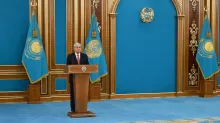
- 24 September 2026, the People's Council. Here the formula turned into a task: the goal is "to position Kazakhstan on the world stage as a Middle Power". Journalists rightly clarify: this is a foreign-policy goal, not a new official status.
- Republic Day 2026. Tokayev noted that abroad Kazakhstan is increasingly called a middle power.
Note the trajectory. First "middle powers in general", then "ones like us", then "we are one", and finally "this is our task". This is the normal path of any foreign-policy doctrine, and it also shows where observation ends and ambition begins.
WHY THE MIDDLE CLASS SPECIFICALLY
The middle-class analogy works better here than it might seem at first glance.
First: they need rules. Those at the top can live outside the rules: they have security, lawyers and a reserve airfield. Those at the bottom live outside the system; they have nothing to lose. The middle class lives inside the system: it needs contracts that are enforced, courts that judge, and a currency that does not turn into a scrap of paper. It is the same with powers. A superpower can afford to ignore international law because it has something with which to replace it. A middle power cannot: it has neither the strength to dictate nor a shield to sit it out. That is why middle countries turn out to be the main consumers and the main defenders of the UN Charter, and this is what Tokayev says from the podium.
Second: they are shock absorbers. The middle class pays taxes, generates demand, goes to the polls and sits at home during Qantar, but it is precisely its trust or distrust that decides whether the system is worth keeping. Middle powers do the same job at the international level: they mediate, they keep venues open for negotiations, they ensure transit, they stop a conflict from becoming total. Kazakhstan did not join the Western sanctions, but it took on obligations not to allow them to be circumvented. This is a typical behavioural pattern of the middle class: not to rebel, not to sing along, but to manoeuvre so that the building does not collapse.
Third: they pay first. When the system cracks, the first to suffer are not those with a margin of safety, nor those with nothing to lose, but those in the middle. Currency swings, "secondary" sanctions risks, transit corridors that depend on other people's wars: all of this is the middle power's mortgage.
Fourth, and most ironic: self-certification. The middle class adores considering itself the only honest taxpayer in the country. Middle powers, judging by the April statement from Antalya, are not immune to the same temptation: "we are more responsible than the big ones" is easy to say from a hall where there is not a single big one. A pleasant thought, but it has to be proved by deeds.
WHERE THE ANALOGY BREAKS DOWN
The middle class is defined by income, and it is hard to argue with figures. A middle power is defined by recognition, and here the decisive word is not its own. You can declare yourself a middle power, just as you can declare yourself an intellectual, but whether the neighbour believes it is tested in practice.
Hence two traps.
The leverage trap. A mediator without leverage turns into a postman: he delivers the letter and receives a polite "thank you, no". A telling example: on 25 July in Omsk, Tokayev proposed to Putin that the conflict with Ukraine be frozen and a return made to the "Istanbul formula 2.0" under the guarantees of the great powers. The proposal was bold in its place and time, but the Kremlin did not accept it, and critics rightly note that a freeze under the patronage of those same great powers is more likely to fix the front line than to solve the problem. A middle power can propose a framework, but it cannot force one. Its resource is trust, not pressure.
The façade trap. A genuine middle class is impossible without institutions: protected property, an independent court, normal competition. Without them it remains a statistical fiction that, at the first crisis, flies abroad together with capital. It is the same with powers: a bridge between the great ones, built on corruption and weak institutions, holds only until the first heavy lorry. The external agency of which Tokayev speaks is fed by the internal: the quality of the state, economic diversification and the way the authorities treat their own citizens. A fine speech in New York is no substitute for an audit in Astana. Any claim to a role comes with homework.
IN LIEU OF A CONCLUSION
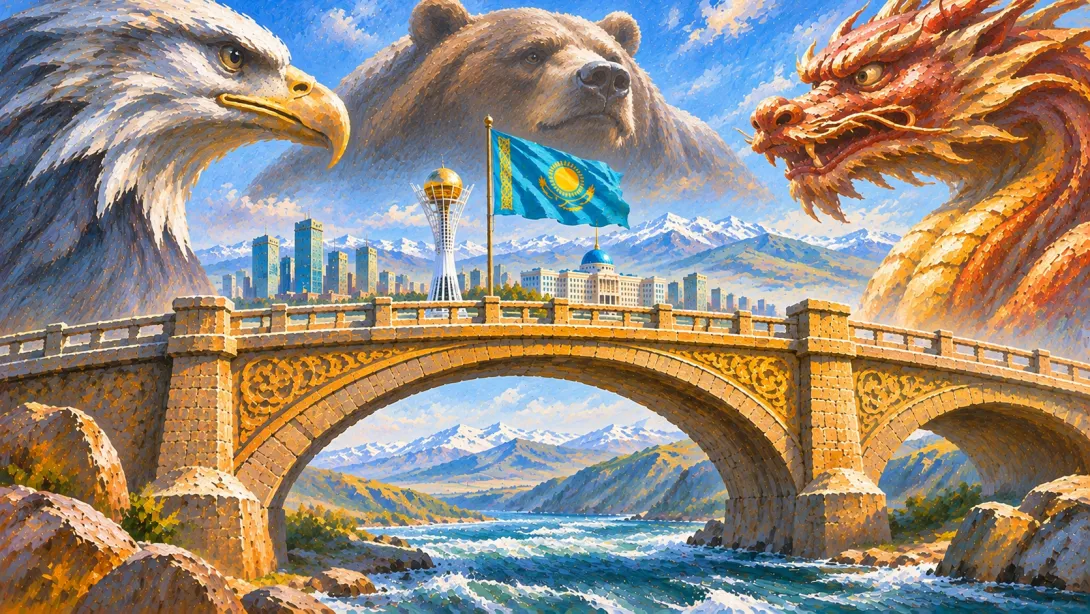
The middle class does not write the rules and does not win wars, but if it disappears, everything else collapses. Middle powers today find themselves in the same position: they are not the vanguard of a new world, but its load-bearing structures. Tokayev is right in his diagnosis: while the great powers argue, the bridges have to be built by those in the middle. The only question is whether those bridges will withstand the load.
The status of a middle power can be neither proclaimed by decree nor received as a gift. It is earned: with instruments, reputation and patience, for which no one is obliged to applaud. And it is recognised by those who yesterday were certain that being in the middle simply meant "some sort of nobody".
Author: Kirill Pavlov