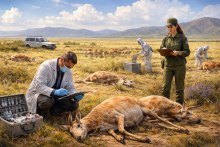
Quarantine has been introduced in the rural district of Ulken Aksu in the Uyghur district of the Almaty region due to an outbreak of anthrax. A few days ago, four cases suspected of infection were recorded in the area. The preliminary cause of the illness is the involvement of local residents in the slaughter of a sick animal.
Earlier, the regional akimat stated that anthrax is not transmitted from person to person and that quarantine would not be introduced. However, on 5 September, the results of bacteriological tests confirmed the presence of anthrax in samples taken from two head of cattle, after which it was decided to introduce a quarantine.
For context, back in spring the FB RK editorial team suggested that animal burial sites flooded during the spring floods could pose a significant threat to Kazakhstanis. In connection with this, we requested data from the Ministry of Agriculture on how many anthrax burial sites were flooded during the floods.
At that time, in April, the ministry reported that across Kazakhstan there were 10 flooded anthrax burial sites, noting that laboratory tests of samples from these sites had returned negative results, and there was no threat of an epidemic.
Later, in May, the Ministry of Agriculture stated that as a result of the floods, as many as 12 anthrax burial sites had been flooded. These included 3 sites in Aktobe and West Kazakhstan Region, and 6 sites in North Kazakhstan Region.
The ministry, as before, assured that there was no threat of an epidemic and noted that it was monitoring the epizootic situation in the country. The ministry reported that active vaccination of livestock against particularly dangerous diseases was being carried out in the regions.
However, in August, due to an outbreak of anthrax in cattle, quarantine was introduced in the village of Priryechnoe in the Denisovsky district of the Kostanay region. Furthermore, there were rumours that the meat of livestock that died during the floods was being ground into mince and sold in various catering outlets and markets. The Ministry of Agriculture, as is traditional, denied this information.
Today, a question arises: if the Ministry of Agriculture regularly stated that it was monitoring the epizootic situation regarding anthrax in the country and was vaccinating cattle, how did a sick animal end up being slaughtered in the Uyghur district?
Given that the ministry's statements about the absence of a threat of anthrax infection have not been confirmed, doubts also arise regarding the assurances that the meat of livestock which died during the floods did not reach the shelves of Kazakhstan's markets.
Furthermore, as of today, there is at least one case of the slaughter of a sick animal, which should previously have been vaccinated in a timely manner, and, in the event of illness, disposed of. And it is unknown how many head of infected livestock were ultimately slaughtered and sold to Kazakhstanis in this way.