The FBRC editorial team continues its series of articles on insect control in the regions of Kazakhstan. In the Pavlodar region in 2026, insect treatment is being carried out using a combined model — with a predominance of biological methods and additional application of chemical agents.
The main focus is on treating the larval stage of insects.
HOW BIOLOGICAL PROTECTION WORKS
According to the Akimat of the Pavlodar region, disinsection activities began on 6 April 2026 with the treatment of temporary water bodies against the larval stage of biting midges and will last approximately until July.
It is reported that the bulk of the work in the region involves the biological method. To combat larvae, the preparation 'Bacticid' based on the bacterium Bacillus thuringiensis var. israelensis is used. It accounts for about 95% of all treatments.
As experts previously explained, the mechanism of action of such preparations is that the bacteria, upon entering the body of the larvae, damage their intestinal tract, leading to the death of the insects.
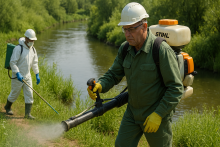
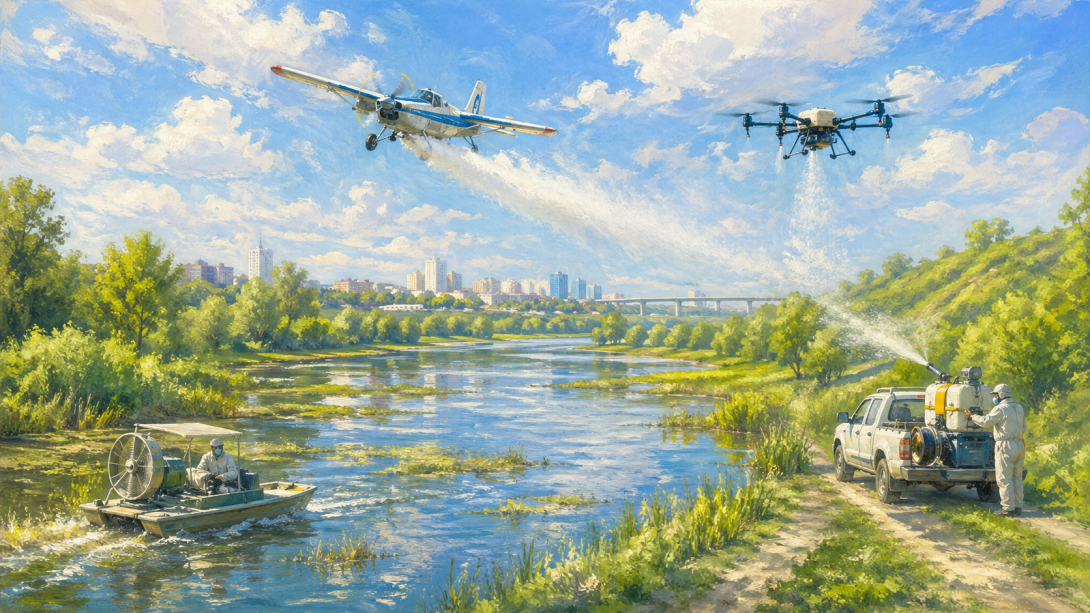
Biological treatment is carried out in river floodplains and water bodies using aircraft and sprayers and is considered safe for the aquatic environment. However, completely eliminating the insect population is impossible, and their total eradication could disrupt the ecosystem.
WHY CHEMICAL PREPARATIONS ARE USED
To control adult individuals, which are less sensitive to biological agents, barrier treatment is used. This scheme serves as a supplement to biological protection.
In 2026, the preparations 'K-Otrine' and 'PHOBI' are being used, containing deltamethrin and d-allethrin.
- Deltamethrin can cause symptoms of acute poisoning if application procedures are violated and is toxic to bees and aquatic organisms.
- D-allethrin is also toxic to the aquatic environment and can cause respiratory tract irritation if used improperly.
At the same time, other preparations are being shown on social media in the region, indicating a wider range of agents than is reflected in the official response. However, the Akimat emphasises that all preparations are used within established dose limits.
WHY THE COMBINED APPROACH IS MAINTAINED
The simultaneous use of biological and chemical methods is related to the specifics of the insects' life cycle. Biological agents are effective against larvae, while additional treatment is required to control flying adults.
HOW THE PROCESS AND INFORMATION ARE MANAGED
Treatments in the region are carried out at various levels — from water bodies to populated areas, including the territory along the embankment from the railway bridge to the Usolka dam.
10 small aircraft are involved in the disinsection, and the total area of aerial treatment is 172,000 hectares. Additionally, barrier treatment is planned in 67 populated areas, river treatment along more than 3,200 km, and in hard-to-reach places, drones are being used.
Preparation for the season is also reported: preparations have been stockpiled, a reserve of biological suspension has been formed, local treatments have begun, and basements have been treated in Pavlodar, Aksu and Ekibastuz.
Information on the progress of disinsection is published on social networks, including on the page @gnus.tabigat_pv, and is covered in the media.
RECENT PRACTICE
The approach to disinsection in the region remains unchanged: since 2024, the main focus has been on biological protection, with chemical preparations used only to a limited extent — in the form of barrier treatment.
In subsequent years, this model became established as a combined approach and continues in 2026: biological agents are used against larvae, and chemical agents are used to control adult individuals.
Against this backdrop, in other regions of Kazakhstan, in several instances the bulk of disinsection is carried out mainly using chemical means, including preparations that are unsuitable for use in urban environments.
The practice in the Pavlodar region shows that it is possible to shift the main volume of treatments towards safer methods.