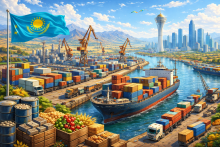
In the first four months of 2026, Kazakhstan's total foreign trade turnover increased by 7.9% compared to the same period last year, reaching almost $44.9 billion. This is a solid figure, but it hides one important detail: imports are growing significantly faster than exports. The inflow of goods into the country rose by 11.3%, while outflows increased by only 5%. Kazakhstan sells oil, copper and grain, but buys more and more finished goods, including food products.
TRADE TURNOVER WITH THE EAEU
This trend is particularly evident in trade with the countries of the Eurasian Economic Union (EAEU). According to data from the Bureau of National Statistics, trade turnover with union partners grew by 13.3%, while Kazakh exports to the union countries actually decreased by 7.9%. However, imports from them jumped sharply by 24.1%, to $7.16 billion over four months. The main partner here is Russia, which accounts for 87.6% of all trade turnover with the EAEU countries.
WHAT IS BEING IMPORTED
Food occupies a special place in this import flow. Dairy products from EAEU countries arrive in Kazakhstan in huge volumes. From January to April 2026, a total of around 52,000 tonnes of dairy goods worth over $130 million were brought in from Russia, Belarus, Kyrgyzstan and Armenia, and this covers only six main product categories.
Cheese and cottage cheese lead in value: almost 10,700 tonnes and more than $54 million over four months - an average of $13.6 million per month. The main suppliers are Russia and Belarus. Condensed milk accounted for another $29 million in imports, with supply volumes of over 12,400 tonnes.
Kefir, yoghurt and other fermented milk products - almost 14,500 tonnes worth $19.8 million. Butter - approximately 1,800 tonnes worth $9.3 million. Non-condensed milk and cream - almost 9,550 tonnes worth $12.3 million. Notably, Kazakhstan exported only $816,000 worth of raw milk to EAEU countries, meaning it imported 15 times more than it sold.
A similar picture emerges with grain. Kazakhstan is a major exporter of wheat to third countries, yet within the EAEU it is also a significant buyer. From January to April, over 721,000 tonnes of wheat worth around $114.6 million were brought in from union countries.
The dynamics of supply increased month by month: while 81,700 tonnes were brought in in January, February saw 143,800 tonnes, and March a record 267,400 tonnes. Adding barley, another 69,400 tonnes worth $12.6 million, total grain imports from the EAEU exceeded 798,000 tonnes with a value of over $128 million.
WHAT NEXT
So, dairy and grain imports alone from EAEU countries over four months amounted to more than $258 million. And this is a very telling signal, because despite the country's agricultural potential, Kazakhstan continues to increase its imports of basic food products. Exports are growing slower than imports, and the trade balance is shrinking - from $4.12 billion a year ago to $3.15 billion now. This means the issue of food self-sufficiency is becoming increasingly pressing.