1 December 2026 the state-owned Company for the Management of Returned Assets (CMRA) will, for the twentieth time, try to sell a pair of De Beers earrings valued at KZT 158.1 million. Alongside them, a Van Cleef & Arpels chain, a diamond set, a Breguet watch and a YEPREM ring are once again going under the hammer: each lot has already been listed more than 20 times. Having studied the documents that the CMRA attaches to the lots, FBRK found that the prices of these items rest on 2024 valuations whose validity has long expired, and that the reports contain plenty of errors and boilerplate fragments lifted from other documents.
WHAT IS UP FOR AUCTION
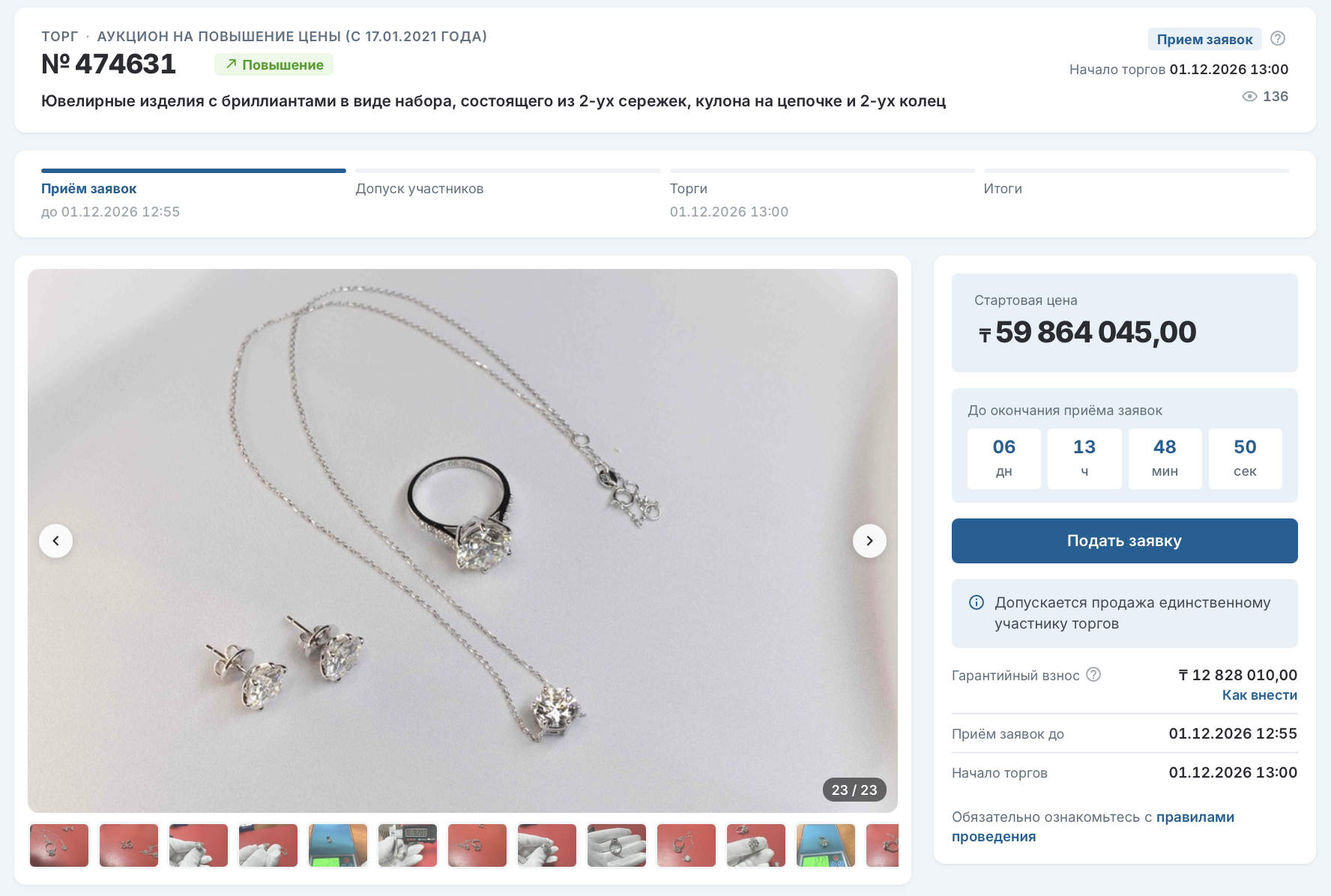
FBRK collected data on 651 CMRA auctions on the E-Qazyna platform from October 2024 to December 2026 whose descriptions mention diamonds. 588 of them did not take place; only 35 did. Almost all the sales went through at the starting price with a single bidder: for example, the YEPREM earrings went for KZT 6.65 million against a valuation of KZT 9.5 million.
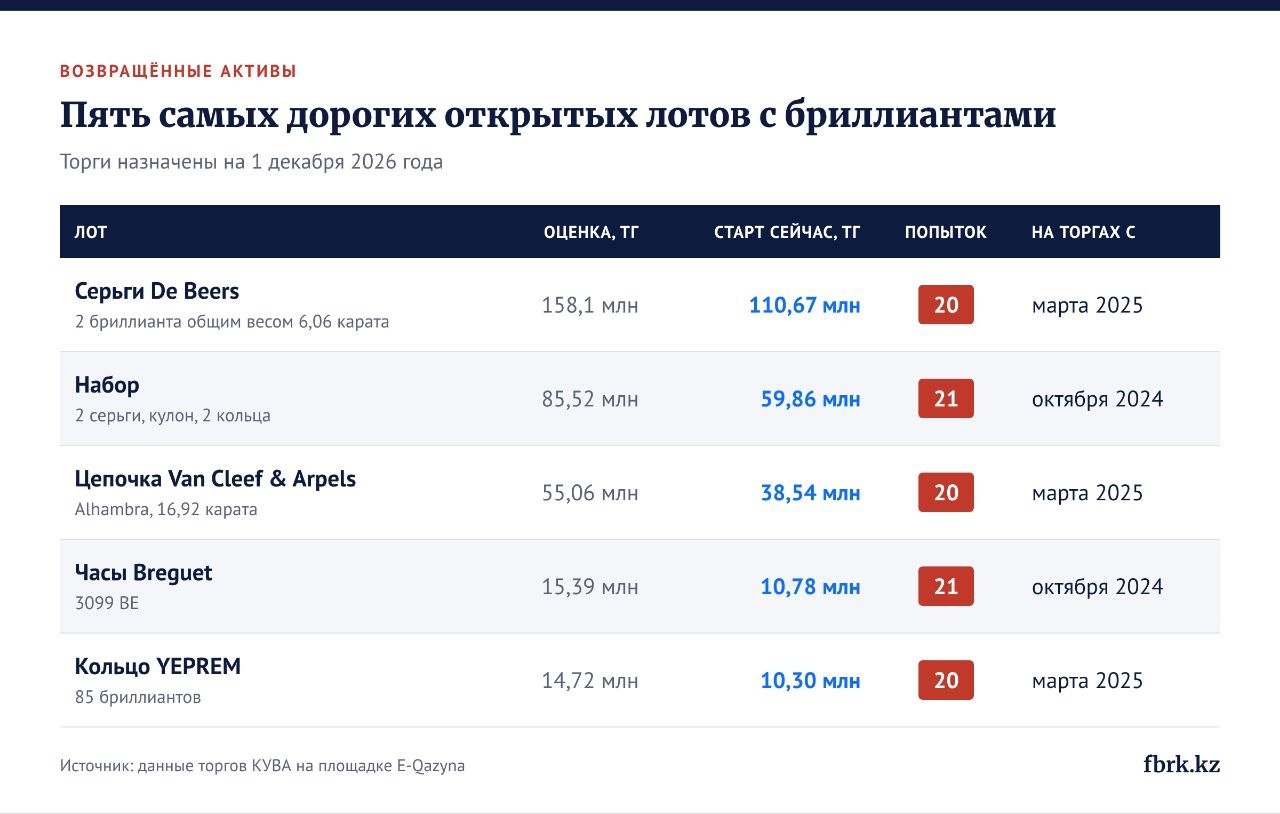
The five most expensive open lots featuring diamonds, whose auctions are scheduled for 1 December 2026:

HOW THE RETURNED-ASSETS AUCTIONS WORK
The CMRA was established by a Government resolution of 21 September 2023 to implement the law "On the Return to the State of Illegally Acquired Assets". According to Forbes Kazakhstan, as of February 2026 the company had taken on 71 property items and 196 pieces of jewellery worth KZT 97.6 billion. The proceeds go to the Special State Fund.
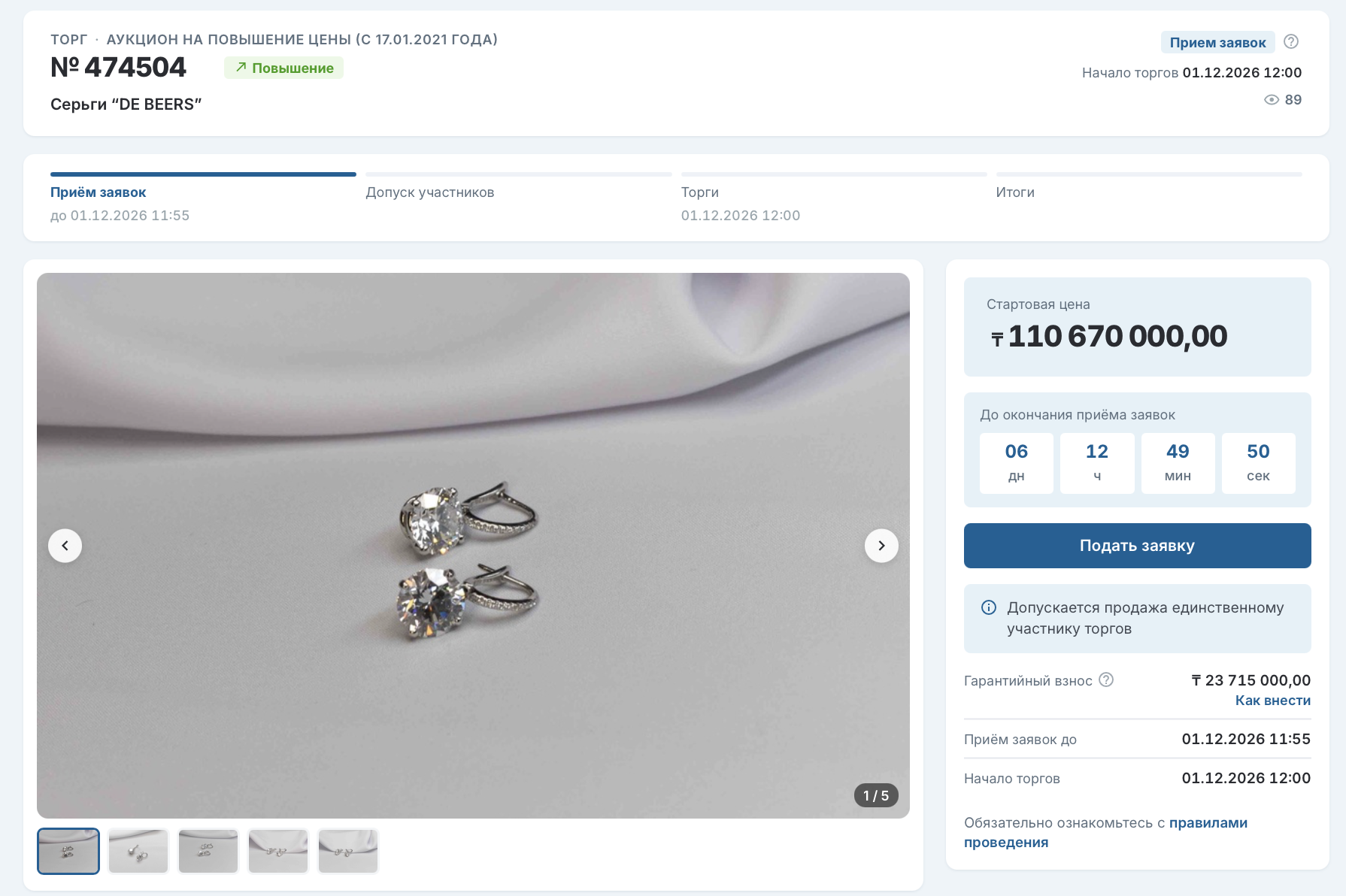
The sale procedure is set by the Rules for the Management of Assets Transferred to the Management Company. The starting price equals the valuation; at the second auction it drops to 85%, at the third to 70%. If there is no buyer, a tender and a commercial competition are held at the full valuation, and then the cycle begins again "until actual sale". That is precisely why the De Beers earrings, unsold in January 2026 at KZT 110.67 million, were listed again at KZT 158.1 million.
The rules also provide for other routes: sale on international platforms or to the former owner at not less than the appraised value. Whether these were used for the jewellery is not clear from the public data.
WHAT IS WRONG WITH THE VALUATION OF THE RETURNED JEWELLERY
Two valuation reports are attached to the lots, and both were drawn up not for specific items but for entire batches. The report by Almaty Valuation Centre LLP covers 69 items (earrings, chain, ring); the report by The Expert LLP covers 24 "luxury items" (the set, the watch). A buyer of earrings worth a hundred million is left to find their own line in a 182-page document.
Both reports stipulate that the final value is recommended for a transaction only if no more than six months have passed since the date of preparation. The valuation of the set and the Breguet watch is dated March 2024 – by the first auction in October 2024 that period had already expired. The valuation of the earrings, chain and ring was carried out on 23 December 2024, with the contract, the inspection and the valuation date for all 69 items falling on the same day. According to the CMRA's trial balance as of 17 February 2026, 42 items worth KZT 743.8 million are carried at these same valuations, without any write-down.
The price of the De Beers earrings rests entirely on a jeweller's opinion: market comparables were given a weight of 0%, and the opinion itself states a single figure with no methodology or sources.
The Breguet 3099 BE watch is valued at the price of a new watch of a different reference, the Reine de Naples 8928BB, from a Moscow online store, less 30% "wear".
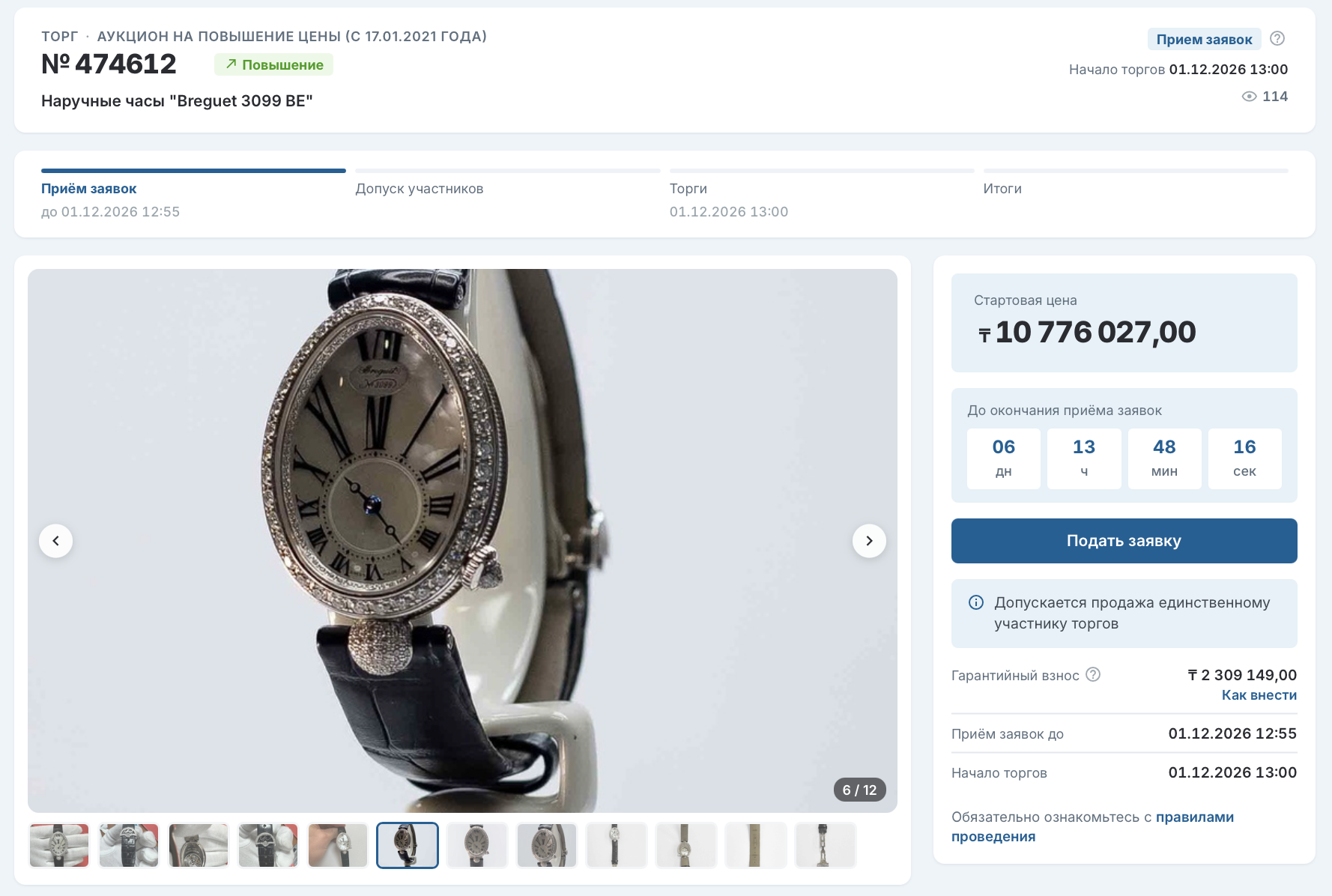
The YEPREM ring – on the basis of a single listing from the same store. The stones in the set were calculated using an online calculator, and the valuer himself writes that the valuation was carried out without a gemmological examination. Where, in that case, the precise colour and clarity characteristics of the stones came from is not stated in the report.
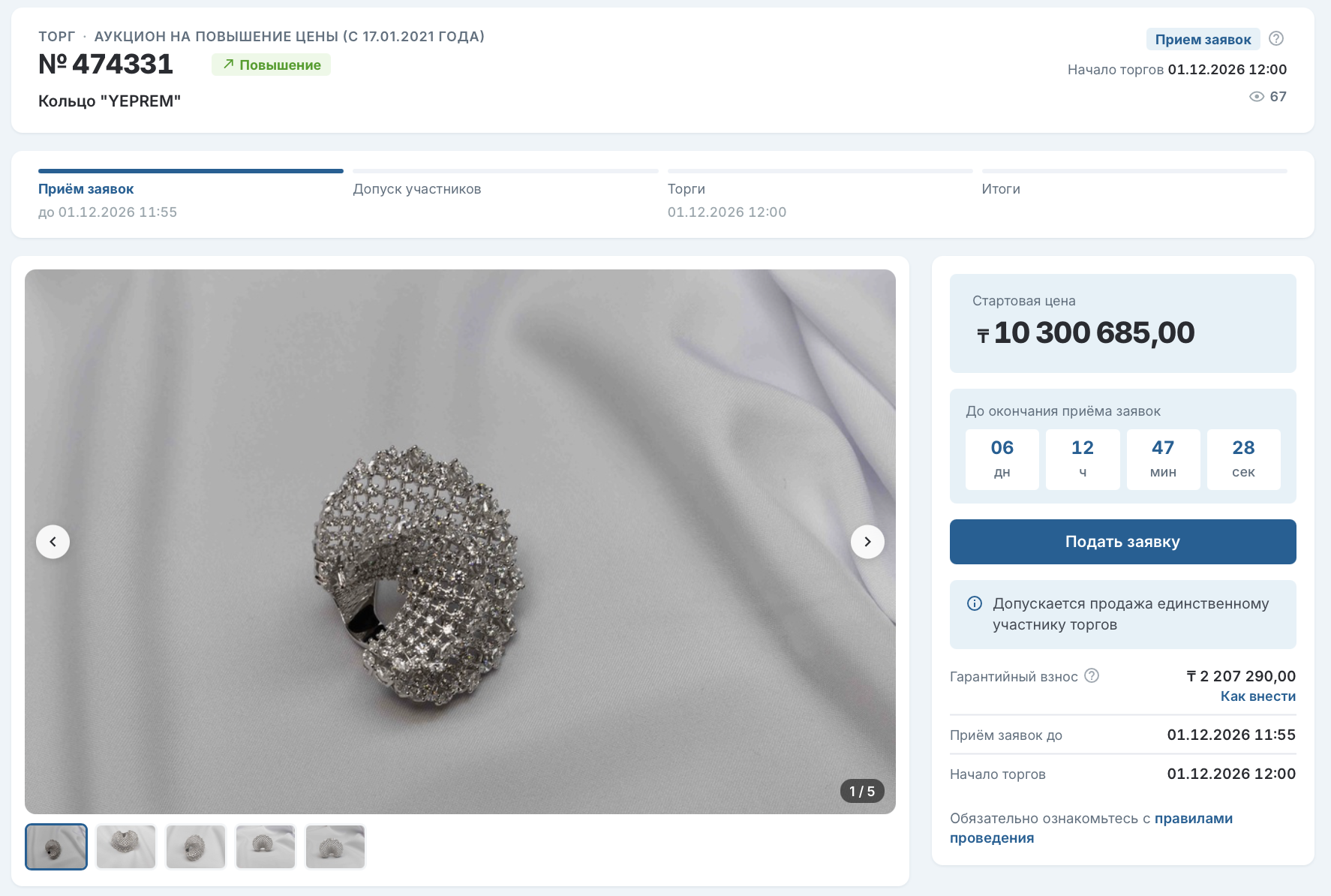
The report on the earrings, chain and ring in places looks as though it was assembled from other documents. Explaining why the jewellery can be compared with similar items on the market, the valuer writes about mobile phone numbers: they "have an actively traded market". Another calculation method, based on manufacturing cost, is explained using the example of buying a new motor vehicle.
There are also contradictions of substance. In the text the valuer states that he declined to compare with market comparables. But in the final calculations those comparables determine almost half the price – 47.22%.
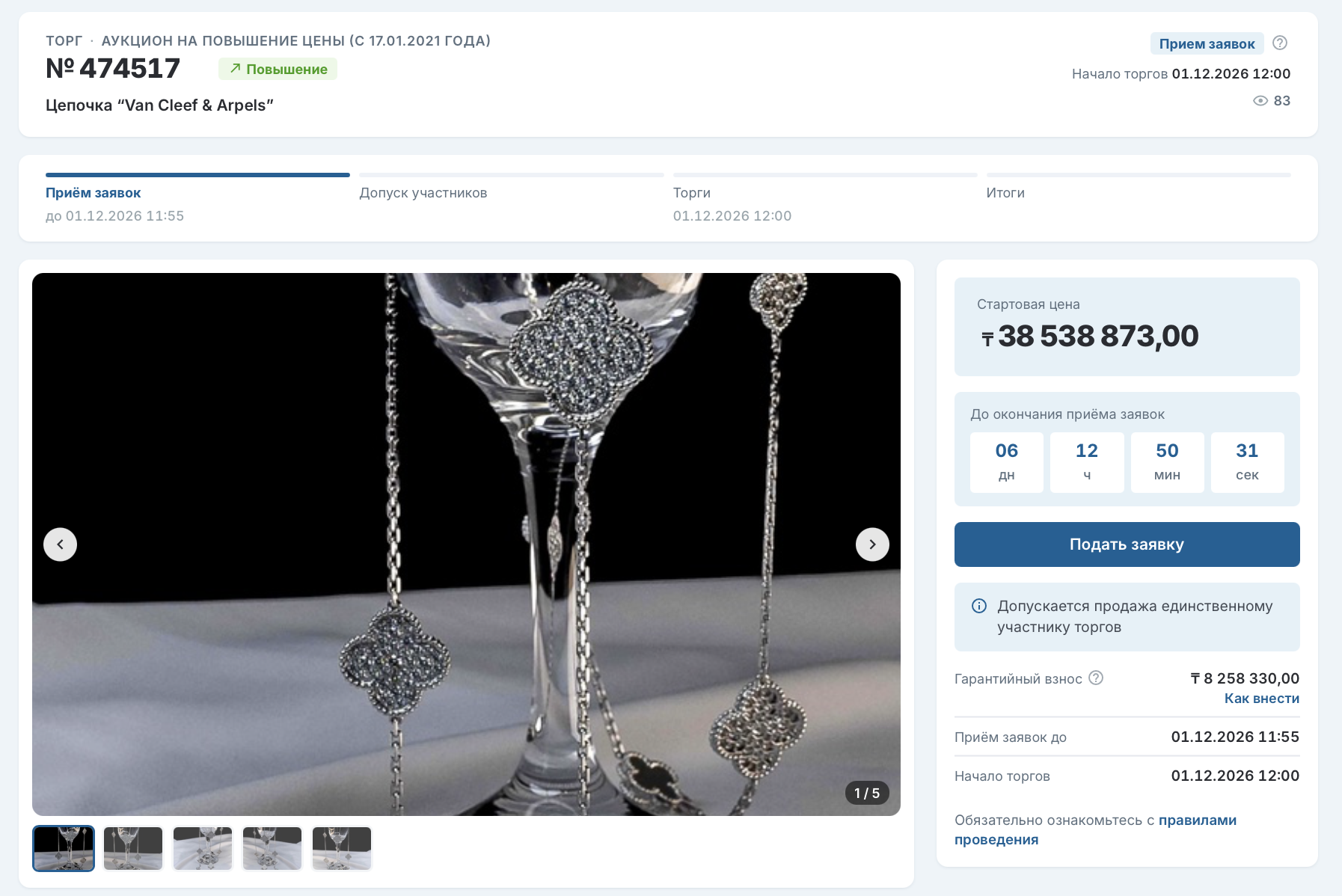
The weight of the Van Cleef & Arpels chain does not add up. In the description the metal weighs 80.6 g out of 84 g, meaning the diamonds account for about 17 carats, as stated in the lot. In the calculation table the metal already weighs 83.77 g, leaving only about 1.3 carats for the stones.
WHO THE JEWELLERY MAY HAVE BELONGED TO
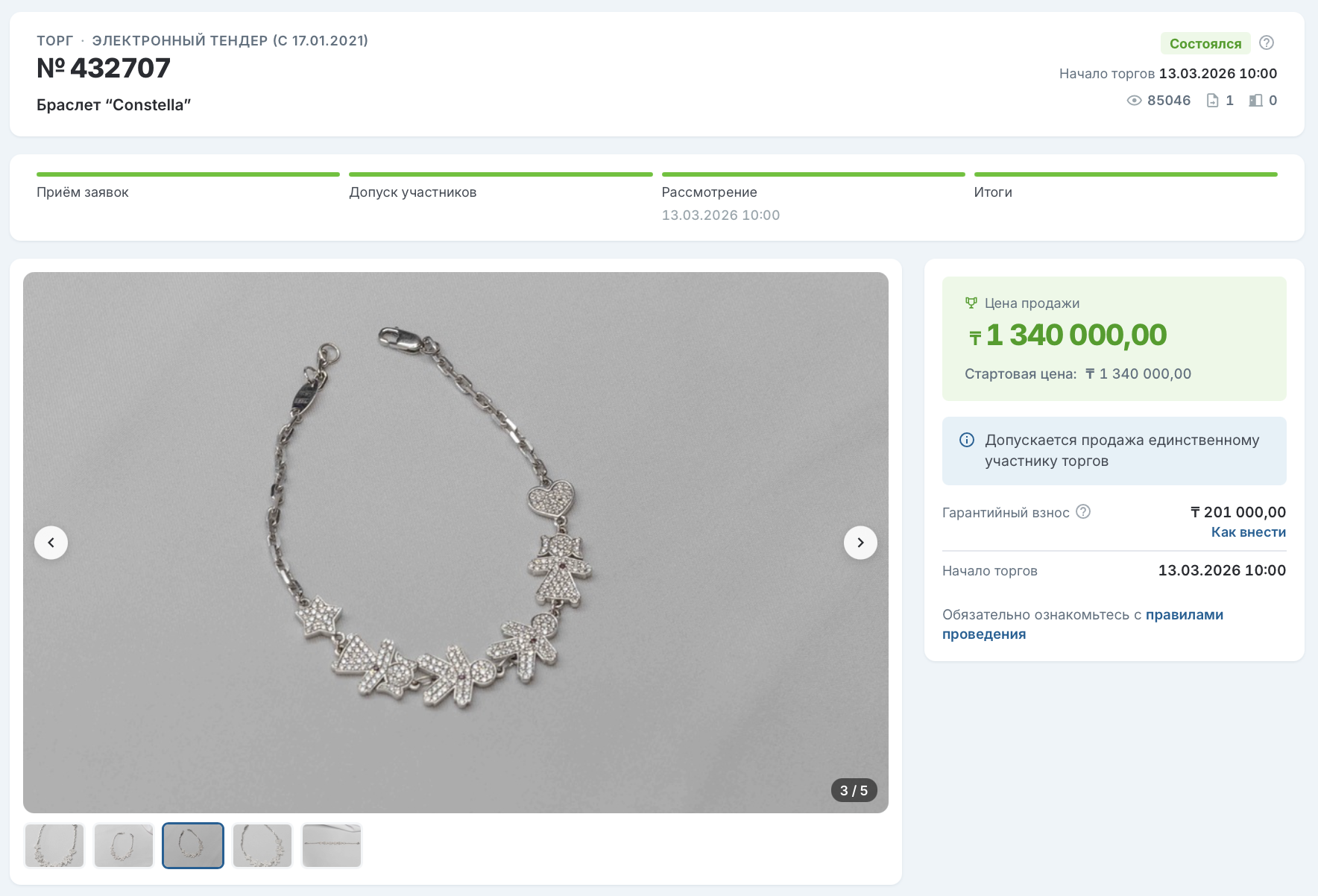
The CMRA does not name the former owners, citing confidentiality. However, the report that the company itself attaches to the De Beers earrings, the chain and the ring mentions a "bracelet with engraved inscriptions". The inscriptions are quoted verbatim: four names with dates of birth. This concerns a Constella bracelet in white gold with 254 diamonds and four rubies, valued at KZT 1.34 million. In March 2026 it was sold at auction.
According to Centralmedia24, citing its own sources, these dates match the birth dates of the children of Kairat Satybaldy. Three of the four names on the engraving match those which, according to Radio Azattyk, appeared among the co-owners of property in Dubai together with Satybaldy's unofficial wife. This connection has not been officially confirmed.
In 2022 Satybaldy was found guilty by a court and sentenced to six years' imprisonment with confiscation of property. The unserved part of the term was later replaced with restriction of liberty. Among other things, he returned to the state 174 items of jewellery, watches, coins and other luxury goods, and over two and a half years assets worth KZT 783 billion in total.
Less is known about the second batch – the set and the watch. In the report the "Client" and "Owners" fields are empty, and the inspection location is given as a Jusan Bank branch in Astana.
WHAT THE ENDLESS AUCTION CYCLE MEANS
The valuation is the only anchor of the entire process: the starting price, the discounts and the guarantee deposit – which for the earrings amounts to KZT 23.7 million – all depend on it. If the valuation is inflated, the items will keep going round the auction cycle; if it is understated, the sole bidder may get them below market value. Which scenario applies in each case cannot be determined without an independent revaluation. For now, the unsold jewellery is carried on the balance sheet at full value, and the Special State Fund does not receive a single tenge.