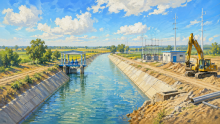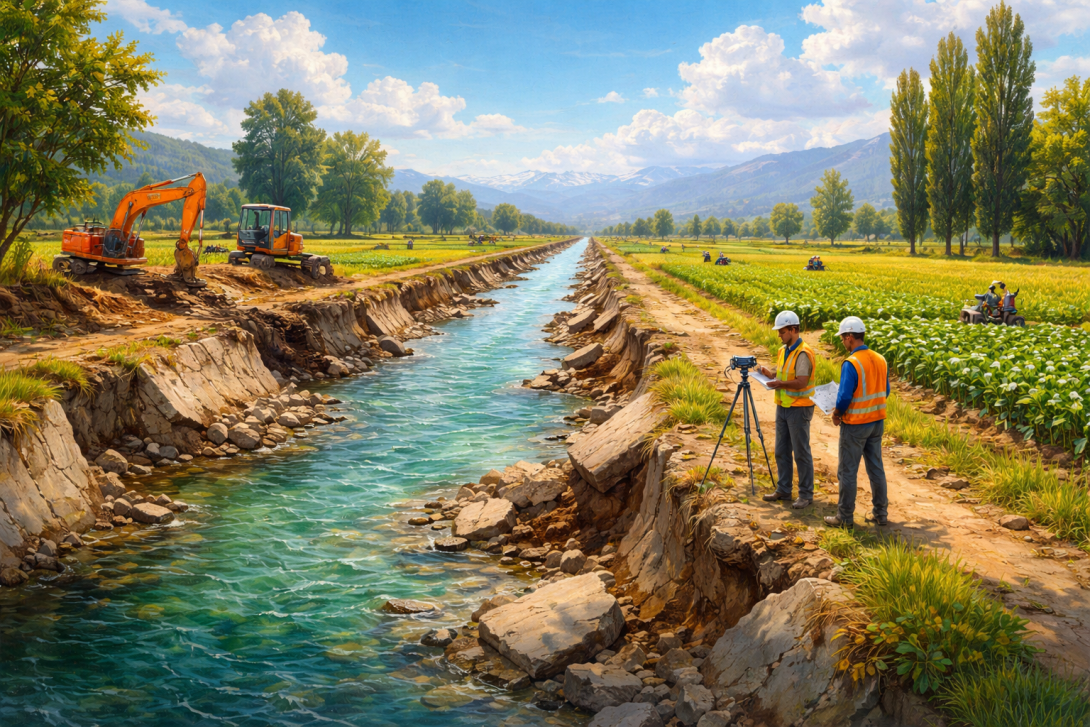
In April of this year, the media widely reported on the destruction of the K-30 canal in the Zhetysay district of the Turkestan region, on which the irrigation of 1,700 hectares of farmland depends. The banks of the structure were collapsing, its capacity was declining, and farmers from the villages of Zhetykazyna, Zhanadala, and Zerdeli, along with thousands of residents, risked being left without water at the height of the growing season. The editorial board of the FBKK decided to investigate the situation independently and sent an official request to the Ministry of Water Resources to find out exactly how the department intends to solve the problem, and indeed whether it intends to at all.
WHAT IS WRONG WITH THE CANAL
As reported by the publication 24KZ in April 2026, the K-30 canal was in an emergency state. Residents feared its destruction would leave thousands of people without a harvest. It was noted that the structure had been used for a different purpose since 2011: originally built to drain groundwater and flush out salts, it was later repurposed for mechanical water lifting for irrigation. Since then, no major reinforcement of the channel has been carried out.
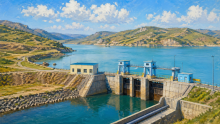
The Ministry of Water Resources and Irrigation (MWRI) stated that the 15.77 km-long 'Mechanical Water Supply' canal from the Shardara Reservoir and the inter-farm canal K-30, which is 24.87 km long and was the subject of the reports, have been classified as Category II in terms of technical condition following a technical inspection. This means it is a 'serviceable structure', but such an assessment comes with a direct recommendation: to carry out major repairs or reconstruction of the hydraulic engineering structure. 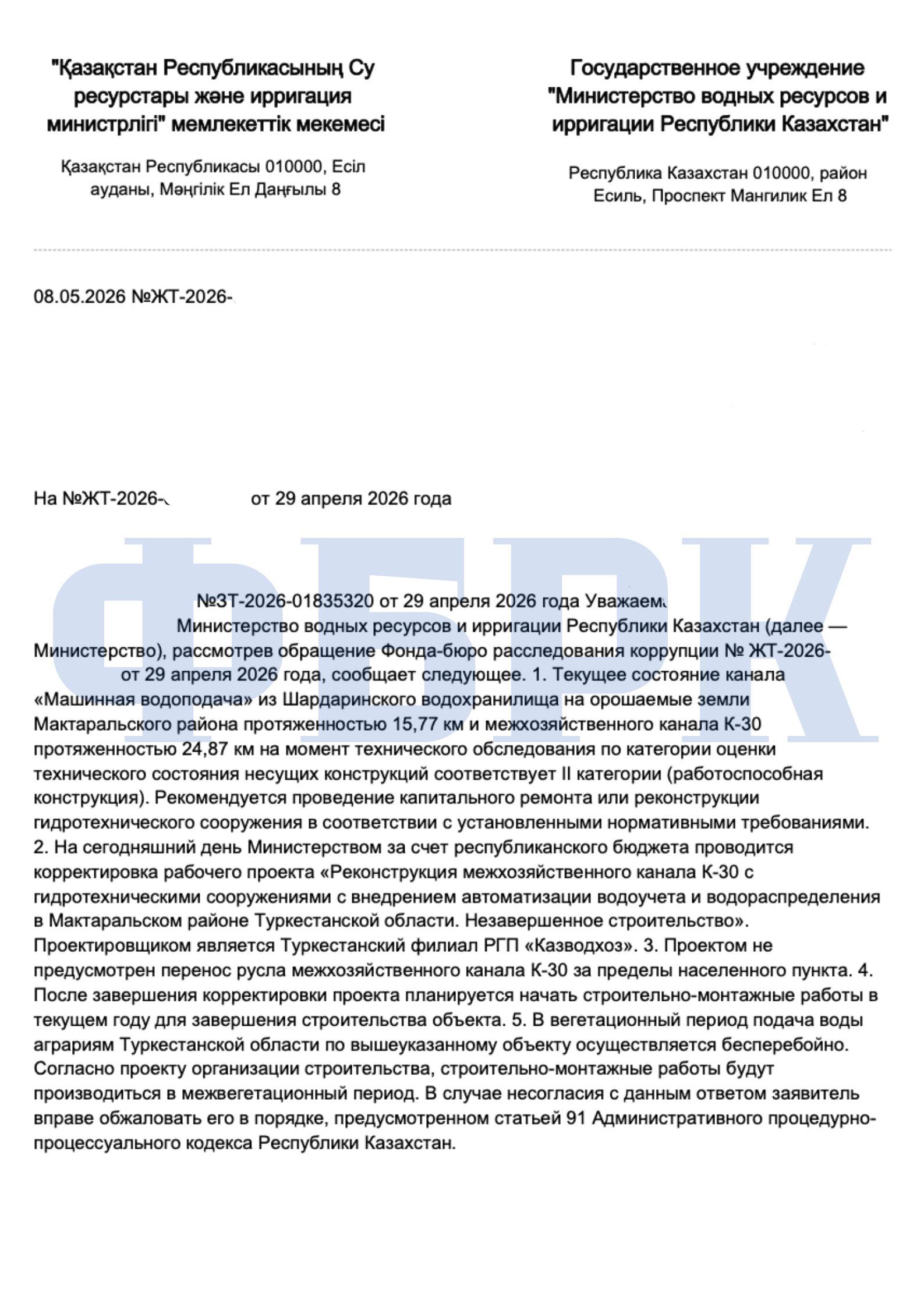 In other words, according to the department's assessment, the canals are still functioning adequately for now, but without intervention, the situation will only worsen.
WHAT THE MINISTRY IS DOING
According to the MWRI, using funds from the republican budget, adjustments are currently being made to the working project 'Reconstruction of the inter-farm canal K-30 with hydraulic structures, incorporating the automation of water accounting and distribution in the Maktaaral district of the Turkestan region. Unfinished construction.' The designer is the Turkestan branch of the RSE 'Kazvodkhoz'.
After the adjustments are completed, construction and installation work is planned to begin this year. It will be carried out during the inter-vegetation period — that is, outside the irrigation season — so as not to interrupt the water supply to farmers.
One of the options previously considered by local specialists from 'Kazvodkhoz', as reported by the publication 24KZ, involved relocating the canal's channel outside the populated area. However, in its response, the MWRI indicates that the current project does not provide for such a relocation.
The Ministry emphasises that during the growing season, the water supply to farmers in the Turkestan region via this facility is carried out without interruption. The construction and installation work is scheduled for the inter-vegetation period specifically to avoid affecting the irrigation season.
WHAT IS THE RESULT
The problem has been officially recorded, funding from the republican budget has been allocated, and the project documentation is being adjusted. However, the specific timeline for completing the project adjustments and starting the work is not stated in the response, only the rough target of 'this year'. Farmers who depend on the K-30 canal during the peak of the summer drought, when the level of the transboundary 'Dostyk' canal drops, will apparently only get clarity on the progress of the reconstruction once the project is finally approved.
Separately, it is worth noting that Kazakhstan directs approximately 65% of its total water balance to irrigation, and it is here that water losses are maximal: worn-out channels, a lack of precise accounting, and uncontrolled water abstraction. It must be said that through such infrastructure, no less water is lost than actually reaches the fields. The Ministry reports an uninterrupted supply, which is good. But 'flowing' and 'reaching' are fundamentally different things.
Against this backdrop, state advice to citizens to wash clothes less often, not leave the tap running, and brush their teeth frugally looks particularly telling, but hardly useful. And while the K-30 canal awaits reconstruction, and the project undergoes yet another round of adjustments, the question remains open: how much water does the country lose not because there is too little of it, but because there is nowhere and no one to conserve it?