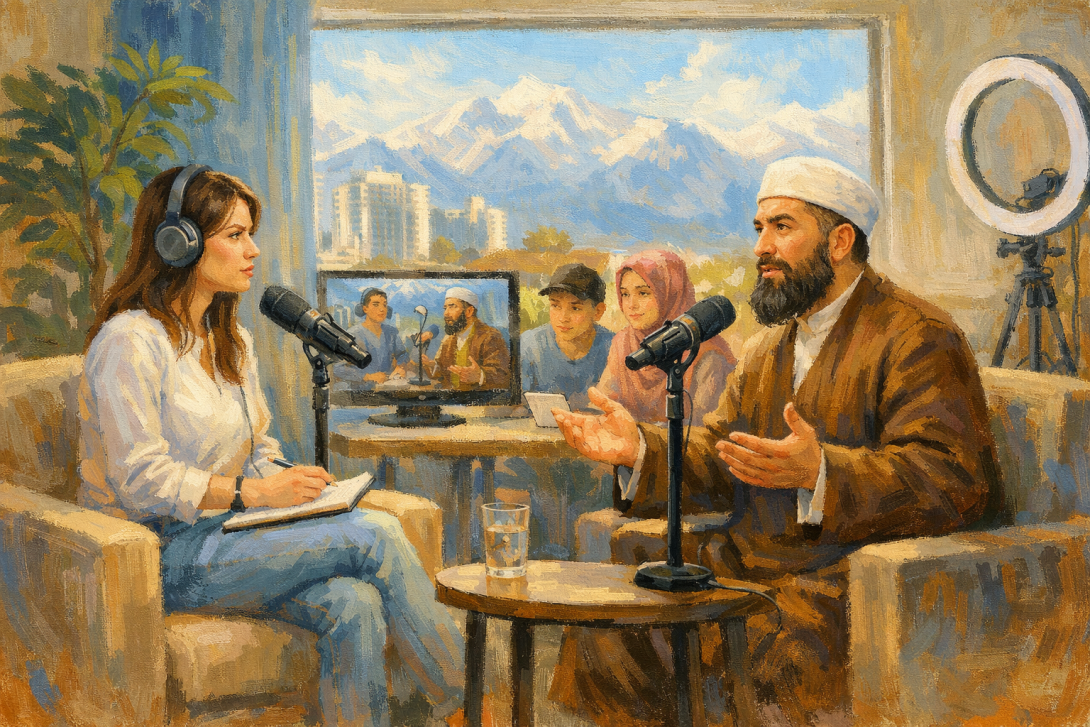
In the Kazakh media space, it is increasingly common to see bloggers and authors of major platforms inviting speakers with a pronounced pseudo-religious agenda for interviews and podcasts.
Their statements revolve around issues of control over women — their appearance, behaviour, and role in society. At the same time, such points are often presented as a simple point of view, without any attempt to challenge them or even call them into question.
As a result, the viewer begins to perceive this as normal, rather than a controversial position that requires discussion.
WHO IS REALLY SHAPING THE AGENDA
The speakers in such formats are, as a rule, consistent and predictable. They broadcast already established views and rarely step outside these boundaries. But the key question here is directed at those who give them a platform.
It is the content creators who decide whom to invite, which topics to raise, and how to structure the conversation.
When an interview takes place without critical questions or an alternative viewpoint, it ceases to be a dialogue. It is no longer a discussion but, in fact, a monologue amplified by the audience.
A NOTEWORTHY EXAMPLE
A recent case involving Imam Kurbanali Akhmett has been telling.
In one interview, he stated that after a conflict, he ‘gave away’ his second wife in marriage to his own student. According to him, the decision supposedly came from the woman herself. He also reported that he later entered a third marriage and supports polygamy.
His remarks quickly spread across social media and provoked a sharp reaction from users.
Later, in Almaty, he was held accountable. Law enforcement authorities stated that the man is not a representative of the official clergy, and his statements contradict the legislation and could negatively impact public consciousness and interfaith harmony.
In the end, he was fined 25 MCI (108,125 tenge) for violating the law on religious activities. A journalist who disseminated this content received a similar fine.
WHAT IS IMPORTANT HERE
This case in itself is not an exception. Similar views have been voiced before and are unlikely to disappear. The key point lies elsewhere: they gain significant reach precisely when they move beyond a narrow audience and appear on popular platforms.
Without critical analysis, such statements begin to be perceived not as a private opinion, but as an acceptable position. Young people, who largely shape their understanding of norms through media content, are particularly susceptible to this.
WHY THIS IS A QUESTION OF RESPONSIBILITY
A large audience always involves influence. And the choice of speakers in this sense is not a neutral decision. When a platform gives a voice to only one side and does not create conditions for debate, it effectively participates in cementing these views.
In this context, the discussion is no longer just about freedom of speech, but also about which ideas ultimately become the norm — and how they shape the perceptions of the next generation.