Prices in Kazakhstan rose more slowly in August 2026 than before: annual inflation fell to 9.8% - its lowest level since the start of the year. The indicator has been falling for the eighth consecutive month, but behind the overall figure lies a mixed picture: some goods are getting cheaper, while others are rising at double-digit rates.
HOW INFLATION HAS CHANGED
According to the Bureau of National Statistics, from January to August 2026, annual inflation fell every single month without exception - from 12.2% to 9.8%. A year ago the figure was the same - 12.2%, and in 2024 it was 8.4%. The monthly rise in prices also slowed: 0.6% in August 2026 compared with 1% a year earlier, with food falling in price over the month for the first time in five years by 0.1%, non-food goods rising 0.8%, and services 1.2%.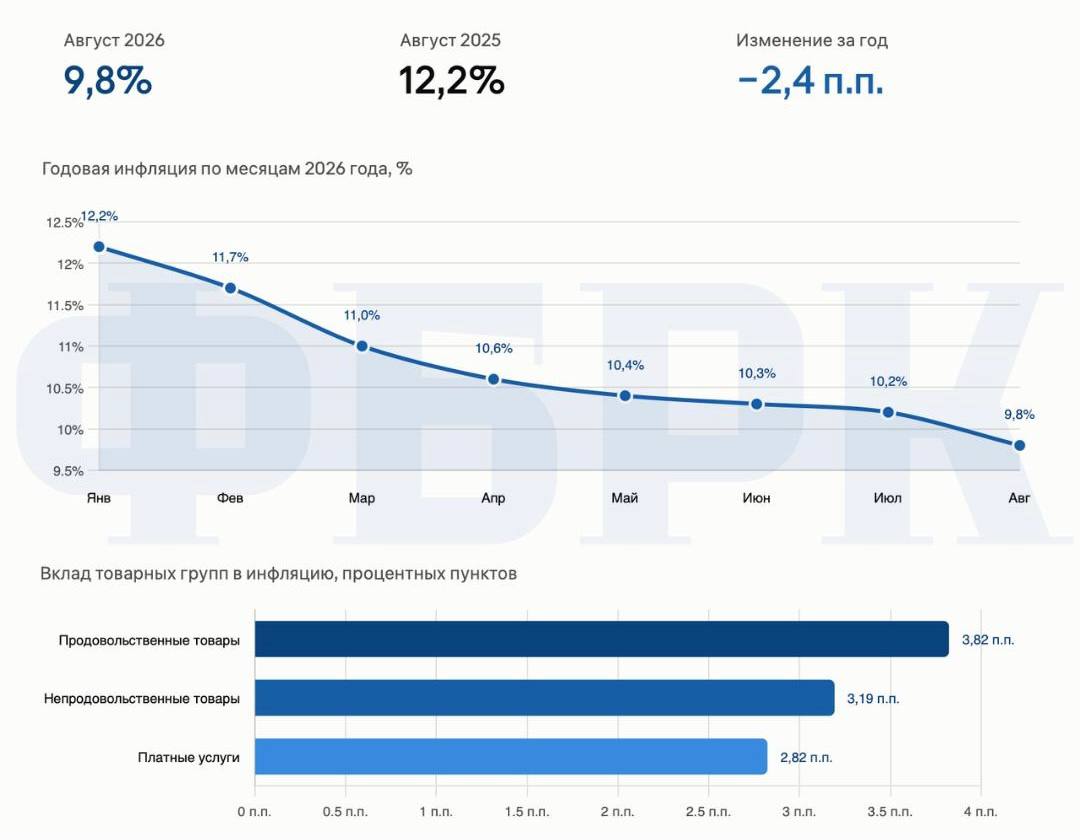
In other words, the fall in annual inflation is not a one-off effect of a single month, but a sustained trend. The indicator declined consistently in all eight months of 2026. At the same time, the current level (9.8%) is still noticeably higher than in August 2024 (8.4%), meaning that the retreat from the peak levels of 2025 has not yet returned inflation to its earlier pace.
WHAT IS GETTING MORE EXPENSIVE AND WHAT IS GETTING CHEAPER
Food rose in price over the year by 9.5% and made the largest contribution to inflation - 3.82 percentage points (p.p.) out of 9.8. The biggest increases were in meat and poultry - 12.9% (1.15 p.p.) and sausages - 14.3% (0.48 p.p.). Vegetables fell in price by 2.5%, and fruit by 0.7%.
Non-food goods rose by 11.4% (3.19 p.p.): leading the way are clothing - 10.2% (0.6 p.p.), personal goods - 13.1% (0.37 p.p.), and petrol - 12.8% (0.43 p.p.).
Paid services rose by 8.9% (2.82 p.p.). Rental accommodation increased by 17.1% (0.28 p.p.), while cold water fell by 40.9%, subtracting 0.21 p.p. The contribution of insurance and financial services has almost evaporated - from 1.08 p.p. in August 2025 to 0.01 p.p. a year later.
So despite the overall slowdown, the picture across product groups is extremely uneven. Meat products and clothing continue to rise at double-digit rates and remain the main source of inflationary pressure, while in certain categories (vegetables, fruit, cold water) prices are falling, partially offsetting the increases.
The sharp drop in the contribution of insurance and financial services is the most notable change in the structure of inflation over the year, but the Bureau's data does not specify what exactly caused it: a genuine reduction in tariffs or the fact that a sharp price spike from a year ago has fallen out of the calculation base.
WHERE INFLATION IS ABOVE AVERAGE
With a national average of 9.8%, the highest inflation is in the North Kazakhstan region (12%), the Zhetysu region (11.7%) and the Akmola region (11.6%). The lowest is in Karaganda (8.1%) and Almaty (8.7%). A year ago the picture was the reverse: the Karaganda region led on inflation - 14.4% - and now shows the lowest price growth in the country.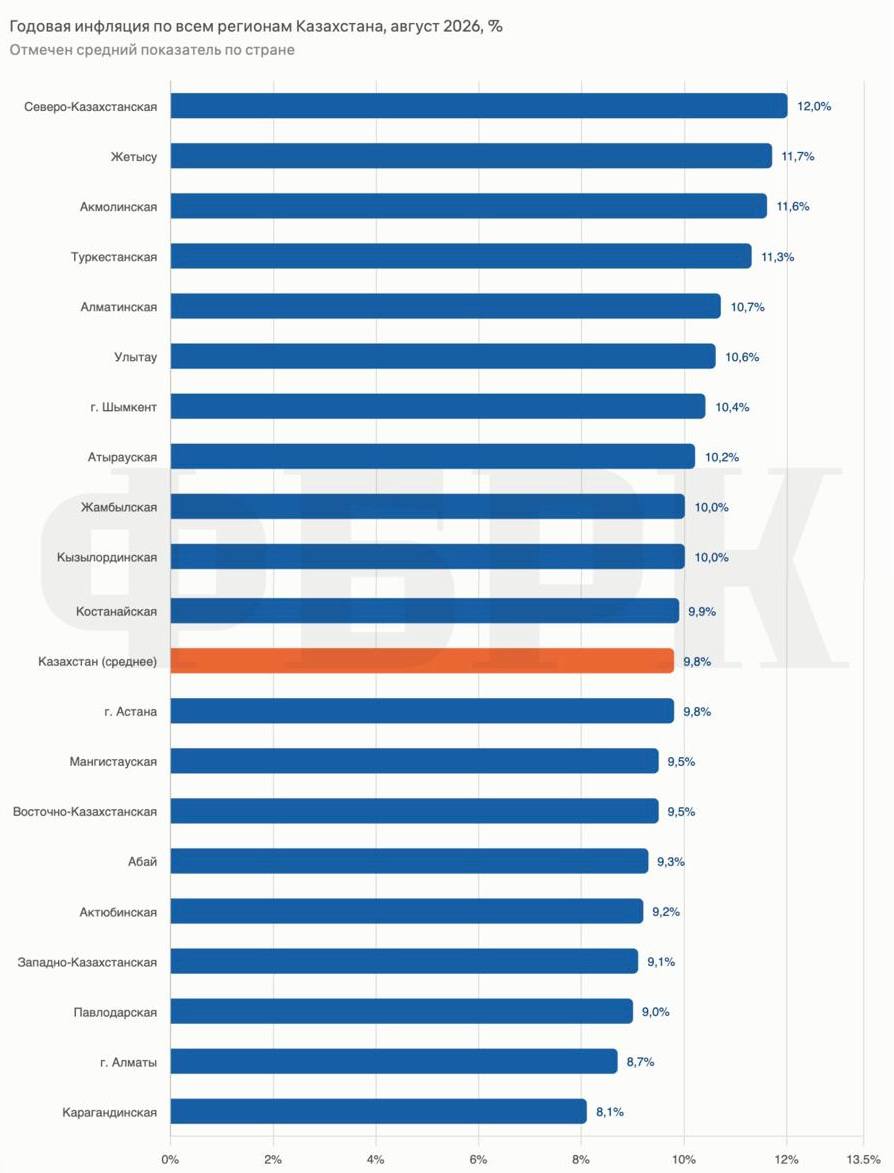
WHAT THIS MEANS
The Bureau of National Statistics data for August 2026 records a sustained, rather than random, slowdown in inflation: the indicator fell every month throughout the year and reached its lowest level since the start of 2026. However, behind this overall trend lies uneven dynamics at the level of individual product groups and regions. Food and non-food goods continue to rise faster than paid services, and it is they (rather than services) that account for the bulk of current inflation. Within the groups themselves, the spread is even wider.
Such asymmetry suggests that the decline in the average inflation figure does not mean simultaneous relief for all spending items - for those whose budgets depend on meat products or rental accommodation, price growth remains far above the official 9.8%. At the same time, the sustained national slowdown is combined with sharp local shifts, as in the case of the Karaganda region, which within a year has gone from being the inflation leader to the region with the lowest price growth.