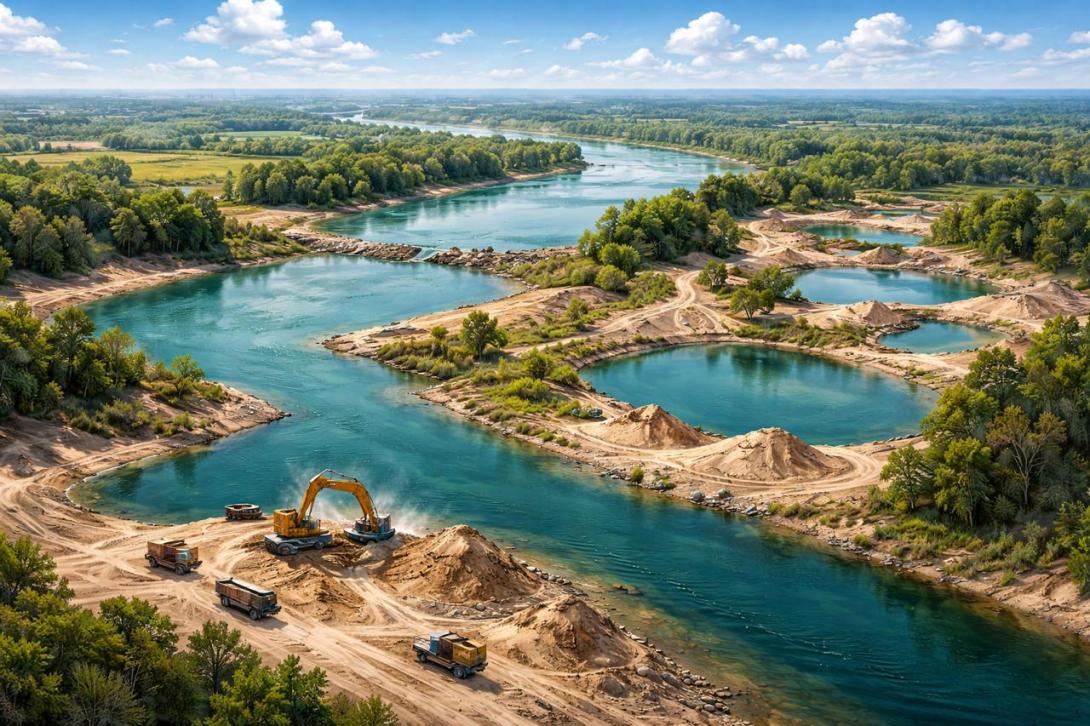
Messages have been received by the anonymous FBRK bot regarding a worrying situation on the Ilek River. According to local residents, intensive sand and gravel extraction is taking place along the floodplain terrace: new quarries and excavations are appearing almost every one and a half to two kilometres. People fear that such large-scale intervention in the river system could lead to serious environmental consequences, including a significant reduction in the river's flow. The FBRK editorial team decided to investigate what is happening to the main river of the Aktobe Region.
A RIVER THAT CANNOT BE LOST
The Ilek River is the main water artery of the Aktobe Region and the largest left-bank tributary of the Ural River. This transboundary river is of strategic importance not only for the region but also for the West Kazakhstan Region, which it indirectly feeds through the Ural system. For Aktobe, the Ilek has historically remained a key source of water supply. Located on the river is the Aktobe Reservoir – the famous 'Aktobe Sea', which provides the city with drinking water.
Today, according to the city administration itself, a shortage of drinking water is recorded in at least four residential areas – Bauryrlastar-3, Bauryrlastar-5, Zhanakonys-3 and Zhanakonys-4. A project for water transfer from two additional water intakes – the Kundaktykyrsky and Moiseyevsky intakes – is under development, a project that has been in the design phase for many years.
In other words, this is not just about ecology, but about a strategic resource upon which the lives of hundreds of thousands of people depend.
WHAT THE LAND CADASTRE SHOWED
According to data from the Unified State Real Estate Cadastre (USREC), on the section of the river from Aktobe to Martuk alone, within the floodplain terrace of the Ilek, there are more than 50 land allotments associated with the extraction of sand, sand and gravel mix (SGM) and building stone. These are predominantly in the Martuk and Alga districts, as well as within the city limits of Aktobe.
The list of deposits along the Ilek could fill several pages: Khlebodarovskoye, Komyssaiskoye, Karatogaiskoye, Bestamakskoye, Sholaksai-Yuzhnoye, Georgiyevskoye, Kurailinskoye, Kargalinskoye and others. In total, the area of land allocated for extraction amounts to hundreds of hectares, which clearly demonstrates the scale of economic development of the river valley.
The view from the air, according to observations by ecologists and journalists, is also highly telling. The Ilek floodplain is dotted with flooded quarries, which over time have turned into isolated water bodies. Cut off from the main river channel, the water in them does not participate in natural water exchange and gradually returns to the atmosphere through evaporation. As a result, the river loses part of its water resources.
WHO IS OPERATING THE QUARRIES ON THE ILEK RIVER
The FBRK editorial team decided to find out who controls the main extraction sites in the Ilek floodplain. We selected more than 20 sites and studied information about their right holders.
PGS-Ilek LLP – one of the oldest market players, operating for more than 23 years. The company is a subsoil user at the large Komyssaiskoye deposit in the Martuk District. The head of the company is Aydar Aydzharikov, and the founder is Bolat Akhmetov.
Incidentally, in November 2024, the Aktobe Regional Court considered a claim by the State Institution 'Department of Industrial and Innovative Development of the Aktobe Region' against PGS-Ilek LLP and five other companies for compensation of damage to the state in connection with illegal extraction outside contract territories. The area where PGS-Ilek LLP had exceeded its mining allotment boundaries was then 5.29 hectares, and the volume of illegally extracted material was 184,917.92 cubic metres. The Department demanded the recovery of 169.8 million tenge from the company. However, the court dismissed the claim. The reason – procedural violations on the part of the plaintiff itself.
PGS-Karatogai LLP, according to data from the publication 'Aktobe Times', has been operating the Karatogaiskoye-2 deposit since 2010. Intensive development of the site began in 2017. The first head and founder of the company is Yakhmetzhan Kuzembayev; the founders also include Serik Kuzembayev and Nauryzgali Islam. A related sales structure, PGS-Karatogai-Sbyt LLP, operates in the region.
PGS Bestamak LLP – develops the eponymous deposit in the Alga District, 45 metres from the Ilek River. The head and founder is Gulnara Gabdzhanova. The company has been on the market for about 9 years. It is worth noting that extraction at this site continued even after a temporary ban: in July 2025, journalists recorded the resumption of work in a quarry on the Aktobe Sea.
Tas Arman Aktobe LLP – has been operating for more than 10 years and is developing several deposits simultaneously. The company has had a seizure placed on its property and bank accounts. As part of the same departmental claim, the court considered claims for the recovery of 237.2 million tenge – the largest amount among all defendants. The volume of illegal extraction at the Kargalinskoye deposit amounted to 225,209.09 cubic metres. The claim was dismissed on the same procedural grounds. The head of the company is Marat Anuarov, and the founders are Anel Anuarova and Anel Tuktubayeva.
Award Company LLP – has been on the market for more than 11 years and is engaged, among other things, in the extraction of building and decorative stone. The head is Yuri Chernenko, and the founder is Mikhail Grinberg. The company once had an administrative fine for destruction of boundary markers. And in the same court case, the sum of 26.9 million tenge was mentioned; a representative of 'Batysgeodeziya' admitted in court that a gross coordinate error had been made when calculating the area of the boundary exceedance for this company.
Among other companies listed in the cadastre for large sites on the Ilek are Nuraiz-Nedra LLP, Global Nedra LLP, Aktobe Non-Metallic Materials Plant LLP, Zher Kazynalary LLP and others. It is also noteworthy that the land users include companies that have effectively ceased to exist: the branch of JSC 'Dzhengiz Inshaat Sanayi Ve Ticaret Anonim Sirketi' was liquidated in 2023, yet its sites are still listed in the USREC; Aktobe Geological Exploration Company LLP has also been liquidated, but its land allotment remains registered.
EXTRACTION IN THE WATER PROTECTION ZONE: WHAT OFFICIAL DOCUMENTS SAY
The non-technical summary for PGS Bestamak LLP, which can easily be found in open sources, directly indicates that the building sand deposit is located 45 metres from the Ilek River, while the officially established water protection zone is 500 metres. The site is located on the left bank of the river, within the first floodplain terrace. This means that the quarry is actually being developed within the river's water protection zone.
A similar situation exists with the Komyssaiskoye deposit in the Martuk District, which is being developed by PGS-Ilek LLP. According to the non-technical summary of this company, the quarry is located 53–60 metres from the Ilek River. The nearest settlements, the villages of Karatogai and Khlebodarovka, are 6 km from the site.
In the conclusion of the Department of Ecology for the Aktobe Region regarding the same project of PGS-Ilek LLP, it is directly recorded that animals and birds listed in the Red Book of the Republic of Kazakhstan – the owl, the little bustard and the steppe eagle – are present on the territory.
A similar conclusion from the Department regarding PGS Bestamak LLP records that the site is located in the water protection zone of the Ilek River, which in itself is grounds for a mandatory environmental impact assessment.
It is important to emphasise that the existence of environmental conclusions is not in itself a violation. This is a procedure established by law that all subsoil users must go through. The question is different – to what extent the results of these assessments are taken into account when making decisions on issuing permits, and how strictly compliance with the conditions is monitored during actual operations.
WHAT IS HAPPENING ON THE RIVER
In April 2026, the publication 'Aktobe Times' recorded that huge areas of floodplain land with chernozem soil are being destroyed in the area of the Orleu residential area in Aktobe. Abandoned quarries that have not undergone reclamation are becoming sources of dust storms and sites for unauthorised activities. Moreover, traces of illegal livestock slaughter were found at the bottom of one of the inspected quarries.
In March, it emerged that a quarry owned by Aktobe Taza-Kum LLP in the same Orleu residential area had blocked one of the Ilek's tributaries. The result – regular spring flooding of residential houses. According to residents, during the 2024 flood, four houses were completely destroyed. The Zhaiyk-Caspian Basin Inspectorate established that the company was extracting sand without authorisation from the Inspectorate, i.e., without the mandatory permit for activities in the water protection zone.
Somewhat later, in May, journalists visited the quarry of PGS-Karatogai LLP at the Karatogaiskoye-2 deposit. There, a dam had blocked the Ilek riverbed, splitting the river into at least three water bodies. Excavators were working within the riverbed itself. The quarry area exceeds 52 hectares – that is 72 football fields. By 2031, the company plans to extract around 592 thousand cubic metres of material from this site.
Associate Professor of the Ecology Department at Zhubanov University, Candidate of Biological Sciences Akylzhan Teleuov, explained that, by law, no work can be carried out in the river channel part, as any changes to the channel entail a change in the shoreline, which restrains flood events.
Deputy Head of the Department of Ecology Talap Usnadin stated in a conversation with journalists that the inspection of quarries on the Ilek is not within his department's competence; it is the prerogative of the Department of Industrial and Innovative Development of the Aktobe Region and the Zhaiyk-Caspian Basin Inspectorate. The latter, in turn, reported that it is ready to begin an inspection after receiving permission from the prosecutor's office.
The problem of sand extraction is not the only threat to the Ilek. According to Kazinform, the river has long been polluted with hexavalent chromium, linked to the activities of the Aktobe Chromium Compounds Plant, which was launched back in 1957. Monthly monitoring of the river is carried out by the testing laboratory of the Department of Ecology.
Ordinary residents also feel the consequences of the floodplain extraction. As the case in Orleu showed, a quarry that blocked an Ilek tributary directly caused the spring flooding of residential houses. And so far, no agency has taken responsibility for restoring the destroyed tributary.
It should also be noted that the Ilek is a transboundary river. The issue of distributing its flow between Kazakhstan and Russia has an international dimension. Water from Russia enters the West Kazakhstan Region both via the Ural River and via artificial canals from the Volga – for this, Kazakhstan pays the Russian side several billion tenge annually.
In the end, is it possible to continue extraction on such a scale without long-term damage to the river's water balance? Unlikely. But if the consequences do prove irreversible, who will be responsible for the state of the Ilek in ten years' time?