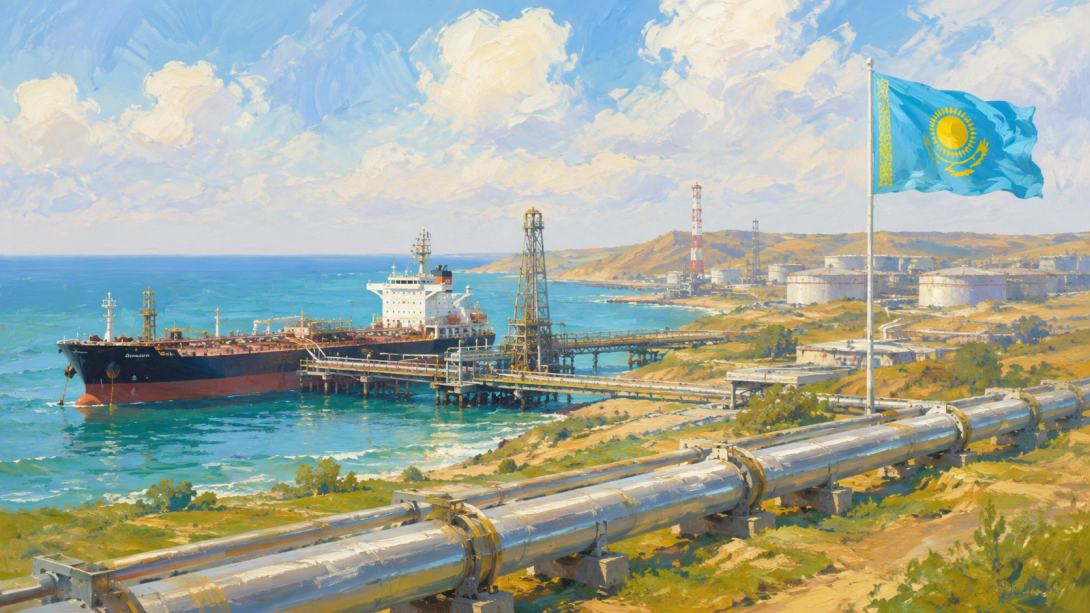
Oil production in Kazakhstan has fallen after the suspension of operations at the export terminal on the Black Sea, through which the majority of Kazakh oil supplies pass. The most significant reduction was recorded at the Tengiz field.
WHAT HAPPENED
According to Reuters, citing two industry sources, the decline in production occurred after oil shipments were suspended through the Caspian Pipeline Consortium (CPC) terminal on the Black Sea. The terminal's operations were halted following drone attacks on oil tankers.
According to one source, production at the Tengiz field, operated by Chevron, more than halved. While average output in July was around 925,000 barrels per day, it fell to approximately 406,000 barrels per day on Wednesday.
HOW PRODUCTION VOLUMES HAVE CHANGED
The total volume of oil and gas condensate production in Kazakhstan on Wednesday stood at 1.63 million barrels per day, compared to the average July figure of 2.07 million barrels per day.
Furthermore, CPC stopped receiving oil from Kazakhstan after halting shipments on Monday. It is noted that more than 80% of Kazakhstan's oil exports pass through the CPC system.
The Russian side stated that the attacks on CPC tankers were carried out by Ukraine. In response, the Ukrainian Ambassador to Kazakhstan, Viktor Maiko, rejected these allegations. According to him, there is currently no evidence of Ukrainian involvement in the attacks, so he urged restraint from hasty and unfounded accusations, reports Times of Central Asia.
The diplomat also noted that Ukrainian authorities had previously warned of the possibility of provocations. He stated that it is necessary to thoroughly investigate the possibility of Russia using drones for such actions and attempts to discredit Ukraine.
WHY THIS MATTERS
The CPC pipeline exports nearly 2% of the world's oil production. The agency notes that the suspension of its operations heightens concerns about global oil supplies amid existing disruptions related to the war in Iran and reduced supplies from Saudi Arabia and other Gulf countries.
CONTEXT
On 19 July 2026, during the loading of oil at the CPC marine terminal, tankers ASIA and NISSOS IOS were attacked. A fire broke out on the tanker ASIA, which was quickly extinguished. No casualties or oil spills were reported, but loading was temporarily suspended.
The Ministry of Foreign Affairs (MFA) and the Ministry of Energy condemned the attacks on the tankers, emphasising that such actions threaten the safety of crews and international energy infrastructure.
Later, it became known that the Government had begun a large-scale expansion of the oil refining industry. The country will increase the capacity of its three largest oil refineries and is working on the construction of a new facility with a capacity of 10 million tonnes per year. The development of the industry takes place against the backdrop of repeated incidents at the CPC marine terminal.
It was previously reported that Kazakhstan stopped pumping oil to the CPC marine terminal in the Russian port of Novorossiysk after a series of attacks on tankers. The terminal ceased taking oil via the pipeline as shipping companies are reluctant to send vessels to the area.