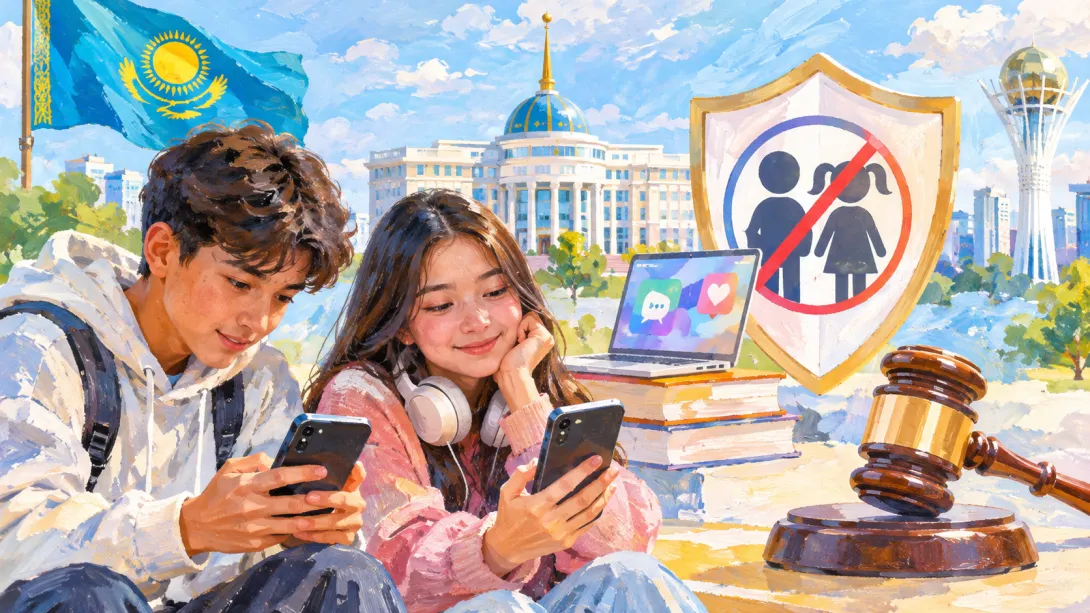
MPs of the Kurultai approved at first reading a bill providing for a ban on registration on social networks for users under 16 years of age. Owners of online platforms will be obliged to verify users' ages, while messengers intended for personal communication will be granted an exception.
WHAT CHANGES WERE PRESENTED
The amendments were presented by Minister of Culture and Information Arman Kyrykbayev during the first reading of the bills on online platforms and mass media.
The changes affect two documents: the Law "On Amendments and Additions to Certain Legislative Acts of the Republic of Kazakhstan on Online Platforms and Mass Media" and amendments to the Code of Administrative Offences (CAO) of the Republic of Kazakhstan.
HOW USERS' AGES WILL BE VERIFIED
Under the proposed provisions, users under 16 will not be able to register on social networks. Owners and representatives of online platforms will be obliged to take measures to verify age at registration.
The restriction will not affect messengers used for interpersonal communication and interaction with parents and teachers.
WHY THEY WANT TO STRENGTHEN PLATFORM LIABILITY
According to Arman Kyrykbayev, over 10 months of 2026 monitoring identified 128,500 unlawful materials on online platforms. About 70% of such publications were removed.
Accordingly, the bill provides for administrative liability for failure to comply with orders from the authorised body to remove unlawful content and information about cyberbullying against children.
It is also proposed to oblige online platforms to open representative offices in Kazakhstan. A separate provision provides for the identification of anonymous users and administrators of public communities with an audience of more than 5,000 subscribers.
WHAT OTHER PROVISIONS WILL AFFECT THE DIGITAL ENVIRONMENT
The amendments provide for the regulation of audiovisual platforms and online cinemas. To distribute television and radio channels via audiovisual platforms, it is proposed to introduce licensing, and online cinemas will be obliged to have legal representatives in Kazakhstan.
In addition, the bill affects the work of journalists and social media users. In particular, it is proposed to:
- label responses from state bodies so that audiences can identify the source of official information;
- publish retractions of defamatory information in the same source where it was published;
- introduce administrative liability for obscene language in mass media and on online platforms, as well as for spreading defamation on online platforms;
- clarify the rules on using images of citizens without their consent.
WHAT WILL CHANGE FOR CONTENT CREATORS
Authors of educational materials and courses will be required to provide information about their education confirmed by a diploma or certificate.
The bill also introduces the concept of "occult services". These are services based on claims of supernatural, paranormal or scientifically unconfirmed abilities.
When publishing materials about such services, authors will be obliged to warn audiences that they are for entertainment purposes and lack scientific or practical confirmation.