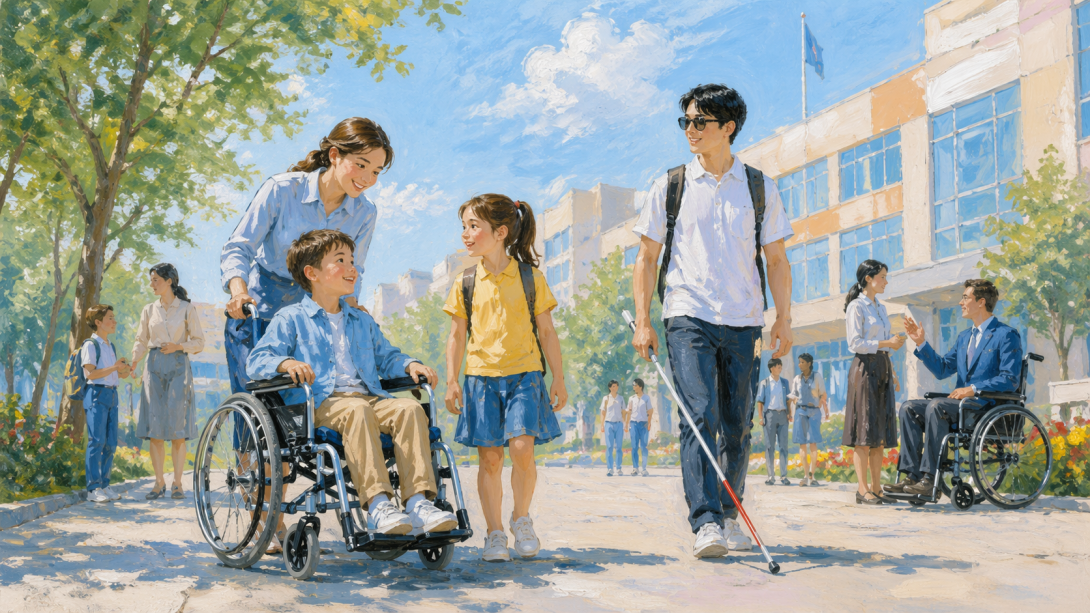
At a meeting chaired by Prime Minister Olzhas Bektenov, measures relating to inclusive policy and the expansion of support for people with disabilities were reviewed. The discussion focused on more than 237,000 children with special educational needs, a shortage of specialist professionals, and the involvement of businesses in social projects.
HOW INCLUSIVE POLICY IS DEVELOPING
According to the Prime Minister, the development of human capital, the rights of people with disabilities, equality of opportunity, and the creation of an accessible environment are enshrined in the new Constitution as strategic directions of state policy.
"Our task is to provide comprehensive support for people with disabilities. In this regard, on the instruction of the Head of State, the Government has adopted the Concept of Inclusive Policy until 2030," Olzhas Bektenov noted.
HOW INCLUSIVE EDUCATION IS BEING EXPANDED
Minister of Education Zhuldyz Suleimenova reported that at the start of the 2025–2026 academic year, more than 237,000 children with special educational needs were registered in Kazakhstan. Currently, 90% of them receive special support, and the aim is to increase this figure to 95% by the end of the year.
The network of specialist organisations includes 539 institutions. Schools already have more than 1,000 inclusive support rooms, and a further 40 will be opened this year. According to the ministry, the introduction of teaching assistants has reduced the number of children studying at home by 11%, bringing around 2,000 pupils back into the classroom.
SHORTAGE OF SPECIALISTS AND THE LABOUR MARKET
According to Minister of Labour and Social Protection of the Population Askarbek Yertayev, the system requires 69 audiologists, 98 rehabilitation specialists, and more than 2,000 speech therapists.
In 2026, 181 audiologists, 190 rehabilitation specialists, and 1412 speech therapists are due to complete their training and begin work in the second half of the year. The issue of staffing is being addressed jointly with relevant ministries.
WHAT BUSINESSES AND THE FUND WERE INSTRUCTED TO DO
Special attention was paid to expanding the social responsibility of businesses. A report was heard from the Chairman of the Board of the Samruk-Kazyna Fund, Nurlan Zhakupov, on the implementation of inclusive projects.
According to him, since 2020, 700 billion tenge has been allocated for the implementation of 100 social projects supporting people with disabilities. The fund's group employs more than 3,000 people with special needs.
Olzhas Bektenov stated that the fund must continue this work, and called on private businesses to provide ongoing support to citizens in need, rather than limiting themselves to one-off initiatives.