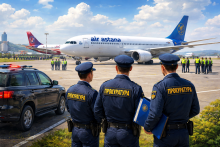
The Air Astana group of companies ended the first half of 2026 with a net loss of $21.2 million. Despite revenue growth, the financial result came under pressure from increased fuel costs, aircraft maintenance and other operating expenses.
WHAT FINANCIAL RESULTS DID THE COMPANY POST
According to Finmentor.kz, in the second quarter of 2026 the company's revenue and other income grew by 18.3% compared with the same period in 2025, reaching $433 million. At the same time, capacity remained virtually unchanged.
The company said it continued to improve the efficiency of its limited capacity by raising fares and reallocating aircraft to more profitable international routes.
Meanwhile, EBITDAR fell by 3.7% to $93.6 million, with its margin narrowing from 26.5% to 21.6%. For the quarter, the company posted a net loss of $0.1 million, against a profit of $18 million a year earlier. For the first half of 2026, the net loss stood at $21.2 million, compared with a profit of $10.7 million in the same period the year before.
WHAT AFFECTED THE FINANCIAL RESULT
According to the company's reporting, the main pressure came from rising fuel costs and other operating expenses. The average price of aviation fuel at international refuelling points increased by 98% year on year.
An additional impact came from the tenge strengthening against the US dollar by 7%, since part of the company's expenses is denominated in the national currency while financial reporting is conducted in dollars. Personnel costs, aircraft ownership, maintenance and rectification of Pratt & Whitney engine issues also increased.
HOW THE ROUTE NETWORK IS CHANGING
The company continued to expand its international operations. The international RPK (revenue passenger-kilometres) indicator grew by 5.5%, while the domestic figure fell by 7.2%.
The Chinese route was the most actively developed. In the second quarter, capacity on routes to China increased by 81% compared with the previous year. The group operates up to 51 flights per week across seven routes. New services were also launched on Astana — Guangzhou, Aktau — Urumqi, Almaty — Xi'an and Almaty — Chongqing.
In addition, its presence on routes to India, Europe and Turkey grew. The frequency of Almaty — Delhi flights increased to two per day, the number of flights to London reached four per week, to Frankfurt — 11, and to Istanbul — 25. International transit passenger traffic through Almaty and Astana increased by 82%.
WHAT IS KNOWN ABOUT THE FLEET'S CONDITION
The company reported a gradual reduction in the number of grounded aircraft due to Pratt & Whitney engine issues. 11 additional engines were received for operations, and repair and return times for the units were shortened. According to the reporting, the number of grounded aircraft is now approximately 60% lower than a year earlier.
Around 80% of Air Astana's aviation fuel is purchased in Kazakhstan, mainly directly from refineries. International refuelling points account for around 20% of purchases, with 25% of that volume hedged in the second quarter. The company said no fuel supply disruptions had been recorded.
As of the end of the reporting period, the company's cash stood at $481.5 million. The Net Debt/EBITDAR ratio rose from 1.3x to 2.1x, remaining below the company's medium-term internal target of 3.0x. The group's fleet reached 63 aircraft.
CONTEXT
The loss for the first half of 2026 coincided with a change of leadership at Air Astana. Peter Foster stepped down as head of the company on 31 March 2026 after 21 years in the role. His successor was Ibrahim Jangiliel, who previously served as chief financial officer.