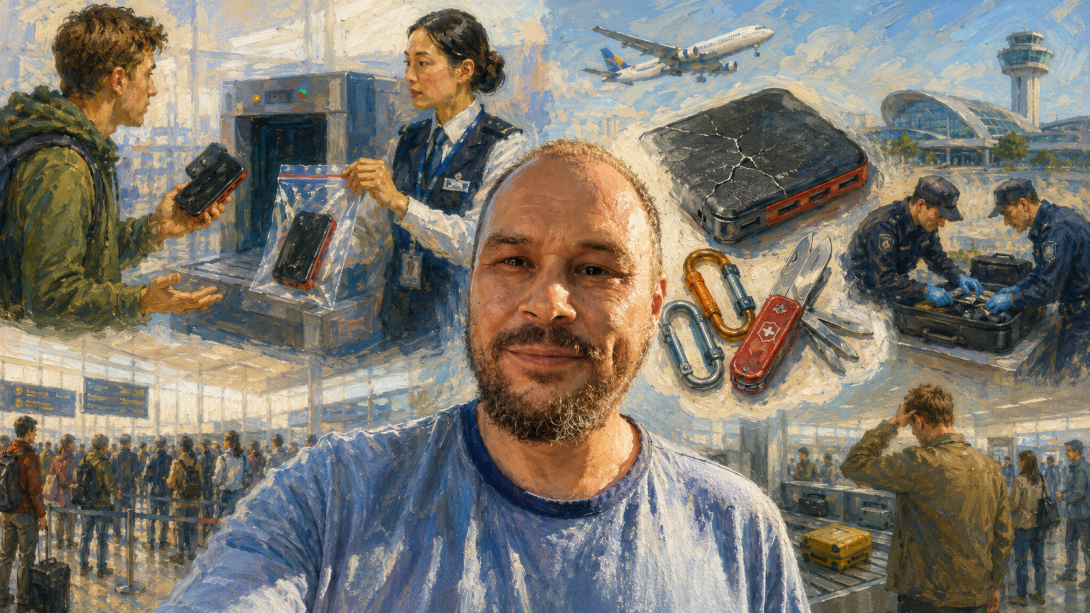
The story of the power bank confiscated from Kirill Pavlov at Astana airport raised questions not only about the screening procedure, but also about how consistently the rules are applied and how the airport responds to public complaints.
FBRK has studied and analysed high-profile incidents from previous years involving Nursultan Nazarbayev International Airport and how they were ultimately resolved.
WHAT HAPPENED WITH PAVLOV
On 12 August 2026, Kirill Pavlov reported a conflict with a female security screening officer at Astana airport. According to him, before his flight, an old work power bank was confiscated from him due to a crack in its casing.
Pavlov asked for the regulatory basis for the ban to be shown. According to him, the officer produced a guidance leaflet stating that damaged batteries were prohibited from carriage.
Pavlov pointed out that it was the device's casing that was damaged, not the battery itself, and noted that this power bank had previously been carried through airports on numerous occasions without any objections from security services.
The requirement itself, that damaged lithium batteries should not be carried, is justified: IATA recommends that passengers do not carry damaged, swollen, or punctured lithium batteries due to the risk of fire.
Therefore, the question here is not whether aviation security is necessary. The question is what exactly in that particular power bank was classified as damage and on what basis it was deemed prohibited from carriage?
IF THE POWER BANK IS DANGEROUS NOW - WHY WAS IT ALLOWED THROUGH BEFORE?
It is at this point that the story ceases to be merely a dispute between a passenger and a particular employee.
Let us suppose that the airport employee is right and the crack in the casing does indeed indicate damage to the device that could potentially pose a threat.
Then the next question arises: how did this same power bank pass through aviation security controls previously?
Pavlov claims the device had been through dozens of airports and had previously been permitted for carriage. If that is the case, there are two possible explanations.
- First: previous security screening services failed to detect the potentially dangerous condition of the device. This then raises questions about the quality of those earlier checks.
- Second: the condition of the power bank is acceptable, and the current employee applied the rule more strictly than had been done previously. This then raises questions about the consistency of enforcement.
In either case, the problem does not lie with the passenger. It concerns the control system itself.
This is precisely why it would be useful for the airport to provide, not a general statement about safety, but a specific answer: was the battery itself, or the entire power bank, considered damaged, which specific rule was applied, and is there a special procedure for handling such devices after confiscation?
AFTER THE COMPLAINT - A WAVE OF COMMENTS IN DEFENCE OF THE AIRPORT
Following Pavlov's publication, an active campaign in support of the airport staff's actions began in the comments. FBRK regards this as the work of a bot farm.
The comments repeated similar talking points: that the damaged power bank posed a danger and that the employee had acted solely in the interests of passenger safety. Some users, meanwhile, moved from discussing the rules to making personal assessments of Pavlov.
A comment from a user who claimed to have been nearby during the conflict was telling. According to him, when asked where exactly the ban was stipulated, staff could not immediately give a specific answer. Another participant in the discussion introduced herself as a former civil aviation worker and also spoke in defence of the screening service's actions.
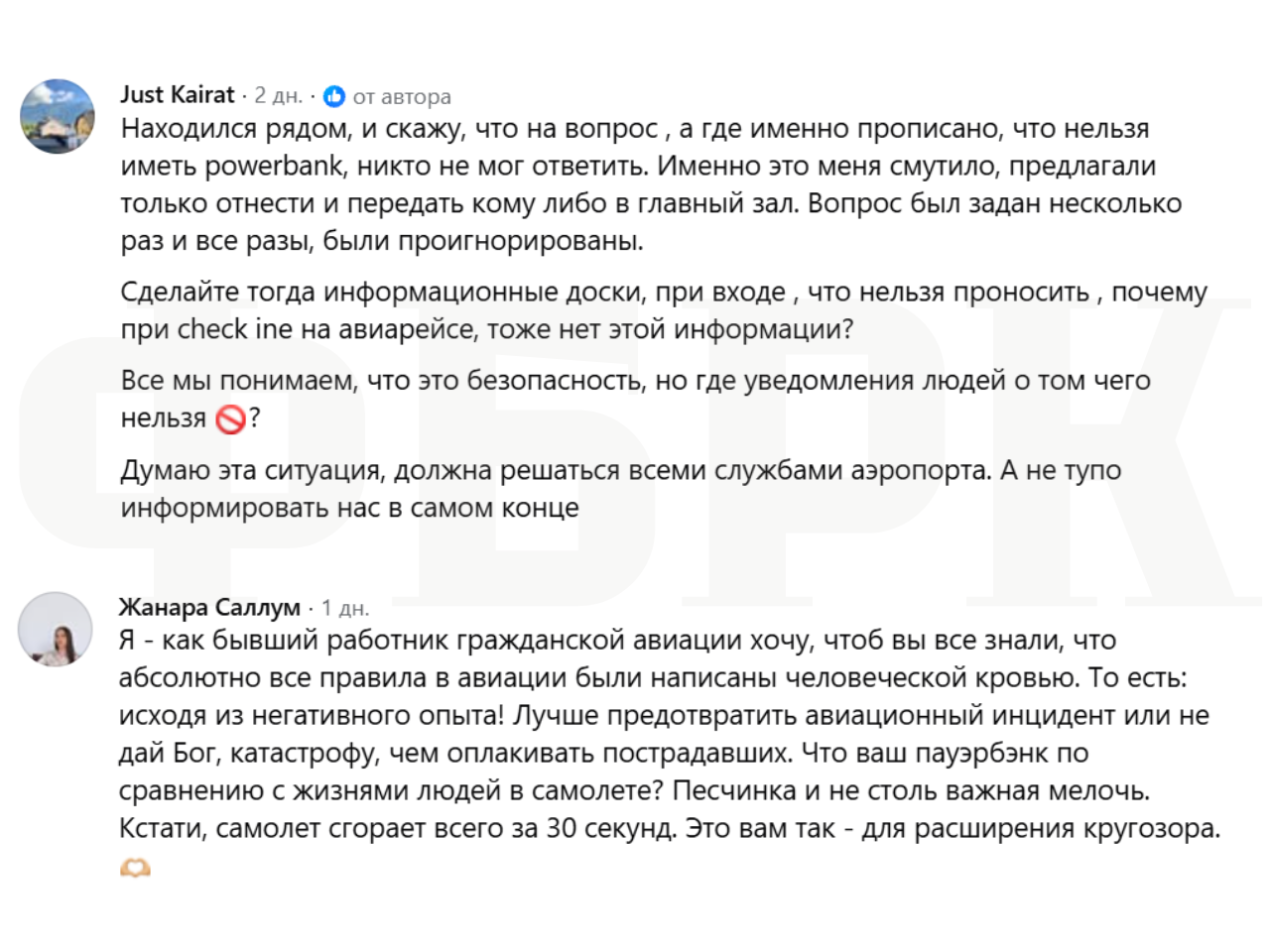
For FBRK, it is telling that instead of a public explanation of the specific rule, the discussion shifted towards defending the staff and criticising the author of the complaint himself. If the decision to confiscate the power bank is justified by the rules, then the most convincing response to such a complaint should be the regulatory document itself.
SIMILAR STORIES FOUND IN THE COMMENTS TOO
Pavlov's story prompted users to share their own accounts of inconsistent screening practices. One commenter reported that at Astana airport, four climbing carabiners were confiscated from him, although in Almaty they had previously gone unnoticed. Another user recounted that a Swiss Army knife had passed through security controls in Europe and the UK without issue for years, but was confiscated in China.
There are also opposite examples, where a disputed item was returned to its owner after additional checks. One discussion participant said that in China, staff initially mistook his medical gadgets for a power bank, but after checks and explanations, they were convinced otherwise and returned the devices. Another user wrote that he had carried a small needle in a repair kit for nearly five years before it was confiscated at Almaty airport.
WHAT HAS HAPPENED AT THE AIRPORT BEFORE
The power bank incident is not the first time complaints have been raised against Nursultan Nazarbayev International Airport.
In January 2022, passengers and representatives of the hunting community complained about an additional fee of 15,000 tenge for the escort of firearms and ammunition. The problem was that a similar service was already included by airlines in the carriage cost. This raised the issue of what was effectively a double charge. The aviation prosecutor's office protested against the practice. The airport disagreed with the prosecutor's position and attempted to challenge it. The court ultimately cancelled the paid service.
Between August and October 2023, the transport police reported the arrest of six airport porters suspected of being involved in opening suitcases and stealing money and valuables. In one case, a female passenger reported the loss of $19,000; in another, a passenger reported the loss of $7,800. According to law enforcement, those detained gave confessional statements, and part of the money was recovered and returned to its owners.
In June 2024, passengers complained about the stuffy conditions at the airport. The administration acknowledged the problem and reported that climate control equipment was being repaired. In August 2024, passengers complained that they could not retrieve their luggage for over an hour. The airport again acknowledged the delay and apologised. Around the same period, passengers also reported long queues and terminal overcrowding. Among the reasons cited by the airport were high demand, runway repairs, and the large number of international flights in the morning hours.
In July 2025, passengers again reported huge queues at the domestic terminal and that some of them barely made their flights. The airport explained the situation by the simultaneous check-in of eight flights and high passenger flow. In August 2025, the complaints recurred. This time, the airport officially acknowledged the high load during peak hours and advised passengers to arrive 2–3 hours before departure.
In June 2026, blogger Aisha Sadvakasova claimed that a security screening had been conducted, in her view, improperly. She alleged that an airport security officer publicly lifted her clothing during the check. Sadvakasova said she had engaged lawyers and intended to study the airport's regulations and to appeal to the prosecutor's office and the court.
THE PROBLEM IS NOT INDIVIDUAL CONFLICTS, BUT CONSISTENCY
The incidents listed are too varied to declare them all the same problem. The paid service, baggage theft, stuffy conditions, queues, and screening all have different causes and different levels of airport responsibility.
But there is one common thread between them: in each case, a passenger or counterparty encounters a situation where an explanation or rectification of the problem is required from the airport.
In some cases, the airport acknowledges the problem. In others, the matter reaches a regulator or the courts. In others still, it concerns the actions of individual employees.
This is why the current power bank story matters as a test of the quality of internal control.
If the airport considers a specific power bank dangerous, it should be able to explain this under a single, unified rule. If the same item has previously passed through controls, the airport should explain why earlier checks produced a different outcome.
The same applies to public communication. Criticism of the airport should not be addressed by the volume of positive comments. If an employee's decision is lawful and justified, it can be defended much more simply - with the regulatory document.
POSSIBLE CONSEQUENCES
For the airport, such situations create, above all, reputational risk. In aviation, a passenger must trust not only the fact of screening itself, but also that the same rules are applied consistently.
When passengers see that the same item is permitted at one airport and confiscated at another without a clear explanation, a sense of arbitrariness in the controls arises.
If, instead of a detailed explanation in response to a public complaint, organised support appears in the comments, this is capable of increasing distrust, even if the employee's initial decision was entirely lawful.
For the airport itself, the most rational response, therefore, is not to argue with the critic, but to demonstrate procedural transparency.
EDITORIAL OPINION
FBRK believes that in the power bank story, the main question is not the airport's right to ensure security. That right and duty are obvious.
The main question is the consistency and transparency of the application of the rules.
If a damaged power bank is indeed prohibited, the airport should explicitly name the rule on the basis of which the decision was made. If such a condition of the device did not prevent its carriage at previous airports, then it is necessary to explain why a different approach has now been applied.
And finally, the airport's public response should match the scale of its responsibility. A dispute about safety should be resolved by rules and documents, not by a bot farm in the comments.
CONCLUSION
Kirill Pavlov's story has served as an occasion to look beyond a single screening conflict. Over the past five years, questions have arisen around Astana airport concerning additional charges, baggage security, climate control equipment, terminal capacity, and screening procedures.
Each of these incidents has its own circumstances. But together they show how important two things are for the country's largest airport: the consistent application of rules and an open response to complaints.
In the power bank situation, a simple answer is now needed: which specific rule was applied and why did the same item previously pass through security controls? If the airport provides a documented response to this, the dispute can be settled with facts. If not, questions about the control system will remain.