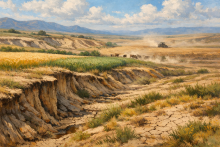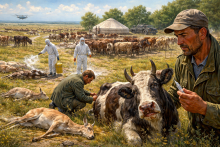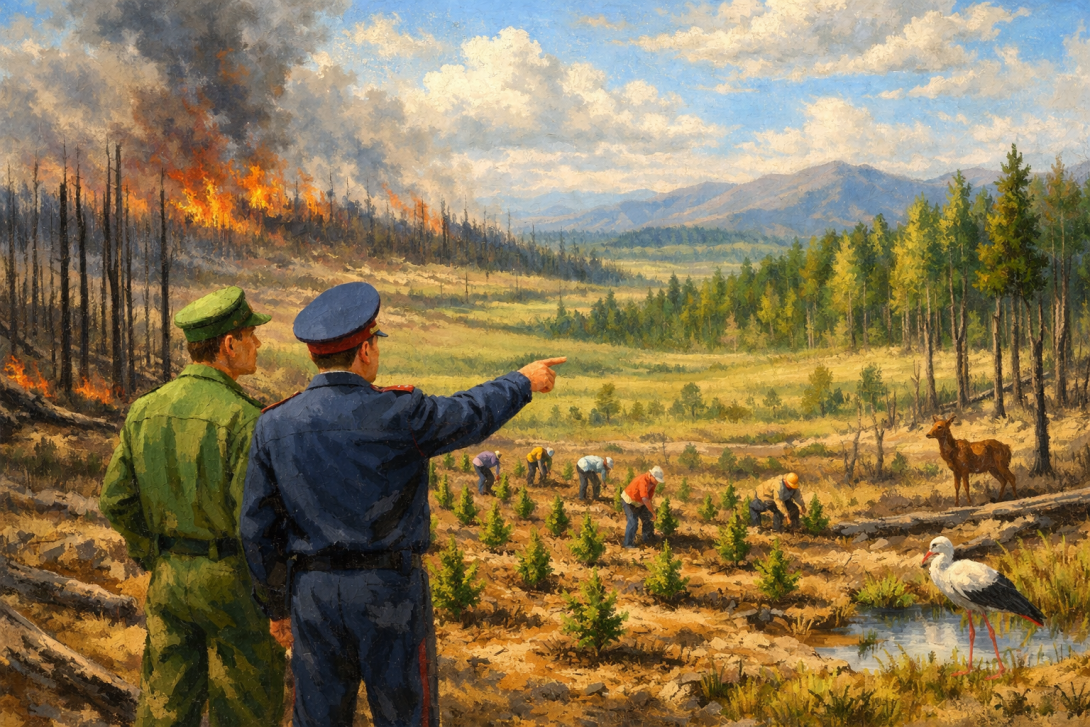
Kazakhstan enters the fire season prepared to extinguish fires, but without an answer to a more awkward question: what happens to what has already burned? And when a journalist asks a official directly, it transpires that the horizon for recovery is measured not in years, but in decades. Or even centuries.
WHAT HAPPENED
On 30 April 2026, a press conference was held by the Central Communications Service (CCS) on the subject of “The start of the fire season”. Two speakers answered journalists’ questions: the acting chair of the Forestry and Wildlife Committee of the Ministry of Ecology and Natural Resources of the Republic of Kazakhstan, Maksat Yelemesov, and the deputy chair of the Fire Service Committee of the Ministry of Emergency Situations of the Republic of Kazakhstan, Askar Tuleshev.
WHERE IT BURNS MOST OFTEN — AND WHY IT’S IMPORTANT TO KNOW IN ADVANCE
The founder of the FBRC, journalist Kirill Pavlov, asked the speakers about forecasting tools: does the ministry have risk assessment systems for forest and steppe areas? The question is pertinent, as in Kazakhstan, steppes burn significantly more often than forests.
Maksat Yelemesov replied that a precise forecast is impossible. Satellite monitoring provides data on the general index of fire danger, but “to predict that a forest fire will start exactly at this point, in this quarter of a particular forestry area - is impossible”.
However, according to him, a relevant programme has been developed and is operational. How effective it is in practice remains unclear, because “to anticipate and forecast the exact location of a forest fire - is practically impossible”.
The practical consequences of this very ‘impossible’ situation have been witnessed by our country on multiple occasions. Such disappointing examples include, for instance, the forests of the Auliekol District in Kostanay Region, as well as “Semey Ormany”. And today, other questions arise — about their restoration.
FIGURES THAT SPEAK FOR THEMSELVES
By the end of 2025, only 47% of the burned area in the Auliekol forests had been cleared. In “Semey Ormany”, last year 367 hectares of seedlings were planted — with a survival rate of 55%, meaning just over 201 hectares actually took root. A simple calculation shows that at this rate, the complete restoration of “Semey Ormany” will take more than 300 years.
On the question of forest restoration, Yelemesov first clarified the interpretation of the figure: 55% is the proportion of surviving seedlings within the planted blocks, and the 367 hectares of forest cultivation work “all remain”. Within three years, forestry enterprises are obliged to carry out replanting and bring the survival rate up to the standard 70%. The climate of “Semey Ormany” and Kostanay Region (sand, scarce rainfall) makes the figures unstable: “survival rates vary from year to year”, Yelemesov noted.
Furthermore, according to him, a roadmap has been developed to eliminate the consequences of the emergency: clearing, preparation, and all reforestation activities are to be completed by 2035.
However, when Kirill Pavlov asked directly how many years full restoration would take, the answer was different: “around 60 years for the forest to be as it was before we lost it”.
Sixty years is neither a failure nor a disaster; it is the objective biology of the forest. But the question is this: if we know that restoration will take this long, how seriously do we take preventing another fire of this scale from happening?