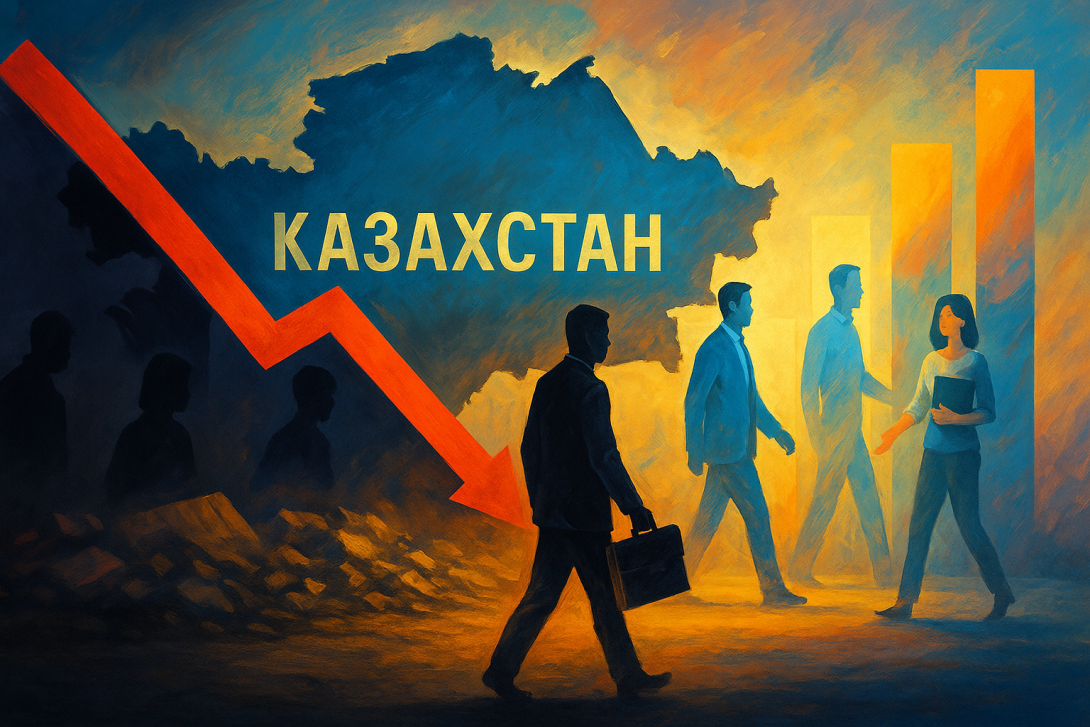
Over the past five years, Kazakhstan has managed to significantly reduce the share of the shadow economy in gross domestic product (GDP) — from 23% to 16%, which has been the result of comprehensive state policy and the active implementation of digital technologies. Achieving the target of 15% set by the President by 2025 requires further strengthening of control and systematic measures to crack down on illegal financial schemes.
Kazakhstan's success in reducing the share of the shadow economy warrants careful analysis, particularly in the context of global challenges for developing economies. The reduction of the indicator from 23% to 16% since 2019, which was reported in July by Kassym-Jomart Tokayev, appears to be a significant achievement, given that the total volume of the shadow sector worldwide is estimated at $12.5 trillion.
The goal of reaching the 15% figure by 2025, set as early as the beginning of 2021, indicates the country's leadership understands the systemic nature of the problem.
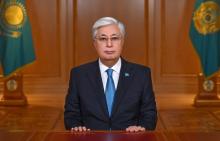
As the president noted in his 2024 Address:
"The financial situation is also aggravated by the persistently high share of the shadow economy. To significantly reduce it, a set of well-considered measures should be adopted."
The Comprehensive Plan for combating the shadow economy for 2023–2025 with phased targets — 18.2% in 2023, 16.6% in 2024, and 15% in 2025 — demonstrates a realistic approach to solving the problem. The results in individual sectors are particularly impressive: in the services sector, the share of the shadow economy fell from 19.4% to 11% since 2013, in real estate transactions — from 6.85% to 0.71%, in transport and warehousing — from 3.31% to 1.28%.
The introduction of new rules for checking mobile money transfers with a threshold of 1 million tenge over three months has caused certain concerns within the business community. However, the finance ministry's position that the measure is aimed solely at combating the shadow economy appears justified in the context of the global digitalisation of financial transactions.
The effectiveness of the measures being taken is confirmed by recent data on the growth of Kazakhstan's gross domestic product by 6.3% over the first seven months of 2025. It is telling that significant growth is demonstrated precisely in those areas where the fight against the shadow economy was actively pursued: transport and warehousing grew by 22.5%, and the trade sector by 8.6%.
According to International Monetary Fund (IMF) data for 2025, Kazakhstan occupies first place among post-Soviet countries in terms of GDP per capita — $14.77 thousand, ahead of Russia and China.
Kazakhstan's experience proves that a systematic approach, combining digitalisation, enhanced control, and consistent structural reforms, is capable of delivering measurable results. Combating the shadow economy is a long-term process requiring constant refinement of methods of influence, but the initial results demonstrate the correctness of the chosen strategy.